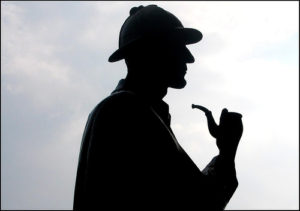
2016 was a busy year for blogging. Amazon accepted Bridge Daughter for their Kindle Scout program, which entailed a month-long nomination process before they agreed to publish it. It was the start of a fairly intense roller coaster ride, most of which I captured in blog posts along the way.
Amazon’s imprimatur on the novel opened many doors. With a single email sent on a single day of the week to a mere sliver of their customer base, Amazon could generate hundreds of book sales, as though rubbing a lamp to summon a djinn. Amazon’s backing also led to a movie production company inquiring about film rights. They read the book and they asked questions, but ultimately they passed.
(Amazon dismantled the Kindle Scout program in 2018, which I still consider a tragedy.)
Of the long-form blog entries in 2016, I produced three that I remain proud of. I’m torn which to feature here. My account of Don Herron’s Fritz Leiber tour still evokes nostalgia. Don Herron is the creator of the classic Dashiell Hammett tour in San Francisco. Getting a chance to meet Herron and take his lesser-known Fritz Leiber tour was a once-in-a-lifetime opportunity, as he no longer leads it save for special occasions.
Another piece I’m proud of is my review/analysis of the Generation X cult classic Slacker, one of my favorite films. This entry has an untold side story: A few months after posting it, an online film aficionado site on Medium asked if I was interested in adapting the review. Unfortunately, what the editor wanted me to write about wasn’t what I found interesting about Slacker, and the opportunity fizzled out.
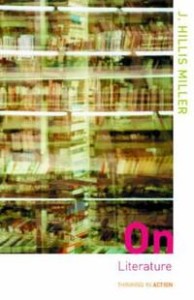
On Literature by J. Hillis Miller
The third is a blog post I keep returning to as a kind of manifesto: “Fiction as a controlled experiment,” a write-up of my thoughts on the book On Literature by J. Hillis Miller.
Miller was a scholar at Yale and U.C. Irvine, and known for promoting deconstruction as a means of literary criticism. I discovered On Literature on a shelf of used books in a Tokyo bookstore, and assumed it would be thick with postmodern terminology and abstruse theories. Instead, On Literature is personal and ruminative. Parts of it read like a confessional. Miller admits to a lifelong love of reading, and writes in glowing terms on several children’s books he marveled over in his youth.
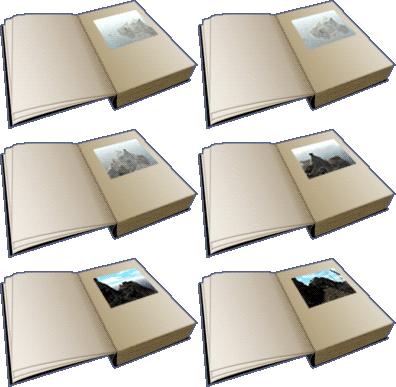
What caught my attention the most, however, is when he confesses to viewing a work of fiction as a “pocket or portable dreamweaver.” He describes books as devices that transport the reader to a new “hyper-world” for them to experience. The way he describes it reminds me of the linking books in the classic video game Myst.
Myst linking book
This quaint vision of narrative is unfashionable in the world of literary criticism. Miller’s vision is also, in my view, charitable to lay readers, who are less interested in high theory and more interested in enjoying books, and curious why some books are more enjoyable than others.
But I do think this vision—”a pocket or portable dreamweaver”—is also a useful guide for an author developing a story or a novel. Miller insists a work of fiction is not “an imitation in words of some pre-existing reality but, on the contrary, it is the creation or discovery of a new, supplementary world, a metaworld.” That is what the creation of story is—not merely revealing or reporting an already existing world, but creating a new one in the author’s mind, and, in turn, recreating it in each reader’s mind. These multiple worlds are similar but never exactly the same.
Miller died in 2021 due to COVID-related issues, one month after the death of his wife of over seventy years. Reading On Literature makes me wish I could have enrolled in one of his courses. Whereas so many of the European deconstructionists seemed intent on subverting the power of literature, Miller was plainly in awe of the written word, and strove to promote it. We need more readers like him.
This is the much needed backstory of the character of Stapleton from Conan Doyle’s “Hound of the Baskervilles”. It is exceedingly well done and in keeping with Conan Doyle’s original story. … Heartily recommended for lovers of Holmes and those looking to add to their own Sherlock Holmes collections.
Thanks, Melisende! Full review here, more information on the book here, and Amazon page here.
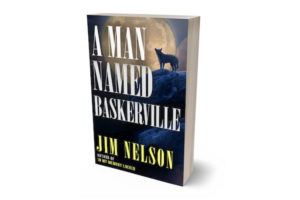
Baskerville is my take on the Arthur Conan Doyle classic. Told as a journal penned by the original’s villain, it relates his life story from a pauper’s childhood in the Empire of Brazil to life on the run in Panama and Costa Rica. He lands in England determined to confront his family and claim his place at Baskerville Hall. All the while, he lays out his plan to settle a score with Holmes and Watson, whom have taken him for dead after their confrontation on the bogs of Dartmoor.
A review copy of the novel is available to NetGalley members upon request. Please note, I’m currently seeking NetGalley members who actively review and crosspost to other sites (Goodreads, Amazon, book blogs, etc.)
In November, Amazon opened a beta program for Kindle Direct Publishing authors called Virtual Voice. It may be the biggest upheaval to independent publishing since Amazon launched KDP over a decade ago.
Virtual Voice uses synthetic (i.e., computer) voice technology to produce audiobooks. On first blush, that sounds like a pretty crappy experience—who wants to listen to a robot narrate a book? Know that automated voice technology has advanced tremendously in recent years, to the point that people have trouble distinguishing between it and a human voice.
It’s tempting to go into my thought process over the pros and cons of synthetic voice audiobooks. At this moment, I’ll just say I find the possibility alluring.
I’ve done audio in the past. I recorded Everywhere Man at Fantasy Studios, a dreamy, once-in-a-lifetime opportunity that was quite expensive and exhausting. A few years ago, I made a concerted effort to hire a voice actor to record Bridge Daughter. I was put off by the terms dictated by every actor who responded to my call for bids. Both experiences impressed on me the risks of producing my own audiobooks, risks of both cost and rights.
Synthetic voice audiobooks eliminate a lot of the question marks. If I’m reading the Amazon announcement correctly, a KDP author chooses a voice from a catalog of voices, previews a sample, and names a sale price. My guess is, the final audiobook will be ready in a few hours. Audiobooks created with synthetic voices are labeled as such on the Amazon market and may be previewed, so the buyer knows what they’re getting.
It sounds like a no-cost, risk-free offer for independent authors. I’m more than curious. Unless Amazon botches the roll-out—a possibility, they’ve botched things before—I predict we’re going to see a Cambrian explosion of audiobooks on the Amazon market soon enough.
Illustration from Erotic Review for “At the White Sands Motel, 1956”
I once wrote erotica by accident. Writing and getting the story published is a wild tale.
If you know of anything of my output—my novels, my interactive fiction—that might surprise you. You’ve probably never read anything by me that remotely involves the sex act: No kinky sex, no ho-hum sex, not even missionary style. Generally, I shy away from that kind of thing. Getting a story published in an erotica magazine still tickles me to this day.
The story-behind-the-story begins in a creative writing class. The instructor offered us a list of writing prompts. We were to select one and write an opening.
The first speed bump in this tale is that these prompts were communicated to us orally. The prompt I selected regarded a teenage lifeguard named Hamke. Years later, I learned I had misheard the details. The prompt did not include the name “Hamke” or anything about a lifeguard. How I managed to screw up so much remains a mystery lost to the shroud of time.
In any event, the name and occupation stuck. I assumed it was a German name, as I’d never heard of it before. (Apparently, I’m not alone.) While I enjoy swimming, I’ve never known a lifeguard nor worked as one. Why this prompt caught my interest, I do not know. Over the following week I roughed out a first draft about a teenage Hamke standing guard over a motel pool in Nevada. In need of a title, I jammed one onto the front page of the manuscript: “Living It Up at the White Sands Motel.” (I believe it was a riff on the quip about a cheap lodging being a “low-rent Shangri-la.”)
Around this time, I dated a woman also enrolled in the creative writing program. She was experimenting with poetry about the body. She read many of my stories, which is generous—even when you’re dating a writer, that’s no guarantee they’ll actually read your output. She called my work cerebral, and noted that my characters seemed “detached” from their physical nature. She challenged me to write a story where the main character’s physicality is centered.
Now, this doesn’t necessarily mean “write about sex” or “write about someone with a smokin’ bod.” It could mean the main character is physically challenged, or has suffered some grievous physical damage they’re recovering from. It could mean some aspect of their body defines them in a material way (which is something I had in mind as I wrote my Bridge Daughter series of books.)
In this case, I went for the obvious: Hamke would have sex. More than that, he would lose his virginity.
I poked and prodded at the manuscript—draft after draft—trying to tune all the off-key notes. In workshops, peer writers would scratch their heads trying to figure out what to make of this strange story. There was a lifeguard with a flat-top and a weird name, an empty motel in the desert, and an older couple from New Jersey who invites him to their air-conditioned room for an afternoon romp. By this time I’d renamed it (still flailing for a proper title) “At the White Sands Motel, 1956.”
I submitted to the usual literary magazines, searching high and low for a place to land it. The rejection slips came back a bit more quickly than the other stories I’d sent out. Perhaps the complaints I heard in in the workshops (“‘Hamke?’ Is that Jewish?”) was now confounding editors. The sex was not graphic, but it was on the page and not merely alluded to. The wife was acidic and domineering, and her husband frustratingly passive. Wide-eyed Hamke, who was simply “along for the ride” (so to speak), was not a character to stand up and cheer for.
Enter London-based writer Saskia Vogel. By chance, she came into the bar I tended while working through graduate school. She was working on a study of kink; I despaired over a short story about a lifeguard losing his virginity. We swapped email addresses and kept in touch after she returned to England.
Around this time, fellow grad student Lizzy Acker mentioned off-the-cuff she was developing a new San Francisco reading series with the theme “funny / sexy / sad.” The work writers presented had to feature one of those elements.
“You know,” I said, not entirely innocently, “I have a story that’s funny, sexy, and sad.”
It’s true: Hamke’s fumbling and awkward loss of innocence is funny. The wife impatiently orders Hamke across a tour of her body as though teaching him to drive a stick shift. It’s sad, too. As one workshop instructor remarked, the boy is robbed of a positive formative experience.
Lizzy included me in the series’ opening night line-up, and the reading went uproariously well. Maxfield’s House of Caffeine was packed. The audience reacted with every twist and turn of Hamke’s awkward journey. They burst out laughing at all the right moments. Red-faced parents held their hands over their children’s tender ears. People were moved by the ending, and a couple of tears were shed. The applause knocked me off my feet. It was, by every measure, the best reading I ever gave.
How the hell could I not get this story published?
Then, an interregnum. I separated from the girlfriend who challenged me to write about the body. I separated from my appendix, and a few months later, I busted up my right shoulder. I separated from graduate school. (Well, a degree was conferred, how’s that.) Hamke’s story remained a magnet for rejection slips. Meanwhile, medical bills ate through my meager bartender savings.
With no more excuses, I returned to full-time employment. The first year with my new company, the sector we were involved in hosted their annual conference in, of all places, the Canary Islands.
La Palmas de Gran Canaria. (Photo by the author.)
That’s how, six months after staring down bankruptcy and unemployment, I found myself on a semi-tropical island in the Atlantic a mere 500 miles from Marrakesh. I rented a cheap open-air room overlooking the Las Palmas promenade and a pristine sunning beach. After the conference concluded, I stayed for another week to explore the island and write.
During this vacation I received an email from Saskia Vogel in London. She heard from an editor friend that the UK-based Erotic Review was in need of fiction. Didn’t I have a story about a guy having sex for the first time?
In that low-rent Shangri-la, the couch doubling as my bed and the drapes billowing from the breeze coming off the beach, I hustled one more edit pass out of my aging Hamke story. Thankfully I brought my writing notebook computer with me. This was not a time when Wi-Fi was a sure thing in a rented room, especially in an out-of-the-way place like Gran Canaria, but I in this case I was set. I emailed my little story to editor and publisher Jamie Maclean.
Before I did that, though, I used the Wi-Fi to study up on just whom I was submitting to. My search revealed I was not soliciting some amateur outfit. ER had been around since before 1995, and had published numerous erotic books on top of a monthly subscription-based magazine. Their readers spanned the UK and North America. Not only had I never published a work of erotica, I’d never been published by a magazine that survived solely off subscriptions.
With a healthy taste of self-doubt in the back of my mouth, I pressed the Send button. Then I did what I usually do after submitting a piece to a magazine: I got my mind off things. I went downstairs. I walked the promenade. I had a couple of drinks at a beach bar, and got my toes in some sand.
When I returned to the room, I of course checked my email, fully expecting to find nothing. Instead, an acceptance email waited in my inbox. Compared to the usual turnaround times for literary magazines—one sent me a rejection two years after submission—this was lightning fast. Later it dawned on me that my accidental vacation spot had contributed to the quick response: I was in the same time zone as London, where ER was published.
Three months later, a contributor’s copy of Erotic Review and an international money transfer arrived at my apartment in California. My Hamke story was out there.
And that’s how I became a writer of erotica, scribbler of filth and peddler of smut.
Postscript:
My tale might be seen as a reversal of Ray Bradbury’s strategy to seek out unusual places for his work (such as Gourmet publishing his “Dandelion Wine”). I sought out unusual places to publish an erotica story, and eventually found a natural home for it.
Being published in an erotica magazine has become a point of pride for me. I never set out to write erotica, and I’ve never considered pursuing it since. I once read that no one writes erotica under their real name. Well, I did, although when you have as generic a name as “Jim Nelson,” perhaps it doesn’t matter.
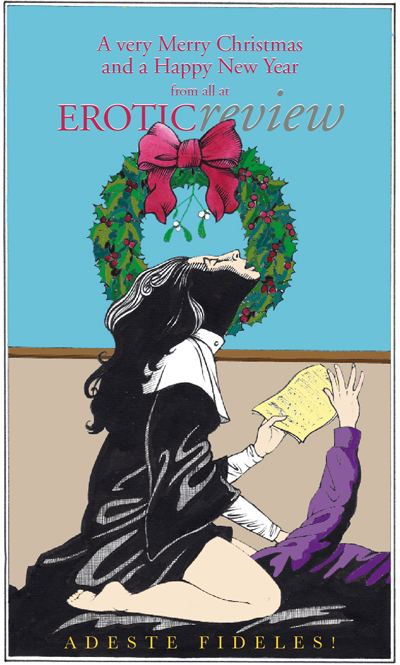
Erotic Review is a class act. They continued to stay in touch. I received editorial updates and invites to ER parties (which, sadly, were all in London). They even sent digital Christmas cards, such as the one above.
Recently ER changed hands and is now retooling under a new editorial staff. If you’re interested in supporting the relaunch, visit them at ermagazine.com.
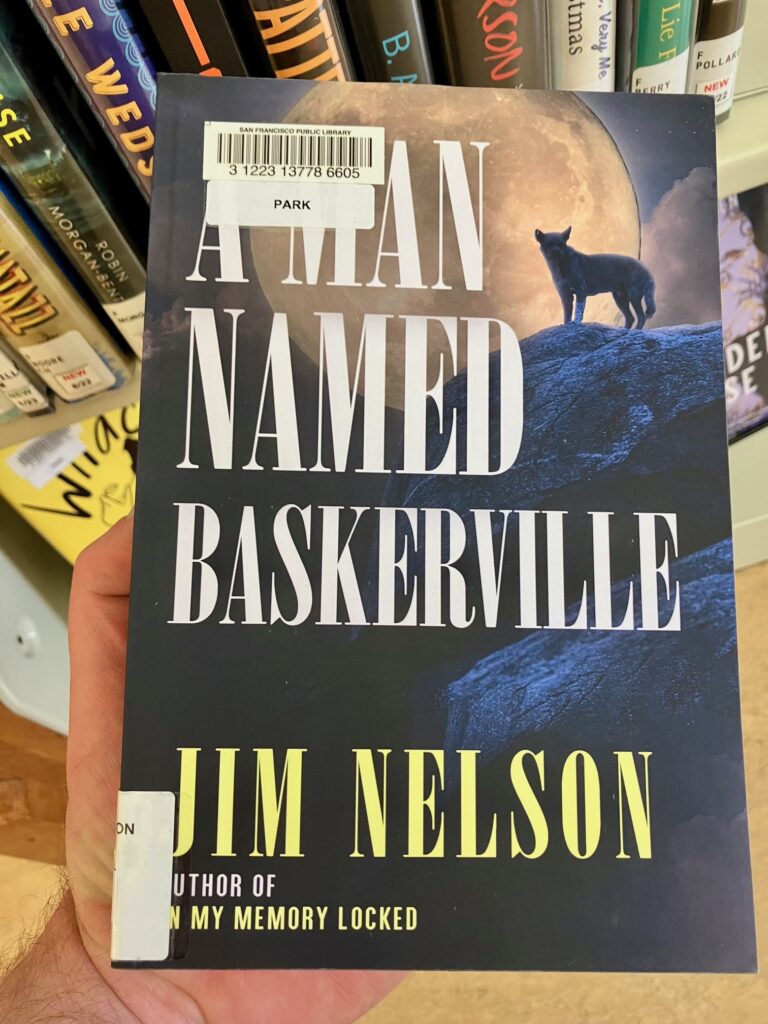
At my local branch of the San Francisco Public Library I happened to notice this little surprise on the New Arrivals shelf: A fresh copy of A Man Named Baskerville, all prepped and ready for checking out. (Here’s the online record, if you’re interested.)
If you’d like to read my books and haven’t yet, keep in mind your local library may have an online suggestions program for acquiring lesser-publicized titles like Baskerville or Bridge Daughter. Check your library’s web site, recommend some books, and you may soon be able to read and share.
Indeed, Sherlock Holmes, Dr. Watson, and the bulk of the Holmes canon have been in the public domain for decades now (in the United States, at least). My conclusion was that the Doyle literary estate has been using fear tactics to con creators—from movie studios down to independent authors—to pay them bogus licensing fees.
Something strange happened after posting that entry, though. I check in with Google Search Console now and then to see how my web site is being indexed and discovered by users. My post on the history of Sherlock Holmes’ copyright status has been indexed by Google but is not available via search. In other words, Google’s servers have seen the post, they’ve analyzed the content, but they refuse to add it to their search engine for users to discover. (Google has indexed pages on my web site that link to the page, but not the page itself.)
It’s been over three months. Posts I made after the Sherlock Holmes entry were indexed and made available on Google immediately, usually within a week. Almost all my other blog posts are available on Google (so far as I can tell). Not the entry on Sherlock Holmes’ copyright situation, though. I’ve made repeated attempts to get the page indexed. I ran a Google Search Console tool to find any problems on the page. I’ve gone through Google’s help system to find any valid reason the page may be excluded. The result: Zilch, and my page remains unavailable on Google search.
This isn’t a problem on alternative search engines Duck Duck Go or Bing. It’s only Google.
Google is free to present or exclude any pages it wants to. I’m not even arguing they owe me an explanation, although I’d appreciate one.
But just as Google is in control of their web site, I’m in control of mine. I’ve tried my best to navigate their systems and understand why they’ve excluded my page, to no avail. So I’ll use my final option—my voice, however small—to let others know.
Update: Several weeks after posting this, Google Search began returning the page as a result.