
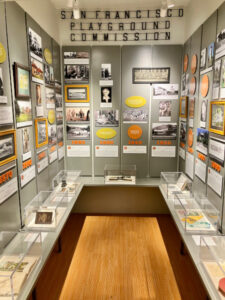
Back in April of this year, I learned of the “Commission Vault Mini Museum” via SFGate.com, the online arm of the San Francisco Chronicle. I immediately booked a reservation to tour the museum, which is so backlogged, it takes month to get in. I only visited on July 9th, three months later.
The Commission in question the San Francisco Park Commission, which governs the city’s Recreation and Parks Department. The museum houses photographs and artifacts from the department’s century and a half tenure, which extends back to 1871.
This must be one of the smallest museums on the West Coast—it’s housed inside a walk-in vault. The floor dimensions are perhaps twelve feet by four feet. It’s so compact only four or five people can comfortably stand in it at once. You begin to understand why open reservations are months out.
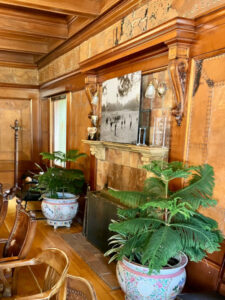
For me, the tour began when I entered the Commission’s headquarters, located at the eastern entrance to Golden Gate Park, inside McLaren Lodge. It was built in the late 19th century for John McLaren, the most famous and prominent superintendent of San Francisco’s Parks Department. The lodge not only served as offices for his staff, but was also home for him, his family, and personal staff. It was as though all 1,017 acres of Golden Gate Park was his personal backyard.
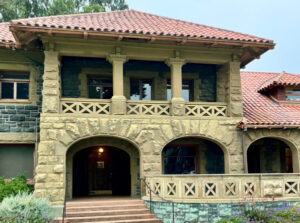
It’s a grand structure, with rustic stone exterior and rough columns and arches, topped with red clay roof tiles. Historian-in-residence Christopher Pollock told me it’s often described as a mixture of Mission Revival and Craftsman architecture, although at least one source dubbed it “Scottish Baronial.” It’s a fitting term for horticulturalist McLaren, who immigrated to America from Scotland in his youth, and was known in his later years as bearing a kind but kingly manner.
Either way, McLaren Lodge’s architecture is oddly familiar but strikingly unusual compared to San Francisco’s other architectural styles. It’s the kind of structure a Hollywood millionaire would build in the mountains near Lake Tahoe, or you read about in The Day of the Locust. In that sense, the lodge is uniquely Californian: A style evocative of another place or time, but not of any other time or place.
As a boomtown, early San Francisco had few public green spaces. The thousand-acre Golden Gate Park on the city’s west side was the solution. The first problem to be solved was the land itself. The acreage was barren and covered in windswept sand dunes blown eastward from the Pacific ocean. (No, really—check out some photos for yourself.)
McLaren and his predecessor William Hammond Hall spent decades terraforming this desolate stretch of wasteland into a woodland reserve, with rose gardens, rhododendron dells, groves of sequoias and Monterey cypress, and wide meadows of Kentucky bluegrass. For entertainment, McLaren installed lakes, fishing holes, lawn bowling courts, horse stables, and much more. Golden Gate Park was California’s first Disneyland, a theme park before there were theme parks, showcasing the state’s natural beauty.
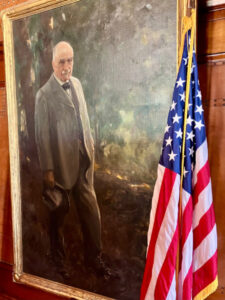
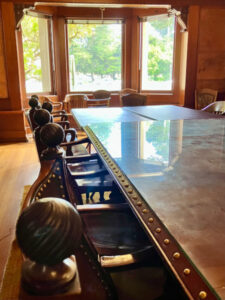
McLaren’s decades of devotion to building the greatest city park in the world, and the resulting grandeur, made him one of the most popular public servants in San Francisco history. The city amended its charter in order to appoint him Park Superintendent for life, a post he held for over four decades. The meeting room where the Vault Museum is found features a prominent portrait of McLaren, still overseeing the Commission’s agenda decades after his passing.
The vault & museum
The vault holding the museum was where the Commission originally stored cash and valuables, from a time when physical currency was more common for things like park permits and payroll. Later, the vault was cleared out and used for storage, which included several filing cabinets of paperwork. Those papers turned out to be historical documents unto themselves. They’re now stored at the San Francisco Public Library.
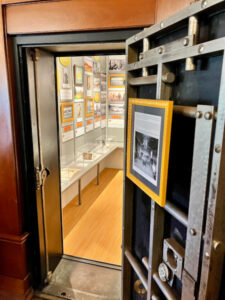
With the vault cleared out, the idea came to use it for a display of the Park’s history, which led to the creation of the Mini Museum.
The Museum itself is a picturesque but brief travel through the decades of Golden Gate Park’s long life. Photographs of the early years show the sand dunes that had to be tamed by McLaren and Hall, as well as the cemeteries originally lining the northwestern border of the park. (Those graves would eventually be moved down the peninsula to Colma; some of the broken headstones would wind up lining the pathways and gutters in Buena Vista Park, a few blocks from McLaren Lodge.)
Each decade thereafter depicts the city’s and park’s development, recording the growing population and an increasing number of public parks throughout San Francisco. (One surprise for me: the nondescript Colombia Square, which I gave short shrift to in my “San Francisco streets with confusingly similar names” page, is actually one of the city’s earliest neighborhood parks.) The timeline also shows Golden Gate Park as a civic meeting place and cultural lodestone, such as when it hosted now-legendary rock acts in the late 1960s.
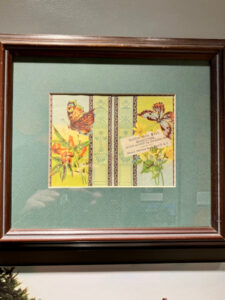
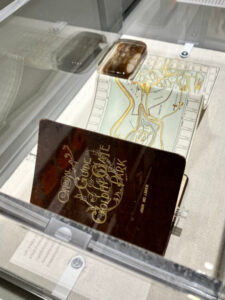
For over a hundred years, San Francisco has been known as a “city of hotels.” It’s also a city of museums and tours, mainstream as well as quirky, cool, odd, and now tiny. It’s hard to call the Commission Vault Mini Museum a must-see for visitors in town for only a few days. I do think it’s worth your while if you love San Francisco history—especially the history of its parks—and can line up a spot for an afternoon viewing. I wasn’t disappointed at all; I’m just unsure if my enthusiasm for Golden Gate Park’s history is widely shared.
Someone on the tour asked if they offered tours of McLaren Lodge itself, which apparently is under consideration. Combining a tour of the vault with a tour of house itself would make an afternoon visit a no-doubter.