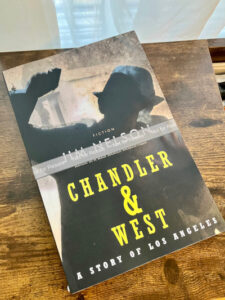
My Hollywood crime novel Chandler & West: A Story of Los Angeles is now stocked by the San Francisco Public Library. As a San Franciscan, I’m especially proud to know my work is on the shelf of my local library. And if you live here, it’s one more way to pick up the book.
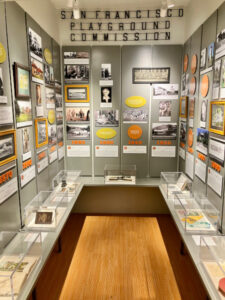
Commission Vault Mini Museum. (All photos by author.)
Back in April of this year, I learned of the “Commission Vault Mini Museum” via SFGate.com, the online arm of the San Francisco Chronicle. I immediately booked a reservation to tour the museum, which is so backlogged, it takes month to get in. I only visited on July 9th, three months later.
The Commission in question the San Francisco Park Commission, which governs the city’s Recreation and Parks Department. The museum houses photographs and artifacts from the department’s century and a half tenure, which extends back to 1871.
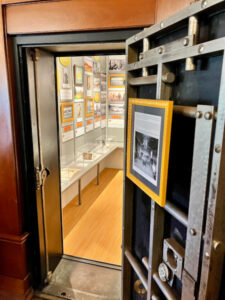
This must be one of the smallest museums on the West Coast—it’s housed inside a walk-in vault. The floor dimensions are perhaps twelve feet by four feet. It’s so compact only four or five people can comfortably stand in it at once. You begin to understand why open reservations are months out.
For me, the tour began when I entered the Commission’s headquarters, located at the eastern entrance to Golden Gate Park, inside McLaren Lodge. It was built in the late 19th century for John McLaren, the most famous and prominent superintendent of San Francisco’s Parks Department. The lodge not only served as offices for his staff, but was also home for him, his family, and personal staff. It was as though all 1,017 acres of Golden Gate Park was his personal backyard.
McLaren Lodge.
It’s a grand structure, with rustic stone exterior and rough columns and arches, topped with red clay roof tiles. Historian-in-residence Christopher Pollock told me it’s often described as a mixture of Mission Revival and Craftsman architecture, although at least one source dubbed it “Scottish Baronial.” It’s a fitting term for horticulturalist McLaren, who immigrated to America from Scotland in his youth, and was known in his later years as bearing a kind but kingly manner.
Either way, McLaren Lodge’s architecture is oddly familiar but strikingly unusual compared to San Francisco’s other architectural styles. It’s the kind of structure a Hollywood millionaire would build in the mountains near Lake Tahoe, or you read about in The Day of the Locust. In that sense, the lodge is uniquely Californian: A style evocative of another place or time, but not of any other time or place.
As a boomtown, early San Francisco had few public green spaces. The thousand-acre Golden Gate Park on the city’s west side was the solution. The first problem to be solved was the land itself. The acreage was barren and covered in windswept sand dunes blown eastward from the Pacific ocean. (No, really—check out some photos for yourself.)
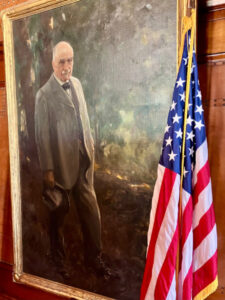
Portrait of John McLaren.
McLaren and his predecessor William Hammond Hall spent decades terraforming this desolate stretch of wasteland into a woodland reserve, with rose gardens, rhododendron dells, groves of sequoias and Monterey cypress, and wide meadows of Kentucky bluegrass. For entertainment, McLaren installed lakes, fishing holes, lawn bowling courts, horse stables, and much more. Golden Gate Park was California’s first Disneyland, a theme park before there were theme parks, showcasing the state’s natural beauty.
McLaren’s decades of devotion to building the greatest city park in the world, and the resulting grandeur, made him one of the most popular public servants in San Francisco history. The city amended its charter in order to appoint him Park Superintendent for life, a post he held for over four decades. The meeting room where the Vault Museum is found features a prominent portrait of McLaren, still overseeing the Commission’s agenda decades after his passing.
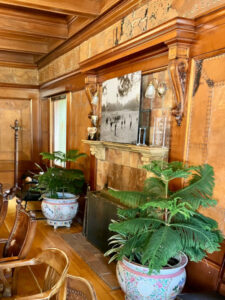
Fireplace and mantle in McLaren Lodge. The walls are covered in leather.
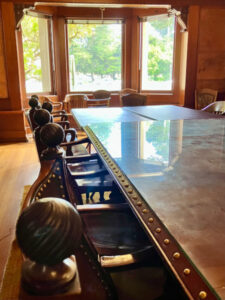
Original meeting table and chairs, still in use today. The window looks out on JFK Drive, the scoliotic east-west spine of Golden Gate Park.
The vault & museum
The vault holding the museum was where the Commission originally stored cash and valuables, from a time when physical currency was more common for things like park permits and payroll. Later, the vault was cleared out and used for storage, which included several filing cabinets of paperwork. Those papers turned out to be historical documents unto themselves. They’re now stored at the San Francisco Public Library.
Vault door leading into the museum.
With the vault cleared out, the idea came to use it for a display of the Park’s history, which led to the creation of the Mini Museum.
The Museum itself is a picturesque but brief travel through the decades of Golden Gate Park’s long life. Photographs of the early years show the sand dunes that had to be tamed by McLaren and Hall, as well as the cemeteries originally lining the northwestern border of the park. (Those graves would eventually be moved down the peninsula to Colma; some of the broken headstones would wind up lining the pathways and gutters in Buena Vista Park, a few blocks from McLaren Lodge.)
Each decade thereafter depicts the city’s and park’s development, recording the growing population and an increasing number of public parks throughout San Francisco. (One surprise for me: the nondescript Colombia Square, which I gave short shrift to in my “San Francisco streets with confusingly similar names” page, is actually one of the city’s earliest neighborhood parks.) The timeline also shows Golden Gate Park as a civic meeting place and cultural lodestone, such as when it hosted now-legendary rock acts in the late 1960s.
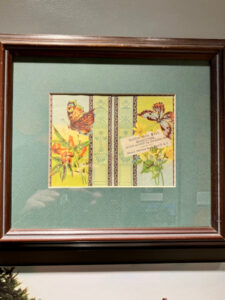
An 1884 schedule of weekend concerts at Golden Gate Park’s bandstand, featuring the “Second Artillery Reg’t Band of N. G. C.”
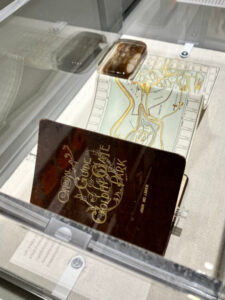
Early “Official Guide to Golden Gate Park” with a surprisingly clean folding map inside. Note McLaren’s name on the cover; I can’t tell if it’s to indicate he owned the copy, or is listing him as the “author” of Golden Gate Park.
For over a hundred years, San Francisco has been known as a “city of hotels.” It’s also a city of museums and tours, mainstream as well as quirky, cool, odd, and now tiny. It’s hard to call the Commission Vault Mini Museum a must-see for visitors in town for only a few days. I do think it’s worth your while if you love San Francisco history—especially the history of its parks—and can line up a spot for an afternoon viewing. I wasn’t disappointed at all; I’m just unsure if my enthusiasm for Golden Gate Park’s history is widely shared.
Someone on the tour asked if they offered tours of McLaren Lodge itself, which apparently is under consideration. Combining a tour of the vault with a tour of house itself would make an afternoon visit a no-doubter.
It’s pretty much what’s printed on the tin, but with a few surprises. Why are there two Mason Streets in the city? If Division Street divides two neighborhoods, what does Divisadero Street divide (if anything)? And is it true that two of the numbered east-west streets actually intersect?
It’s a goofy but fun way to look at San Francisco’s layout and history. I hope you get as much out of reading it as I did putting it together.
Jack Nicholson as J. J. Gittes in 1974’s Chinatown.
I’m not saying anything new when I say Chinatown is one of the greatest movies of all time. Producer Robert Evans captured lightning in a bottle when he put the 1974 film together, gathering a once-a-decade cast and an auteur director around a script familiar in Hollywood’s tones and tropes, and yet unlike anything preceding it.
There’s a tragic timelessness to Robert Towne’s script, a movie nostalgic for a bygone Los Angeles and the wonderful movies it used to make. There’s an audaciousness to the script as well. Making a feature film about the California water wars sounds like a dead-weight clunker, a story laden with all the dramatic zeal of a C-SPAN documentary. Towne’s brilliant insight was to frame the drama as a 1930s private eye noir, and then add a horrific backstory of sexual abuse that the Hollywood of the 1930s could not have even hinted at.
Two drafts of the script are available at the Internet Archive, and it’s fascinating to compare them. The earlier version liberally layers on the film noir device of the detective wearily adding voice-overs. The detective is also more romantic toward the female lead, and less cynical overall. These were all dropped by the final version. Writers Guild of America rates the script as third on their list of all-time greats, behind Casablanca and The Godfather. That said, I bet if you plied a roomful of seasoned Hollywood screenwriters with free drinks, most would glumly admit they wished they’d written Chinatown, more so than the other two films.
The script is booby-trapped with one reversal after another. In the first act, a wealthy Mrs. Evelyn Mulwray hires detective J. J. Gittes to snoop on her husband’s illicit activities. Once the job is finished, Gittes is confronted by another wealthy woman, the real Mrs. Mulwray, who threatens to sue Gittes for defamation of character. These rug-pulls and sleights-of-hand continue throughout the movie, all to slow down Gittes as he hacks his way through a thicket of lies and secrets.
Screenwriter Robert Towne. (Photo by Sarah Morris.)
The sharpest observations I’ve encountered about the script come from Syd Field, a Hollywood writer best known for his books on the screenwriting process itself. (I’ve written about Syd Field several times before.) In his book Screenplay, Field thoroughly mines Chinatown for examples of strong storytelling. Here he makes his admiration plain:
A far as I’m concerned, Chinatown is the best American screenplay written during the 1970s. Not that it’s better than Godfather I or Apocalypse Now or All the President’s Men or Close Encounters of the Third Kind, but as a reading experience the story, visual dynamics, backdrop, backstory, subtext of “Chinatown” are woven together to create a solid dramatic unity of a story told with pictures. … What makes it so good is that it works on all levels—story, structure, characterization, visuals—yet everything we need to know is setup within the first ten pages.
But it’s in Field’s Screenwriter’s Workbook where he uncovers what I believe is the most original observation on Chinatown, and what may be the movie’s greatest secret. Field is explaining his concept of the “midpoint,” the scene in a movie that cleaves the second act down the middle, and creates connective tissue between the two halves of the film. As I wrote back in 2015, Field’s midpoint is “the moment when you’ve laid all your cards out for the reader, the moment when the reader now recognizes what’s really at stake for your main character.”
Syd Field
Field recognized Chinatown‘s midpoint wasn’t literally on page 64 of the 128-page script, but rather on page 54. It’s the scene where Gittes visits the Los Angeles water company to get more information on the murder of the department chief, Hollis Mulwray. As he studies the photos on the waiting room wall, Gittes deduces that Hollis’ wife Evelyn is the daughter of Noah Cross, the retired founder of the Los Angeles water company. That is, the three people central to the murder he’s investigating are closely-related family members.
Before this scene, we think we’re watching a Los Angeles murder mystery set against the backdrop of 1930s water politics. Gittes discovery of the true relationship of the three central characters transforms Chinatown into a drama of a grossly dysfunctional family.
If you watch carefully, you’ll see that the film makes a decided change in direction and tone after the midpoint. The questions of water rights dissolve into the background. The film’s remaining revelations almost all regard the Cross-Mulwray family’s dynamics. There’s a reason the movie’s second-most famous line is “She’s my sister and my daughter!”
This is Chinatown‘s big secret, the ace up its sleeve—the film sets us up to expect one kind of story, but by the end, we’re watching something very different. Like the question of who killed Sam Spade’s partner in The Maltese Falcon, the mystery of who killed Hollis Mulwray is neither important nor surprising. Water and money are simply a means to a tragic and rapacious end.
Update, 7 Jul 2022: I’ve taken a fair amount of heat for the sin of admitting I’d not read Sadly, Porn before producing the following post. Note that I did read the Amazon sample before writing what follows, which is 10% of the book’s opening; I don’t count that as a full read, and didn’t want to quibble about that point when I first published this. Scott Alexander’s review quotes substantially from the book as well, but again, another quibble.
What my detractors don’t seem to get is that this post spends the bulk of its energies examining W. H. Auden’s “West’s Disease” and not Edward Teach’s book. The post originated as a comment to Scott Alexander’s follow-up to his review, but as my comment grew and became more involved, I decided to publish it here, on my blog.
As such, this post should be framed as “If Astral Codex Ten and Resident Contrarian are correct about this one point in Sadly, Porn, it relates to West’s Disease in this way…”
But, of course, it depends on the reader to carry the logic from there, and not simply dunk on me and walk off with LOLs.
I am now reading Sadly, Porn. For the record, I’ve read nothing so far that changes my mind on any of my thoughts below. If anything, it’s only cementing my position.
Allow me to state this up-front: I’ve not read Edward Teach’s Sadly, Porn. Scott Alexander of Astral Codex Ten (ACX) has, though, and in response wrote a rather lengthy and discursive review, as well as a follow-up on the comments it elicited. At this moment, most of my understanding of Sadly, Porn comes from these sources (which I freely admit is an imperfect substitute for reading the book).
From what I’ve gathered, Sadly, Porn is a meandering and intentionally obscure treatise (diatribe?), grounded in psychoanalytics, which purports to explain—among other things—the ways people lie to themselves. Released in December 2021, the Kindle edition clocks in at over 1,100 pages, brimming with extended discourses on topics you might think plucked from the air, such as a ten-page examination of Shel Silverstein’s The Giving Tree. It’s also larded with David Foster Wallace-esque footnotes and Heartbreaking Work of Staggering Genius-style exhortations directed at the reader. The author opens with a thirty-page erotica story which, he later claims, is only included to scare off readers. (An odd strategy, since there are a multitude of writers producing such fiction for a lucrative living.) Really, to get a good idea of the book’s scope, read the ACX review.
What lit my interest in it comes from ACX taking a stab at boiling down Sadly, Porn to its core thesis:
Psychologically healthy people have desires. Sometimes they fantasize about these desires, and sometimes they act upon them. You’ve probably never met anyone like this.
Psychologically unhealthy people, e.g., you and everyone you know, don’t have desires, at least not in the normal sense. Wanting things is scary and might obligate you to act toward getting the thing lest you look like a coward. But your action might fail, and then you would be the sort of low-status loser who tries something and fails at it.
Again, from what I’ve gathered, Edward Teach believes that social status is the chief (or even sole) motivator of human behavior. (Or, perhaps he doesn’t; ACX makes it clear the book is too cagey to state its arguments plainly.)
Teach certainly paints us all as loathsome meat-bags of pettiness. Yet there’s something familiar about his observations that makes it difficult to reject his assertions. In a time where social media has devised a multitude of ways to score our social standing (via follower counts, likes, retweets, and so on), and in a culture endlessly promoting concepts like self-actualization and fame, his claims about the primacy of status-seeking has substance.
Now compare Teach’s accounting of Man’s damnable condition with W. H. Auden’s analysis of Nathanael West’s novels, where he first describes “West’s Disease”:
This is a disease of consciousness which renders it incapable of converting wishes into desires. … All wishes, whatever their apparent content, have the same and unvarying meaning: “I refuse to be what I am.” [But the sufferer] cannot desire anything, for the present state of the self is the ground of every desire, and that is precisely what the wisher rejects. [Emphasis mine.]
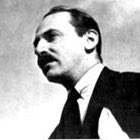
Nathanael West
To simplify Auden’s distinction: A wish is the simple act of imagining oneself as a different person, or in a different situation; a desire is imagining how one might convert one’s current self into a different person or situation. A wish is wanting to be thin; a desire is vowing to join a gym and work-out every day (even if one doesn’t act on it). West’s Disease is the inability to transform one to the other, leading to inaction, loathing, and rage.
The finest examples of West’s Disease may be found in The Day of the Locust, Nathanael West’s most well-known novel. It’s a brilliant and acidic look at 1930s Hollywood, as witnessed by a motley group of misfits well-distanced from Tinseltown’s glamour, money, and success. “Hollywood’s success as a dream factory is predicated on knowing our wishes and actualizing them on the silver screen,” I wrote two years ago. “That’s why Hollywood appears a tantalizing cure for West’s Disease.”
Auden’s diagnosis that a person with West’s Disease “cannot desire anything” echoes another summation of Sadly, Porn from blogger Resident Contrarian:
[Teach asserts] we in general are incapable of action; we don’t want to act but also can’t act, and we rely on a nebulous “them” to put us on a track towards having to do it. … we want a situation where we don’t have to take an action, but where an action is demanded of us by circumstance.
I don’t think it’s a coincidence that RC’s example (“you don’t want to talk to the pretty girl; you want her to trip so you have to catch her”) sounds like a stock scene in a Hollywood romantic comedy. And I do equate wishing, in Auden’s terms, with Teach’s idea that we crave an externality to occur that actualizes our wishes for us. Teach is perhaps exploring Auden’s wish mechanism a bit more fully, but it looks to me that Auden in 1962 struck upon the same vein of thinking that Teach is attempting to communicate in 2022.
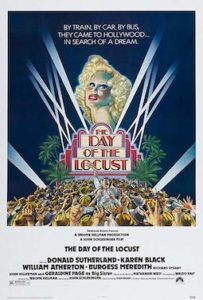
Poster for The Day of the Locust (1975) movie adaptation
West’s Disease is what paralyzes the misfits in The Day of the Locust. These Hollywood outsiders witness the fruits of Hollywood’s money and glamour being distributed to others, never themselves. They want success, but success is supposed to come to them, not vice-versa. Faye Greener, the only character who can claim to have a film career in front of the camera, complains “the reason she wasn’t a star was because she didn’t have the right clothes.” (There’s a similar shrugging passivity in McCoy’s They Shoot Horses, Don’t They?)
But Auden is less absolutist than Teach. It’s West’s Disease, after all: It only afflicts certain individuals, whereas Teach finds it to be widespread. (Perhaps Teach is right, though. Perhaps West’s Disease is contagious and has spread virulently since 1962. Or since 1939, when Locust was published.)
Auden also does not pin down West’s Disease as a natural state of the human psyche, but as a result of modernity:
There have, no doubt, always been cases of West’s Disease, but the chances of infection in a democratic and mechanized society like our own are much greater than in the more static and poorer societies.
When, for most people, their work, their company, even their marriages, were determined, not by personal choice or ability, but by the class into which they were born, the individual was less tempted to develop a personal grudge against Fate; his fate was not his own but that of everyone around him.
But the greater the equality of opportunity in a society becomes, the more obvious becomes the inequality of the talent and character among individuals, and the more bitter and personal it must be to fail.[Again, emphasis mine.]
This jibes with one of my intuitions as I read ACX’s review: That Teach’s near-universality of status-seeking in the human psyche is more likely the result of (or greatly amplified by) recent trends in technology and social organization. Auden wrote the above when notions like meritocracy were ripe in the air and corporate ladders were being erected sky-high. Today, social media and tabloid-esque journalism is king, can show you the numbers to prove it, and has disjointed our culture in unexpected ways.
What’s more, 21st-century American popular media doesn’t merely make “inequalities of talent and character” obvious; our celebrity-obsessed culture revels in and celebrates them. As Budd Schulberg wrote about status climbing: “It will survive as long as money and prestige and power are ends in themselves, running wild, unharnessed from usefulness.”
The Day of the Locust opens describing those with West’s Disease as those who “loitered on the corners or stood with their backs to the shop windows and stared at everyone who passed. … They had come to California to die.” In the final chapter, they rise up in revolt, and Los Angeles burns. Auden saw West’s Disease as damaging not merely to the individual, but to the society around them.
Teach seems to treat West’s Disease as an intellectual, and perhaps masculine, failing. (Apparently cuckoldry is a running theme throughout Sadly, Porn.) The book adopts a scolding and sneering tone toward the reader, implicating them as weak and blithe to this delusion of false desires and status envy.
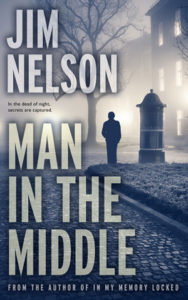
The first chapter of my novel Man in the Middle opens a year ago today.
It’s an odd anniversary to observe, the setting of a book. I didn’t start writing it a year ago today. That came later, after a bit of soul-searching if I really wanted to write a novel about the pandemic during the pandemic.
In some ways, though, I did start writing the novel a year ago. I began keeping a daily diary last March when it grew apparent that the spread of COVID-19 was going to be more than a particularly nasty flu season. The first entry on March 14 is a little over a week before the book’s time-frame. I set the novel’s opening chapter ten days later, March 24, to coincide with the timing of California’s statewide order to lockdown and shelter-in-place. I was tempted to open the book earlier, as my entries on the 21 and 22 both demonstrate the alarm rising within me, as the hard realities of the pandemic started to loom.
The early diary entries show me obsessing over the peculiarities of the then-present moment. Those were days of keeping John Hopkins University COVID-19 map open in a persistent browser tab, so I could check it every few hours. The red dots across the forty-eight contiguous states gave the effect of an America with a case of chicken pox; later I would call it a “creeping horror.” The buses running across San Francisco were suddenly empty, and in a few days most lines weren’t running at all. Downtown San Francisco businesses boarded up their windows, even the storied hotels, which normally operated with doors open twenty-four hours a day. After a trip to Costco for supplies, and witnessing panic-buying first-hand, me and several other beleaguered shoppers took the elevator down to the parking lot. A woman in the back began singing “There’s no way out of here.” At least people still had a sense of humor.
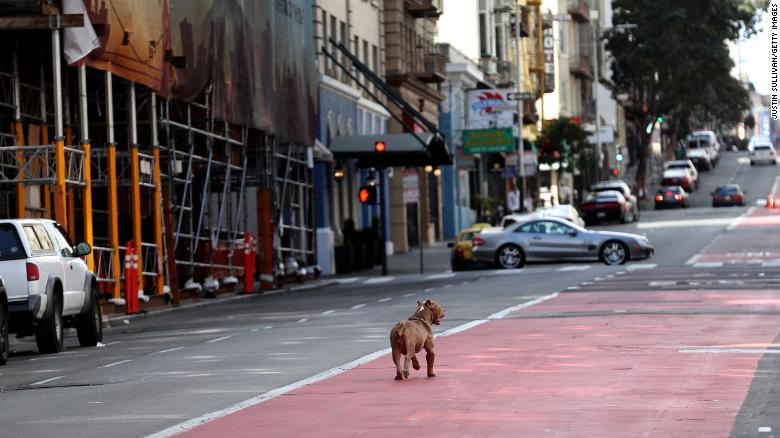
Dog running down a near-empty Geary St., San Francisco on March 17, 2020. I lived near the intersection the dog is approaching. Normally the traffic would be bumper-to-bumper. In a few days, the windows would be boarded up and the streets even more deserted.
During this time period, I jogged down the center line of Montgomery Street at 4:30pm on a Thursday—the heart of San Francisco’s Financial District, normally thronged with stockbrokers and bankers, suddenly looking like the set for a zombie movie. I also recorded having an on-again-off-again cough and running nose, which left me reeling between paranoia and chiding myself for being paranoid.
The nucleus of Man in the Middle is buried in my diary entry for March 22: “It would be funny if we emerge from our shelter-in-place hibernation four months from now and discover the rich and powerful have rewritten all the rules to further favor themselves.” (Four months from now. Ha.)
So many failures of those early weeks have been tossed down the collective memory hole. Multiple times I noted news reports of government officials from both sides of the aisle claiming broad martial law powers during a pandemic. Social network users were suggesting it was time for “appropriate” shaming of people for wearing masks—you read that right—while the media sought to pretend it never downplayed the coronavirus over the flu, or ever referred to COVID-19 by the city it was first detected in.
Months after the first vaccine was greenlighted for the general population, and after a year of lockdowns, fervent hand-washing, and face masks, COVID-19 numbers are still ticking the wrong direction. Or, they’re not. Maybe there is no way out of here.
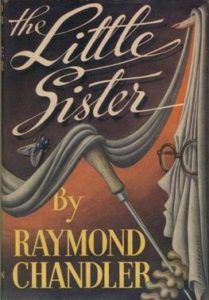
With Raymond Chandler so intimately associated with mid-century Los Angeles, and Chandler so determined to record the city’s excesses through his gimlet eye, it’s surprising how little of Hollywood makes it into his detective novels. The only one to dwell on the movie trade is The Little Sister, and even then, it takes twelve chapters until the reader learns the plot is somehow connected to Hollywood. Yet, The Little Sister is often nominated as one of the greatest Hollywood novels ever made.
By the time The Little Sister was published in 1949, Chandler had built a name in Hollywood as a successful screenwriter. His Oscar-nominated script for the landmark Double Indemnity (co-written with director Billy Wilder) was lauded as both an honest adaptation of James M. Cain’s bestseller and, incredibly, an improvement on the source material, which had been declared a modern classic soon after publication. Chandler was also called in to rewrite dialogue on other films, as his brisk, wisecracking style was in high demand.
Compare Chandler’s entry to Hollywood to Nathanael West’s, who churned out unremarkable scripts while writing The Day of the Locust. West did not travel to Los Angeles with stars in his eyes, nor did he arrive with impressive credentials. He strove to become a serious novelist, not a screenwriter of cheap Westerns and jungle adventures. It was the Great Depression, though, and he heard that Hollywood paid good money for writing.
He heard more than that, actually. According to Marion Meade’s Lonelyhearts, it was West’s brother-in-law—New Yorker writer S. J. Perelman—and his frothing disgust with Hollywood (“where holding a job was ‘a series of hysterical genuflexions and convulsive ass-kissings'”) that lured West to Los Angeles in search of foul-mouthed grotesqueries and high-glamour oddities he could transfer to the page. It’s not difficult to imagine Nathanael West as a character in a Raymond Chandler mystery…if only there was a blackmail angle.
As Chandler tiptoed through Hollywood’s land mines and manure fields, writing screenplays, dialogue, and movie treatments, he discovered he was not revolted or disgusted with what he saw. He was bored.
“An industry with such vast resources and such magic techniques should not become dull so soon,” he wrote in The Atlantic in 1945. “Hollywood is a showman’s paradise. But showmen make nothing; they exploit what someone else has made.”
One fascinating vein running through my list of great Hollywood novels is how often the authors were involved in the business—not only were they witnesses, they were collaborators in the insanity they documented.
“Hollywood is easy to hate,” Chandler wrote in The Atlantic, “easy to sneer at, easy to lampoon. Some of the best lampooning has been done by people who have never been through a studio gate.” By the time he wrote The Little Sister, though, he’d been through the studio gate many times.
Like Ross MacDonald, Chandler realized early on he could leverage the American hard-boiled detective novel to write about America grappling with modernity, a country suddenly flush with money and influence. The detective novel is told from the perspective of an outsider with a keen grasp of social, political, and economic realities. Chandler went heavy on the grotesque when he depicted Los Angeles, populating his novels with fortune tellers for the rich, perfumed gigolos, mob toughs talking like they had been borrowed from Hemingway’s “The Killers,” and so forth.
Chandler reels it in for The Little Sister. The novel is a bit drier than his earlier work. Most Hollywood novels brim with a fatalistic cynicism, but Chandler incorporated a more literal, perhaps even-handed, depiction of Tinseltown.
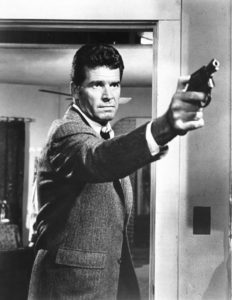
James Garner portrayed Chandler’s detective in Marlowe, a poorly-received 1969 adaptation of The Little Sister.
This literal-mindedness is what prevents The Little Sister from falling into a trope of American writing, the moralizing take-down of Hollywood as a depraved and greedy trade. Re-reading the novel for this post, I noted Chandler had included some basic scenes missing from the others in this list. His detective, Philip Marlowe, visits a sound stage during filming, where he witnesses a catty back-and-forth between the actors after the scene is flubbed. Afterwards, he drops in on a rising starlet in her dressing room. Another chapter is devoted to dealing with a big-shot movie agent eager to protect his client. These business-like scenes are the building blocks of the second half of The Little Sister.
In 1944, Chandler wrote to Atlantic editor Charles Morton:
Hollywood is the only industry in the world that pays its workers the kind of money only capitalists and big executives make in other industries. … Its pictures cost too much and therefore must be safe and bring in big returns; but why do they cost too much? Because it pays the people who do the work, not the people who cut coupons.
Marlowe sinks into this moneyed and territorial industry as ably as he deals with alcoholic flophouse managers and gangsters who dabble with ice-picks to the neck. Marlowe is surefooted no matter the situation. He is a man of all people, but party to none. This is the character type Chandler honed to a point. It was a character he used time and again to turn over rocks across Southern California to reveal the grubby crustaceans and sun-bleached bones beneath.
On the right the great fat solid Pacific trudging into shore like a scrubwoman going home. No moon, no fuss, hardly a sound of the surf. No smell. None of the harsh wild smell of the sea. A California ocean. California, the department-store state. The most of everything and the best of nothing. Here we go again. You’re not human tonight, Marlowe.
The Little Sister, ch. 13
The one notable grotesque in The Little Sister is the near-real-time transformation of a Midwestern bookish, prudish young woman into a walking caricature of a star-struck pursuer of Tinseltown sophistication. Like the climax of Locust, a critical point is reached, something snaps, and Hollywood’s vapory facade mists away to something more earthy and damning.
Chandler allows a sliver of redemptive light to shine through the smoke-filled backrooms, and it lands on the unlikeliest of characters. (“Lots of nice people work in pictures,” Marlowe notes unironically at one point.) Chandler was far more the softie than his books’ hard-boiled reputation suggests. The Little Sister ends in a surprising place: Perhaps the problem is not with Hollywood, but with those too eager to believe its illusions.