The Day of the Locust – The greatest Hollywood novel of all time?

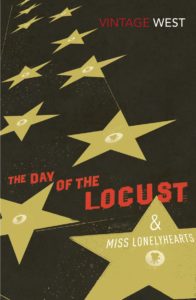
The Day of the Locust by Nathanael West

Previously: Introduction

When I ask writers to name the greatest Hollywood novel of all time, the more well-informed usually reply The Day of the Locust by Nathanael West.

The Day of the Locust‘s reputation as greatest of all time is earned. The opening chapter may be the finest three pages ever written on the absurdities and contradictions of Southern California. Throughout the book, with disgust (and a portion of glee), West holds up for display Hollywood’s winners, as well as the legions of desperate outsiders shut out of Hollywood’s dream factory—those “who came to California to die.” There is plenty of foreshadowing of the novel’s conclusion, yet when the finale arrives it manages to surprise and shock without coming off as a twist ending. It’s not so much a novel about Hollywood, but a novel about those standing on their tiptoes to look over the fence and steal a peek of Hollywood.

West was a New Yorker transplanted to Los Angeles, and his alien status is confirmed on every page. Los Angeles architecture is almost always described as though written with quotation marks. A house is “Spanish” or “New England” or “Moorish.” Hollywood debauchery is not so much of the Playboy Mansion variety, or even Roman bacchanalia. It’s just cheap and pathetic. The airing of a French farce in a Sunset Boulevard cathouse may be the least erotic description of pornography on record. Simulacrums of decadence are mistaken for actual decadence, such as a horse hooves-up at the bottom of a swimming pool during an open-air cocktail party. (No fear, it’s a rubber prop.) California’s artifice, inauthenticity, and halfhearted stabs at opulence are the brick-and-mortar of Locust‘s plot. The first chapter ends noting “Few things are sadder than the truly monstrous,” which may as well be the novel’s thesis statement.

Scene after scene, West lays down an unsparing case damning Hollywood’s emptiness the way a district attorney builds a point-by-point case for the death penalty—but where is the Lot character who escapes the city’s inevitable downfall? West’s ship of fools are uniformly impotent and ineffective. As with West’s other gem, Miss Lonelyhearts, there is little to root for here.

Nathanael West
Nathanael West

W. H. Auden identified “West’s Disease” as “a disease of consciousness which renders it incapable of converting wishes into desires.” In Auden’s formulation, wishes are whimsical and ethereal (“I wish I was a movie star”). Actual desire motivates the individual into action: “I’m going to enroll in acting classes and practice three hours a day.” (I’ve written more deeply about “West’s Disease” and W. H. Auden.)

Hollywood’s success as a dream factory is predicated on knowing our wishes and actualizing them on the silver screen. That’s why Hollywood appears a tantalizing cure for West’s Disease. Its siren song drew the characters to California from the humdrum Midwest and the frosty East Coast. Even if West’s misfits could muster up the energy and exert the effort to try and make it big, Hollywood’s antibodies would swarm to keep these ineffectuals distanced from the beautiful, powerful, and well-connected. Besides, Hollywood only depicts desires. It never actually fulfills them. There’s more than a few reasons West’s original title was The Cheated.

The Day of the Locust movie poster
The Day of the Locust‘s Hollywood adaptation’s garish movie poster

This inability to generate true desire makes the characters of Locust torpid and submissive. It’s why the book’s finale is so shocking: The characters finally shake off their doldrums, convert whimsical wishes to primal, savage desires—and then act on them. The raw energy of the final pages is all the more pronounced when compared to the impotence of the preceding chapters.

(The movie adaptation of Locust has been called a horror film in disguise. West’s grotesque and helpless characters are a mere audience to their own slide into destruction. This and the suppressed violence released orgasmically in the finale lines up with many horror film tropes.)

Much of The Day of the Locust is based on Nathanael West’s experiences in Los Angeles churning out film noir and adventure screenplays for Republic Productions (known as “Repulsive Productions” among Hollywood insiders; biographer Marion Meade refers to the studio as “Cheapsville.”) His produced scripts were marginally successful. His novels fared considerably less well, at least, in his lifetime.

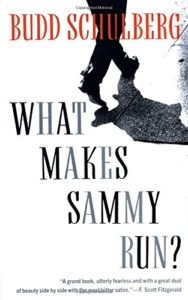
West’s fortune seemed to be turning around right before he and his new bride were killed in an auto accident. West wasn’t exactly martyrized, but his writer associates did see to it to spread word of his genius. Budd Schulberg praised The Day of the Locust as capturing how “the orgiastic crowd, loving you this moment, destroying you the next, is the very essence of Hollywood—as Hollywood may be the essence of our success-driven culture.” That is to say, Hollywood may be the most American of American industries.

Next: What Makes Sammy Run? by Budd Schulberg

What’s the greatest Hollywood novel of all time?

Hollywood sign
Photo by Thomas Wolf (CC BY-SA 3.0)

Let’s lay down the ground rules. A Hollywood novel is

  1. a book-length single work of fiction,
  2. regards the American film or TV industry, and
  3. is set in or around Los Angeles, California.

The Hollywood novel should not be confused with the Los Angeles novel, which may be set in similar locations but is not primarily concerned with the film industry. This includes almost all of John Fante’s work (Ask the Dust).

Also eliminated are autobiographies like Robert Towne’s The Kid Stays in the Picture and Julia Phillips’ You’ll Never Eat Lunch in this Town Again, both entirely about the Hollywood film industry and both reportedly nonfiction.

And, sadly, my first rule eliminates Fitzgerald’s superb The Pat Hobby Stories as it’s a story collection, not a novel. (Otherwise, these are some of the finest, and funniest, stories ever produced about Hollywood.)

Wikipedia offers a rather lengthy list of Hollywood novels. Obviously I’ve not read them all, and so the list that follows is not the hands-down decision on the Greatest of All Time, but is a healthy representation of the form.

The list (links added as entries are published):

Lessons learned from Ross Macdonald

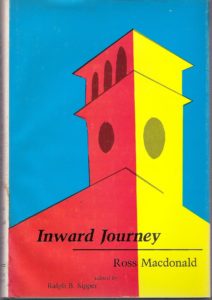
Recently at San Francisco’s Green Apple bookstore I discovered an edition of Inward Journey (1984), a collection of essays, poetry, and remembrances dedicated to mystery writer Ross Macdonald and published shortly after his death. The collection is edited by Santa Barbara rare book seller Ralph B. Sipper, who also collaborated with Macdonald on his autobiographical Self Portrait: Ceaselessly Into the Past.

Ross Macdonald obviously affected and influenced a great number of people in and around the Santa Barbara writing scene. The anecdotes and memories related by his friends and acquaintances paint a picture of a private and thoughtful novelist who quietly guided a number of writers toward improving their craft. It’s a touching book that mostly avoids miring itself in the maudlin. Some of the writers are quite close to the subject, such as his wife’s warm and elegant recounting of an early and late memory of him. Other essayists are more distant and matter-of-fact, such as popular writer John D. MacDonald’s humorous tale of his dance with Ross Macdonald over the appropriate use of their last names in publication credits.

That confusion is due to Ross Macdonald being the pen name of Kenneth Millar, who adopted the name to avoid being confused with wife Margaret Millar, a well-known novelist in her own right by the time his star began to rise. On top of his feud with John D. Macdonald, he also witnessed his style of detective fiction (and his detective, Lew Archer) relentlessly compared to hardboiled writers Raymond Chandler’s and Dashiell Hammett’s work from a quarter century earlier—often to his own detriment.

Between Margaret writing under his family name, authors John D. MacDonald and Philip MacDonald, and the unasked-for competition with Chandler and Hammett, it’s a wonder Ross Macdonald was able to carve out a name for himself. He did, and his workmanlike approach to novel-writing led to a corpus of nearly thirty solid books, the bulk set in Macdonald’s own Southern California, in particular his home of Santa Barbara (renamed to Santa Teresa). As such, Macdonald inherited not merely Chandler’s mantle of the premier tough-guy detective writer, but also the mantle of the leading Southern California mystery writer. The difference is, where Chandler’s stomping grounds are Los Angeles proper, Macdonald’s Lew Archer prowls the Southern California suburbs. This shift corresponded neatly with the rapid postwar growth of the Southern California valleys and coastal communities.

Free and joyful creation

Inward Journey opens with two previously unpublished essays by Macdonald himself. “The Scene of the Crime” is a lecture he gave at the University of Michigan in 1954 regarding the origins and development of the mystery story. It’s one of the most erudite, learned, and humble essays I’ve read on the subject. Macdonald had a degree in literature (his thesis analyzed Coleridge’s Rime of the Ancient Mariner) and he draws on sources as wide-ranging as William Carlos Williams and Faulkner in way of framing the detective story as a modern narrative strategy devised in reaction to modernity itself:

“A Rose for Emily,” [Faulkner’s] most frequently reprinted story is a beautifully worked out mystery solved in a final sentence which no one who has read it will ever forget. … I don’t mean to try to borrow Faulkner’s authority in support of any such theses as these: that the mystery form is the gateway to literary grace…Still the fact remains he did use it, that the narrative techniques of the popular mystery are closely woven into the texture of much of his work.

The other chapter, “Farewell, Chandler,” originated as a private letter to his publisher Alfred A. Knopf. Pocket Books was republishing his detective novels and sought permission to “fix” them by making them more violent and sensational (and therefore more palatable to paperback readers). Macdonald was compared to Chandler his entire career, and this letter both acknowledges the debt while gingerly disentangling himself from Chandler’s legacy:

My hero is sexually diffident, ill-paid, and not very sure of himself. Compared with Chandler’s brilliant phantasmagoria this world is pale, I agree. But what is the point of comparison? This is not Chandler’s book. … None of my scenes have ever been written before, and some of them have real depth and moral excitement. I venture to say that none of my characters are familiar; they are freshly conceived from a point of view that rejects black and white classification…

A writer has to defend his feeling of free and joyful creation, illusory as it may be, and his sense that what he is writing is his own work. [emphasis mine]

These two chapters are worth reading (and worth republishing, if they’re not already.) If you’re a writer of any stripe, I would then encourage you read beyond them. Although many of the remembrances in Inward Journey are strictly personal anecdotes, more than a few dig into Macdonald’s bibliography for clues to understanding the man himself. They also relate tidbits of Macdonald’s writing habits and personal theories on fiction and form.

In particular, George Sims offers a wonderful history, book-by-book, of Macdonald’s bibliography, with highlights of his best work. The final chapters by Gilbert Sorrentino and Eudora Welty describe the evolution of Macdonald the writer (and Lew Archer, the hero) from Macdonald’s earliest works to his last. In 1954’s “The Scene of the Crime” Macdonald claims the mystery novel stands to be viewed in the same light as Zola’s and Norris’ Naturalism; Welty picks up that theme in 1984 and asserts Macdonald has earned the right to be included in the said light:

Character, rather than deed itself, is what remains uppermost and decisive to Macdonald as a novelist. In the course of its being explained, guilt is seldom seen as flat-out; it is disclosed in the round, and the light and shadings of character define its true features. … His detective speaks to us not as a moralist but as a fellow sufferer.

If you have any interest in Ross Macdonald or mystery/detective fiction, and your local library stocks this book, it’s well worth a trip to your nearest branch to absorb these chapters. It’s also available online at the Internet Archive.

The New American Regionalism

Detective (hans van den berg, CC BY 2.0)

An untested opinion I’ve held for many years:

Modern mystery fiction has supplanted 19th-century American regional literature, sometimes known as “writing of local color,” as its dominant form.

Regionalism is most strongly associated with Southern writers like Kate Chopin and Joel Chandler Harris, but after the American Civil War local color writing sprung up all over the country. Charlotte Perkins Gilman (“The Yellow Wallpaper”) cataloged New England’s parochialism while Bret Harte wrote roaring tales of California’s Gold Rush. Scholars make distinctions between the terms “regional literature” and “writing of local color,” but I’ll use them interchangeably here.

Regionalism in American writing faded after the turn of the century to be replaced by a more consensus-based literature. Perhaps the twin rise of mass literacy and mass media contributed to regionalism’s fade, although it did not go extinct. Faulkner and Jean Toomer wrote well into the 20th century, and wrote using techniques that would have been foreign to the earlier regional writers, but their fiction is unmistakably grounded in regionalism.

But did regionalism truly fade away? Or was it replaced by something else?

It seems to me that mystery fiction quietly—almost subversively—filled in regionalism’s absence. Every major city in America is host to at least one major crime or detective writer, from Seattle (Aaron Elkins, G. M. Ford) to Boston (Robert Parker, Dennis Lehane) to Chicago (Sara Paretsky) to New Orleans (James Lee Burke), all representing their respective locales through their work. Name almost any place in America today and you’ll find crime writers prowling its dark corners. In the process, they’re introducing the region’s colors and textures to a national audience.

More than any other form of fiction today, mystery is concerned with setting. Science fiction has almost no restrictions when it comes to setting. Fantasy explicitly takes place elsewhere than the here and now, otherwise it’s not fantasy. Romance fiction has setting too, but its concerns are before the fireplace and in the bedroom.

Even contemporary American literature—”fiction of literary intent,” so-called hard realism—is not as connected to setting as mystery fiction. Too often stories from the small literary magazines feel as though they could take place in any city or suburb or small farm, whichever backdrop suits the characters and the emotional arcs they traverse.

Perhaps the only other form of American fiction so tied to setting is the Western, a genre that not coincidentally shares a great deal in common with the American mystery, especially the private eye genre.

I’m not saying other forms of fiction don’t possess a setting, or that they don’t concern themselves with setting. I’m saying that, for the form as a whole, mystery adopts a priority for regions—regionalism—other forms do not.

In mystery, scenes unfold on streets with grounded names and in bars with a history. A great mystery reads like a travelogue of a town, a neighborhood, or a county. The American mystery has a tradition of hewing to real-world settings, such as the streets of Nob Hill in Hammett’s stories and novels. Ed McBain’s “87th Precinct” police procedurals take place in a fictional New York City borough, but it’s the Big Apple all the same. Sue Grafton’s stand-in for Santa Barbara (“Santa Teresa”) is so Southern California, you can imagine The Eagles cutting a single about it.

This, I say, is the New American Regionalism. Mystery writers delight in bringing alive their surroundings, and by doing so they share their surroundings with their readership. Local color means local characters and local charm. Look at what stylist Elmore Leonard does so expertly in his Florida novels, capturing all the facets of dialects and cultures in Miami. The Encyclopedia Britannica’s entry of local color emphasizes “the features and peculiarities of a particular locality and its inhabitants.” This fits Florida crime writing to a T, with an emphasis on the peculiarities and particulars of the genre’s always-colorful cast of characters (Leonard, Carl Hiassen, Edna Buchanan).

My first inkling of the connection between regional writing and mysteries came to me twenty-five years ago living in San Luis Obispo, California. An ever-reliable bookstore there stocked a case of local writers, including several mystery series. Perusing the back cover blurbs, it was apparent the writers had mined the peculiarities and particulars of San Luis Obispo County for all it had to offer. My cynical younger self found it ludicrous, these over-boiled private eyes and steely Lt. Detectives walking the mean streets of San Luis Obispo, a place ranked “one of the happiest cities on Earth.”

Over the years I’ve lightened up. I came to realize the mystery writers of SLO Town were merely doing what all regional writers have done in America: Explore, critique, and celebrate they places they live.