
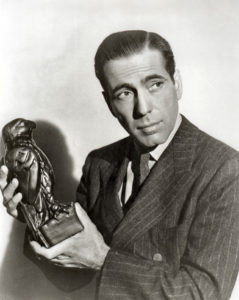
Anyone who’s followed this blog knows I’ve written a few times about Dashiell Hammett’s The Maltese Falcon. In particular, I’ve posted notes on an interlude within it about a man named Charles Flitcraft who, after a near-death experience, leaves his family and home to wander the world, only to return to a similar suburban family life a few years later. This episode is commonly called the Flitcraft Parable, for it does indeed read like one, even if the term is never used in The Maltese Falcon itself.
Detective Sam Spade tells this brief tale to Brigid O’Shaughnessy, the book’s femme fatale. The reason for the telling is a common question about the parable, since it seems out-of-place in this taut and lean novel. I’ve also explored how the parable plays into the book’s final scene, when Spade lays out his credo for O’Shaughnessy.
Recently, I was rereading the Flitcraft Parable for a project I’m developing, when I noticed something surprising in it: It’s the one place in the book where Hammett’s voice comes through, almost directly.
The parable
In the book, Sam Spade tells of Flitcraft, a well-to-do banker with a house, a car, and a family. One day, on his way to lunch, he strolls by a construction site:
A beam or something fell eight or ten stories down and smacked the sidewalk alongside him. It brushed pretty close to him, but didn’t touch him, though a piece of the sidewalk was chipped off and flew up and hit his cheek. … He was scared stiff of course, he said, but he was more shocked than really frightened. He felt like somebody had taken the lid off life and let him look at the works.
Shaken to the core, and realizing he’d been spared by cosmic fate, Flitcraft abandons his family and wealth, and flees for life on the road. Years later, he winds up in another suburban town, remarried and with a new child, living a life near-identical to the one he fled. “He adjusted himself to beams falling, and then no more of them fell, and he adjusted himself to them not falling.”
The perspective
It’s important here to mention that The Maltese Falcon is told in the third-person objective, a perspective rarely used in fiction. It’s a significant choice on Hammett’s part.
Most modern third-person fiction is told as third-person limited, where the narrator describes the main character’s thoughts and feelings. In third-person objective, the narrator never reveals any character’s internal thoughts. The only clues for the reader are external details and reactions, such as facial expressions. Merriam-Webster defines third-person objective as:
…the narrator reports the events that take place without knowing the motivations or thoughts of any of the characters. We know little about what drives them until we hear them speak or observe their actions. The resulting tone is often matter-of-fact, not colored by any opinions or commentary, nor of knowledge of what takes place outside the scene.
It’s an extremely difficult point-of-view to pull off, especially for novel-length work. It’s the kind of restrictive perspective creative writing instructors warn their students to avoid.
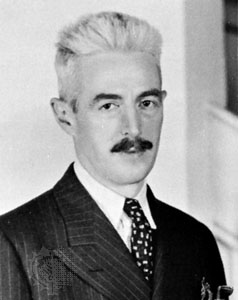
Hammett does pull off third-person objective in The Maltese Falcon though, and he does it so well, most readers don’t even notice it.
So, it’s notable when Hammett’s own voice breaks through the narrative during the Flitcraft Parable, like God calling down from the heavens:
Flitcraft had been a good citizen and a good husband and father, not by any outer compulsion, but simply because he was a man who was most comfortable in step with his surroundings. He had been raised that way. The people he knew were like that. The life he knew was a clean orderly sane responsible affair. Now a falling beam had shown him that life was fundamentally none of these things. He, the good citizen-husband-father, could be wiped out between office and restaurant by the accident of a falling beam. He knew then that men died at haphazard like that, and lived only while blind chance spared them.
To be clear, I’m not saying Hammett has broken the rules of third-person objective here. Yet I can’t help but read the above as something more than “matter-of-fact, not colored by any opinions or commentary, now of knowledge of what takes place outside the scene.”
Rereading the above quote carefully, sentence by sentence, it seems less like a summary offered by Spade to O’Shaughnessy, and more like Hammett inserting himself into the book. He offers, in essence, a summary near to the moral or meaning of the parable, much as Jesus asks at the end of the Parable of the Good Samaritan, “Which now of these three, thinkest thou, was neighbour unto him that fell among the thieves?”
Hammett’s daughter, Jo, remembers her father telling the Flitcraft Parable to her years after The Maltese Falcon‘s publication “as a story he had just heard or read, not as if he had used it as a set-piece in a book.” Apparently, he liked to tell the story to others as well. It seems the parable of a comfortable man shocked into a realization of life’s fragility struck Hammett deeply. That’s why I think he took a chance to include it in The Maltese Falcon, and took an even greater chance to explain to the reader, in his own voice, what the parable signifies.