Hammett’s voice in the Flitcraft Parable

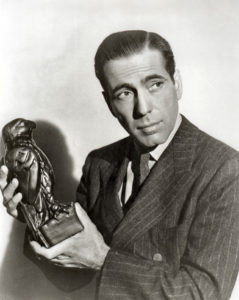
Humphrey Bogart holding the Maltese Falcon (film prop).
Humphrey Bogart and “the dingus.” (CC BY-SA 2.0)

Anyone who’s followed this blog knows I’ve written a few times about Dashiell Hammett’s The Maltese Falcon. In particular, I’ve posted notes on an interlude within it about a man named Charles Flitcraft who, after a near-death experience, leaves his family and home to wander the world, only to return to a similar suburban family life a few years later. This episode is commonly called the Flitcraft Parable, for it does indeed read like one, even if the term is never used in The Maltese Falcon itself.

Detective Sam Spade tells this brief tale to Brigid O’Shaughnessy, the book’s femme fatale. The reason for the telling is a common question about the parable, since it seems out-of-place in this taut and lean novel. I’ve also explored how the parable plays into the book’s final scene, when Spade lays out his credo for O’Shaughnessy.

Recently, I was rereading the Flitcraft Parable for a project I’m developing, when I noticed something surprising in it: It’s the one place in the book where Hammett’s voice comes through, almost directly.

The parable

In the book, Sam Spade tells of Flitcraft, a well-to-do banker with a house, a car, and a family. One day, on his way to lunch, he strolls by a construction site:

A beam or something fell eight or ten stories down and smacked the sidewalk alongside him. It brushed pretty close to him, but didn’t touch him, though a piece of the sidewalk was chipped off and flew up and hit his cheek. … He was scared stiff of course, he said, but he was more shocked than really frightened. He felt like somebody had taken the lid off life and let him look at the works.

Shaken to the core, and realizing he’d been spared by cosmic fate, Flitcraft abandons his family and wealth, and flees for life on the road. Years later, he winds up in another suburban town, remarried and with a new child, living a life near-identical to the one he fled. “He adjusted himself to beams falling, and then no more of them fell, and he adjusted himself to them not falling.”

The perspective

It’s important here to mention that The Maltese Falcon is told in the third-person objective, a perspective rarely used in fiction. It’s a significant choice on Hammett’s part.

Most modern third-person fiction is told as third-person limited, where the narrator describes the main character’s thoughts and feelings. In third-person objective, the narrator never reveals any character’s internal thoughts. The only clues for the reader are external details and reactions, such as facial expressions. Merriam-Webster defines third-person objective as:

…the narrator reports the events that take place without knowing the motivations or thoughts of any of the characters. We know little about what drives them until we hear them speak or observe their actions. The resulting tone is often matter-of-fact, not colored by any opinions or commentary, nor of knowledge of what takes place outside the scene.

It’s an extremely difficult point-of-view to pull off, especially for novel-length work. It’s the kind of restrictive perspective creative writing instructors warn their students to avoid.
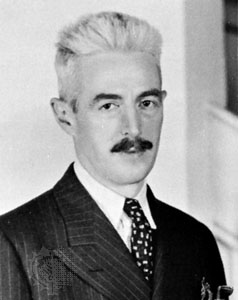
Photograph of Dashiell Hammett
Dashiell Hammett

Hammett does pull off third-person objective in The Maltese Falcon though, and he does it so well, most readers don’t even notice it.

So, it’s notable when Hammett’s own voice breaks through the narrative during the Flitcraft Parable, like God calling down from the heavens:

Flitcraft had been a good citizen and a good husband and father, not by any outer compulsion, but simply because he was a man who was most comfortable in step with his surroundings. He had been raised that way. The people he knew were like that. The life he knew was a clean orderly sane responsible affair. Now a falling beam had shown him that life was fundamentally none of these things. He, the good citizen-husband-father, could be wiped out between office and restaurant by the accident of a falling beam. He knew then that men died at haphazard like that, and lived only while blind chance spared them.

To be clear, I’m not saying Hammett has broken the rules of third-person objective here. Yet I can’t help but read the above as something more than “matter-of-fact, not colored by any opinions or commentary, now of knowledge of what takes place outside the scene.”

Rereading the above quote carefully, sentence by sentence, it seems less like a summary offered by Spade to O’Shaughnessy, and more like Hammett inserting himself into the book. He offers, in essence, a summary near to the moral or meaning of the parable, much as Jesus asks at the end of the Parable of the Good Samaritan, “Which now of these three, thinkest thou, was neighbour unto him that fell among the thieves?”

Hammett’s daughter, Jo, remembers her father telling the Flitcraft Parable to her years after The Maltese Falcon‘s publication “as a story he had just heard or read, not as if he had used it as a set-piece in a book.” Apparently, he liked to tell the story to others as well. It seems the parable of a comfortable man shocked into a realization of life’s fragility struck Hammett deeply. That’s why I think he took a chance to include it in The Maltese Falcon, and took an even greater chance to explain to the reader, in his own voice, what the parable signifies.
Maintaining a regular writing schedule

cafe(友光軒) by voo34oov (CC BY 2.0)

There’s a software industry maxim: “Always be shipping.” That means, if you’re not writing software, you’re not shipping software.

The same thinking applies for writing novels, short stories, self-help guides, biographies, and so on. If you’re not writing (or editing, or proofing), you’re not moving closer to getting your work published.

The following advice will sound familiar to anyone who’s read a book or taken a class on how to write a novel:

“Write an hour everyday.”

The idea behind this bit of sage counsel is that, by writing a little bit everyday, you will eventually reach your goal of writing a novel (or a short story, or a movie script). Another way I’ve seen this phrased is, “If a novel manuscript is 350 pages long, that means if you write a page everyday, you’ll have your novel finished in under a year.”

I’m not a fan of these hard-and-fast rules of writing. For one, they’re often difficult to stick to. Like a strict diet or physical exercise regimen, missing a day or two usually leaves behind a sizable amount of guilt. Guilt may get you back to the keyboard and typing, but it’s a horrible emotion to overcome when you should be focused on your characters and their challenges.

Let me offer a slight twist. Instead of “write an hour everyday” or “write a page a day,” find a regular writing schedule and stick to it. In other words, come up with a schedule right for you.

Once a week

I don’t write everyday. I tried it on a number of occasions. It was not productive.

After a lot of experimentation, I found my best work came when I wrote once a week. I’ve written a number of novels over the past ten-plus years, all while maintaining a weekly, not daily, schedule.

With that one allotted day, though, I spend eight hours writing. That’s writing with minimal interruptions for eight hours straight, like an office worker in a cubicle. And note that I do not require a certain number of pages or words be written in those eight hours. I do my best. That’s all I can ask of myself.

Over the course of my writing day, I’ll pause for lunch. I eat at my computer and go over what I’ve produced so far that morning. Usually I write at cafes, although during the pandemic, I learned how to write at home without interruptions.

The people in my life know that one day a week is off-limits. If something comes up that interrupts my schedule, I make arrangements to write on a different day. It takes a lot to pry that one day from my grip.

Plus, the way I write, I’m usually just starting to cook when I reach my first hour writing. “Write one hour a day?” Juices start flowing at the end of the first hour, and words are still coming at a fast and steady pace. Why stop right when things are going well? I’d rather bank those seven hours a week into a single day, and add another hour on top of them for good measure.

I’ve encountered some skepticism from other budding writers about my routine. Like most writing lore, “write an hour everyday” has become ingrained as one rule among dozens for becoming a successful writer—a kind of mantric or devotional routine that guarantees results. Your novel was rejected? Well, did you skip a day while you were writing it? Also, did you open your book with weather?

“Write an hour a day,” is sound advice in spirit, but not in practice. Better advice is to find a productive writing routine, and stick to it.

A second job

This is the important part: It’s not a wasted day. As I’ve told my family, writing is my second job. It’s not a great-paying job, but it is a job.

Time to write doesn’t magically appear. People in your life will always find some other priority for you. They’ll tell you that you can write later. You have to be firm on this point.

You don’t have to spend a full day a week writing to produce a novel. If you can set aside a few hours twice a week—say, two dedicated evenings—you’ll be surprised how much writing you can get done. But you will want to stick to your schedule for it to work.

One writer I admire is comic book legend Peter Bagge. Apparently, Bagge is infamous in the comics industry for his work ethic. Every morning he rises, dresses in business-casual clothes, and go to his home office to produce comics. He’s not working from home. His office just happens to be in his home. He puts in a full day, five days a week.

I don’t have the success to write everyday and make a living wage off my work. Still, I made a commitment to myself that I would treat the one day a week I had free as a work day, just like Bagge does. I rise, eat breakfast, head to the computer, and write, just as if I was heading to the office.

Silence your phone. Close the door to the room. Put on a pair of headphones. Turn off your computer’s Wi-Fi to avoid the temptation to surf social media.

If you’re not writing, you’re not producing. Make the time to write.

Rethinking realism

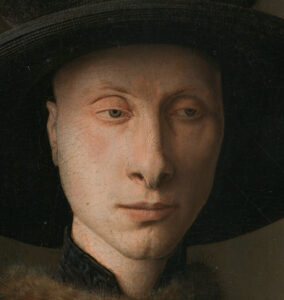
Close-up of man's face from "The Arnolfini Portrait" by Jan van Eyck

Not “rethinking realism” as in rethinking a single objective reality, hard as rocks and nails. I mean “rethinking realism” in the sense of questioning the elevation of literary realism over the many other forms of storytelling.

Realism has long been the go-to form in literature for telling a story a certain way. An entire literary style—Naturalism—sprung from the sense that Romanticism had gone too far and produced a literature divorced from the world as commonly experienced. The pendulum later shifted the other direction, and for a period of time “realistic” literature was derided as bourgeois and reactionary. Since World War II, with the rise of creative writing programs and a reinvigorated enforcement of upper-class distinctions, kitchen-table realism has returned to the pinnacle of literary loftiness in America.

So it’s funny to me that realism is also so important in popular entertainment. This is nowhere as true as with television, which is obsessed with depicting reality—from the “you are there”-style news reporting (a la Dateline NBC) to game shows branded as “reality TV.”

When the writers of TV’s M*A*S*H killed off Col. Henry Blake in a season finale, they were inundated with letters from outraged viewers. The Emmy award-winning writing team’s response was, “Well, that’s reality.” American auteur Robert Altman famously ends Nashville with an out-of-the-blue assassination of a central character. Why? Because, he explained, that’s reality.

Strange, then, that “reality” is so important to literary fiction and to popular media, especially since both styles vigorously insist they are nothing like the other.

It’s not that claims of a story being realistic is faulty or wrong-headed. My complaint is that the excuse—”It’s reality”—is a lazy defense of artistic choices. Writers should cop to their decision rather than take the passive route and saying reality made the choice for them. Writers should ask themselves if a “realistic” moment is adding to, or subtracting from, the story, and make the necessary adjustments.

Anyone who’s attended a creative writing class, workshop, or MFA program is familiar with the high ground presumed by realism. The trendy term is “psychologically realistic fiction.” In writing programs, names like Raymond Carver, Amy Hempel, Tobias Wolff, and Tim O’Brien are tossed out as the zenith of American writing. Students are explicitly encouraged to emulate them, and their importance is implicitly signaled by their repeated presence in syllabi and required-reading lists. (I’ve read “The Things They Carried” at least eight times over the course of decades of writing groups and classes.) These authors are lionized for many reasons, but importantly, they all write about reality.

(There are two exceptions worth mentioning: One is magical realism, although its high regard in writing programs is tied up with identity politics. The other is Borges, whom I jokingly refer to as science-fiction for MFA students. It must be pointed out that both exceptions originate from outside the United States, which I think is not accidental. Also, while Kafka is read and praised in writing programs, it’s never in such a way as to encourage emulation—I suspect my instructors liked the idea of Kafka more than Kafka’s output.)

Look at how so much literary fiction operates. Protagonists tend to be thoughtful, rational, and deliberative. Often, they exhibit little to no affect. Characters in opposition tend to be boorish, thoughtless, and emotional. Dialogue is either flat and unadorned, or snappy, like the patter of a stand-up comic. Scenes flow as one character uttering a brief line, followed by paragraphs of rumination. The other character responds, and more paragraphs of rumination.

The prose might be good—it might even be inspired—but is this realism? Going through contemporary literary magazines, reading one story after another, I’m not sure one will find a lot of psychological realism, in the sense of psychiatry’s DSM-5.

Genre fiction is not immune either. Too often connoisseurs of hard-boiled detective fiction and tough-guy novels claim their favorite authors are superior because of their attention to realism. Raymond Chandler’s “The Simple Art of Murder” is wonderful and insightful criticism, but at its heart is a trashing of the classic British mystery because “fiction in any form has always intended to be realistic.” It’s one of the few arguments in the essay that I question.

Janet Burroway wrote, “Sometimes reality doesn’t make for good fiction.” It’s a tough lesson to learn, and one that even seasoned writers fail to grasp.

After all, there is no widely-accepted maxim stating the primary purpose of story is to reproduce reality. Fiction is supposed to be an expression of a writer’s inner state, not a dry report of the who, what, where, and when. Besides, why do we need to reproduce reality with such fidelity? We’re soaking in it. If you want reality, put down your phone or leave your computer screen. You have returned to reality, effortlessly.

In a writing class I attended, one of the students was a fan of horror, particularly H. P. Lovecraft and Robert Chambers’ The King in Yellow. At an end-of-semester presentation before the class, he expressed frustration at the psychological-realism reading list we’d been given, and of the months of instruction requiring him to write in similar form. “Reading about reality is like reading about your job on your day off,” he told us. There’s something to that.

Story creates a transcendence within the reader. This transcendence defies reality while mimicking it—reality is Play-Doh in the hands of an adept writer. From hard realism to squishy-soft fantasy and everything in-between, great writing takes me to another place and time, a chance to live another person’s life. Books are experimental lives. Books are “portable dreamweavers.”

Aside

If you’re going to break the rules, break all of them, not only the “cool” ones

L'Avant-GardeEvery so often I meet a writer who proudly proclaims he or she is anti-Aristotelian—maybe not in such formal terms, but that’s what they’re saying. “Stories don’t require a beginning, middle, and end,” they announce, or “I don’t write plot-driven fiction. My characters don’t do anything. They exist on the page.”

Then, at the next writers’ group meeting, they bring in a short story that meanders and goes nowhere. Six or eight intelligent people squirm in their chairs trying to find something positive to say about a story that bored them into a coma.

Once I knew a guy who only smoked unfiltered cigarettes, a pack a day. “If you’re going to smoke,” he told me, “smoke for God’s sake.”

If you’re going to break the rules when writing fiction, break all of them, not only the “cool” ones. Don’t use fiction to signal your artistry. Be an artist. Write these stories:

  • Employ a deus ex machina. Trap your characters in an unwinnable situation and then have an all-powerful entity arrive and deliver them to safety.
  • Write a plot-driven story. Make your characters complete cardboard.
  • Tell a story using only summary and exposition.
  • Don’t give your characters an internal subjective logic, that is, they can’t even defend their actions or beliefs to themselves. Doing something to be cruel or for immediate gratification has an internal logic; your characters should do things randomly and wantonly.
  • Write a story with a beginning, middle, and end. Lop off the beginning and end. Or, lop off the beginning and middle.
  • Resist in medias res. Don’t start your story in the middle of things. Start it hundreds, thousands, tens of thousands years in the past. Or, start it hundreds of years in the future and never return to the main events, i.e. no flashbacks or time travel.

Write these stories, then write them again. And then write them again. After a year of breaking the rules, you’ll know if you’re an avant-garde writer or not.

At least you’ll have a better idea of what avant-garde really means in the realm of fiction, and not its surface interpretation so popular in our times. And, you’ll learn that the rules of fiction are not rules as much as hard-earned lessons of what succeeds and what fails when telling a story.