Will we finally see Neuromancer on the screen?

See also “One year later: Will we finally see Neuromancer on the screen?”

Update, 1 July 2025: William Gibson has announced the Neuromancer adaptation is in production.

Neuromancer (Brazilian edition)

The Illuminerdi (via) reports Apple TV+ is tooling up to produce a streaming adaptation of William Gibson’s cyberpunk masterpiece Neuromancer. The big question Illuminerdi concerns itself with is which actor will play protagonist Case, a drug-abusing hacker hired to pull off a virtual heist in cyberspace.

The story buries the lede. The truly big news is that Neuromancer has a reasonable chance of being adapted to the screen. Apple TV+ may not be the leading force in streaming entertainment today, but it’s established a track record of producing high-quality material and taking some risks along the way. I know I sound like the eternal fanboy when I say this, but, “This time it might be real.”

Neuromancer is a brilliant novel, one of my favorites, and by my lights, the book that rearranged science fiction. Just as Raymond Chandler did not invent the hard-boiled detective novel, William Gibson did not invent cyberpunk. But both authors took earlier bricklaying done by them and other writers, pulled it all together, and buffed the final result to a chrome-like sheen. There’s science fiction before Neuromancer, and there’s science fiction after Neuromancer.

Hence Neuromancer on film has been a hot topic among science fiction fans since the book was first published in 1984. Every few years over the subsequent decades, news would percolate up that a movie adaptation was in the works, only for the organizers to lose interest, fail to find finding, or simply not get the green light. The Wikipedia section on Neuromancer‘s numerous aborted film adaptations doesn’t do justice to its rocky history. Fake movie trailers have been sewn together; fan-made movie posters have been photoshopped. The rumors, anticipation, and disappointments surrounding the film’s production are legion. (My response to hearing of this latest adaptation attempt: “I’ll believe it when I see it.”)

There were several sidelights along the road to this moment, starting with Johnny Mnemonic in 1996. At first glance, it appeared the perfect aperitif for Neuromancer fans: Mnemonic was an adaptation of a Gibson short story set in the same story universe. The film landed flat, though, and is pretty grating to watch. (Some call it a cult classic—I can’t tell if they’re being ironic or not). Keanu Reeves turned in a cold performance (which he claims was intentional) within a confounding and bizarrely campy narrative. Some say Mnemonic was underfunded. Gibson said it was overfunded. Even if the studio execs were clueless in their meddling—not a stretch to imagine—I still think postmodernist director Robert Longo was simply in over his head.

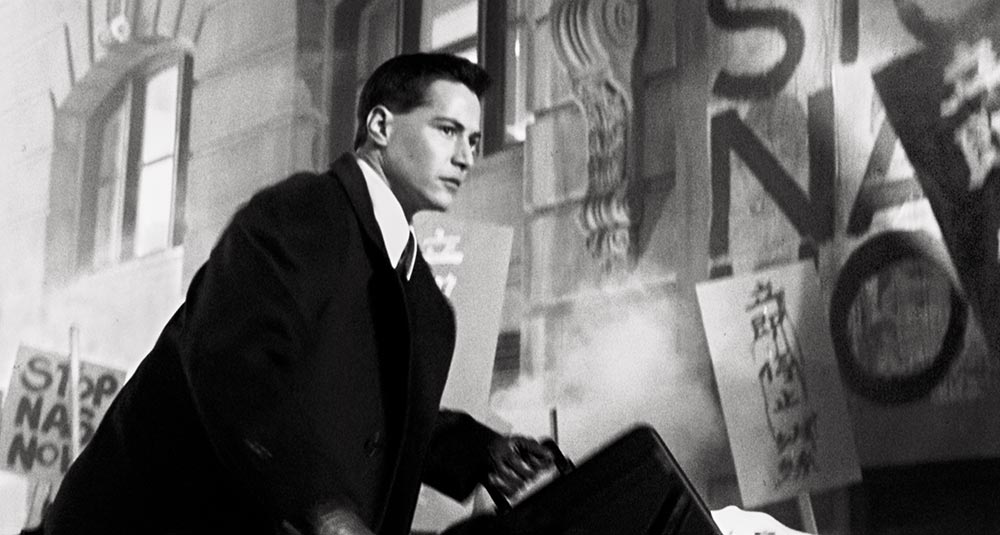
(That said, I’ve not seen the new re-edit Johnny Mnemonic: In Black and White, so I’ll reserve judgment whether the film is irredeemable. I admit: The stills look damn promising.)

Movie still from Johnny Mnemonic: In Black and White
Johnny Mnemonic: In Black and White

It took The Matrix (1999) to give hungry cyberpunks the cinematic meal they were waiting for. There’s so many parallels between it and Neuromancer, you can’t help but think the writing/directing Wachowskis owe Gibson a pitcher of beer (if not a brewery). But Darren Aronofsky (Pi, Requiem for a Dream) was on to something when, after viewing the film, he claimed “Cyberpunk? Done.” By using up Neuromancer‘s best devices, as well as every philosophical question explored by Philip K. Dick, the Wachowskis came close to shutting the door on the most interesting development in genre fiction since the 1930s. The banality and repetitiousness of the next three Matrix films—including 2021’s Resurrections, which I held a sliver of hope for—only seemed to cement Aronofsky’s point.

(Cyberpunk’s heyday in the 1990s has passed, but neo-cyberpunk lives. The new breed exists where a worldwide computer network is no longer an imagined future, but a concrete element of the story’s past.)


I’m perennially suspicious of Hollywood adapting books to the screen, especially science fiction. Too often screenwriters will ditch the most memorable and gripping parts of the source material to slide in Tinseltown’s tired narrative shorthand. Amazon’s The Man in the High Castle leaps to mind. I’ve not seen the recent adaptation of Foundation, but at least one reviewer thinks Asimov’s classic hasn’t actually been adapted. Still, Illuminerdi reports William Gibson is signed on as an executive producer for Neuromancer. That gives me a touch more confidence in the direction of the project.

But only a touch. In 2015, I wrote how Hollywood has abandoned “‘tight, gapless screenwriting’ to scripts focused on world-building, sequels, expansion, rebooting.” That was written in time when superhero franchises were claiming greater real estate at the cineplexes, and Hollywood had finished converting Tolkien’s charming tale about wee folk into a eight-hour epic-action trilogy. Cinema houses still ruled back then. Like a sneeze coming on, the theater owners knew a violent upheaval was imminent. Today, streaming services are the premier way to deliver movies to eager audiences. And that’s what worries me the most.

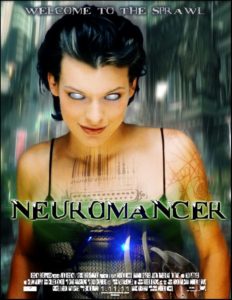
MIlla Jovovich as Molly Millions in Neuromancer (fan-made movie poster)

My dread is not that this cyberpunk classic will be adapted to television instead of the silver screen—it’s to see it adapted to a medium that expects seasons and episodes. As with High Castle and Foundation, the streaming services love season-long episodic television: All the better for binge-watching.

Episodic television ushers in the narrative shorthand that Neuromancer absolutely does not need: every hour ending on a contrived cliffhanger; the sexual tension of when-will-they-hook-up; the let-down of the couple separating (complete with the trite break-up language of television: “I need some space” or, “This is going too fast”); and so on.

As Rob Bricken noted in his review of Foundation, which was serialized for Apple TV+:

Even if you’re coming in without having read a page of Asimov, you’ll still notice the drawn-out plots that go nowhere, the padding, and the weird choices the show has the characters make to keep the plot from moving forward. Cheap, nonsensical melodrama fills the series…The show also wants to have pew-pew laser battles and ship fights and spacewalk mishaps and junk, none of which offer anything you haven’t seen before, and are usually used to just run out the clock anyway.

He makes this sharp observation:

Then there’s the show’s terror that people might not make certain connections, so it shows something, has the character comment on it to themself, and then maybe throws in a flashback to someone saying something relevant even if it was said three minutes prior.

This comes from television writing 101: “Tell them what they’re going to see, show it to them, and then tell them what they saw.” If that sounds like how to organize a Powerpoint presentation, you’re right. It’s also why television writing in 2022 remains hard-wired to the narrative structures of I Love Lucy.

Just as Gibson’s console jockeys rewired systems to hijack signal broadcasts and repurposed wet-tech to bore holes through firewalls, let’s hope modern streaming technology is bent to Neuromancer‘s whims, and not vice-versa.


Addendum: One of the criticisms I’ve received, here and elsewhere, is that Neuromancer cannot properly be condensed into a two-hour movie, hence a series is a better fit for its adaptation.

I agree a multi-part show is appropriate for Neuromancer‘s intricate story line. I loathe condensing Neuromancer into a ninety-minute film almost as much as I loathe seeing Neuromancer: Season Two on my TV screen. However, when I originally wrote the above post, I kept fishing around for a good example of a multi-episode streaming series (for illustrative purposes), and failed to locate one.

This morning I recalled The People v. O. J. Simpson: American Crime Story (which started life on FX and moved to Netflix). Its miniseries format would work well for Neuromancer. Each segment builds the story and develops characters toward a conclusion, like chapters in a novel. There’s a beginning, a middle, and a door-closing end.

My gripe is that Apple TV+ may attempt to “episodize” Neuromancer, making it more like a soap opera or a recurring show than a single story told a chapter at a time. This is what happened to Man in the High Castle—which was more “inspired by” than a retelling of the source material—and what appears happened to Foundation.

Follow-up: “One year later: Will we finally see Neuromancer on the screen?”

Sherlock Holmes: The enduring allure of history’s greatest detective

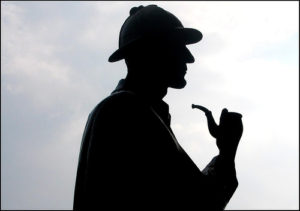
Sherlock Holmes

Mystery and Suspense Magazine has published my article “Sherlock Holmes: The enduring allure of history’s greatest detective” on their web site. In it, I explore the traditional reasons why critics and fans think the Baker Street detective remains popular—even immortal—to this day, and offer in return my own thoughts on the subject:

What is the enduring appeal of this shape-shifting character? Doyle gives no indication that Holmes is particularly attractive or magnetic in personality. He can be cold, abrasive, and downright rude in moments. One cannot help but feel Dr. Watson is a man with a remarkable reservoir of patience. How many Sherlock Holmes adventures open with the detective challenging Watson to discern the history of a person from nothing more than a walking stick, a battered hat, or a muddied shoe? Watson entertains Holmes and his games of deduction, but always as the lesser, never as the equal. (In my experience, medical doctors are not the sorts of people who take well to being talked down to.) Why would such a man continue to fascinate and entertain well into the 21st century?

My thinking on Doyle and his creation has shifted over the past few years due to a renewed appreciation for the Sherlock Holmes canon and, of course, writing a reinterpretation of his classic The Hound of the Baskervilles.

The Mystery and Suspense article is here.

For more background on my thinking, there’s “Sherlock by Train” and “Why I wrote ‘A Man Named Baskerville'”.

And you can learn more about A Man Named Baskerville, which is available in Kindle and paperback.

Link

A Man Named Baskerville giveaway

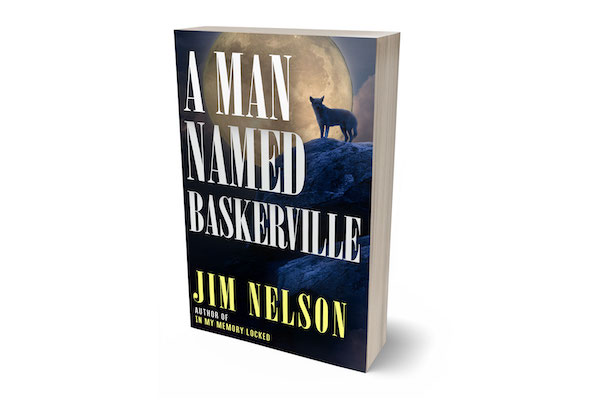
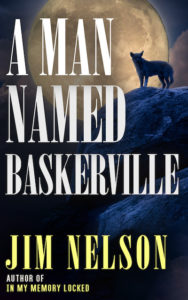
Cover of "A Man Named Baskerville" by Jim Nelson

In celebration of Halloween, I’m working with Goodreads to give away 50 copies of A Man Named Baskerville!

To enter the contest, follow this link and apply to win. There’s no obligation. All you need is a Goodreads account to apply.

If you know any friends or family who may wish to enter, please feel free to share the link with them.

Read here to learn more about my rewriting of the Sherlock Holmes classic. And if you’d like to start reading now, A Man Named Baskerville is available for purchase in Kindle and paperback. The book is FREE for Kindle Unlimited subscribers.

I Hear of Sherlock Everywhere reviews “A Man Named Baskerville”

Another review rolls in for A Man Named Baskerville, this time from the podcast and web site I Hear of Sherlock Everywhere:

While this tale is intended to be Stapleton’s counter to what Watson’s published version of the events would be, it rather exposes a horror within that cannot be saved by the loyalty of a good friend, the love of a woman or the faithfulness of a dog.

The full review is here. More information on the book is here, including links for reading sample chapters in your browser.

Video

Kay’s Hidden Shelf reviews “A Man Named Baskerville”

Over the weekend, BookTuber Kayla of Kay’s Hidden Shelf offers a gracious and positive review of A Man Named Baskerville. It was a wonderful Fourth of July surprise.

If you’re a fan of science fiction, fantasy, and/or historical fiction, I highly recommend checking out her channel, where she offers patient and thoughtful views on a wide range of fiction. Thanks, Kayla!

Kay's Hidden Shelf

Why I Wrote “A Man Named Baskerville”

See the “Twenty Writers, Twenty Books” home page
for more information on this series.


A Man Named Baskerville by Jim Nelson

[Note: The following is adapted and compressed from the afterword to A Man Named Baskerville. It reveals some details from the book. It also contains spoilers to the book it was inspired by, Arthur Conan Doyle’s The Hound of the Baskervilles.]

Years ago, while traveling Japan via its Shinkansen bullet train, I found myself without a book to read. An ebook reader I’d installed on my phone came with a free sample to whet the reader’s appetite. That book was Arthur Conan Doyle’s The Adventures of Sherlock Holmes, a collection of the earliest Holmes short stories. (I explore this incident in greater detail in my 2016 post “Sherlock by Train.”)

The collection stands as a record of a remarkably creative streak. So remarkable, if Doyle were to have stopped writing after its publication, we would still be talking about his literary creation and storytelling prowess. The titles of the stories within are as familiar as the books of the Bible: “A Scandal in Bohemia,” “The Red-Headed League,” “The Man with the Twisted Lip,” “The Adventure of the Speckled Band.” Perhaps the only missing short story title of comparable infamy is “The Adventure of Silver Blaze,” published in The Memoirs of Sherlock Holmes a mere two years later. In toto, they represent the height of Doyle’s powers and inventiveness.

None of this inspired me to write A Man Named Baskerville. As exciting and inventive as a great Sherlock Holmes story can be, never have I entertained the question that has dogged countless other producers of Doyle homages and pastiches: Could I write my own Sherlock Holmes story? Honestly, the thought has never crossed my mind.

After consuming the first collection in a rush of reading, I used the opportunity of a brief train stop and some free wireless Internet access to download more Sherlock Holmes books for our continued journey. I had read a little of Doyle’s work before, and never found much interest in it. They were too Victorian for my tastes, too concerned with Empire and upright decency and British morality. My California upbringing, and the plain-speaking tastes I inherited from my parents, led me to the hardboiled school of Chandler, Hammett, and Cain. Nathanael West’s grotesqueries and William Gibson’s cyberpunks are a better fit for me than Holmes’ Irregulars.

On that train ride, my interest in Sherlock Holmes kindled. Holmes may not have walked Chandler’s mean streets, but he did present a more compelling moral force than I’d sensed before. As with the hardboiled school, Holmes time and again must balance his own sense of justice against the British legal system’s notion of the same. Doyle wrote for an audience who would understand those boundaries implicitly. A hundred and ten years later, I viewed Holmes’ sense of justice through a different lens. This came to a point when my reading reached The Hound of the Baskervilles.

The book was first serialized in 1901, ten years after that auspicious run of early short stories. Doyle had killed off Holmes in “The Final Problem” (1893) hoping to rid himself of the literary creation upstaging all his other work. An appalled public demanded more stories featuring Holmes, and publishers increasingly pressured Doyle to satisfy the market’s cravings.

Inspired by a trip to Devon and its local folklore of wisht hellhounds roaming the countryside at night, Doyle produced The Hound of the Baskervilles. To avoid what we today call “continuity problems,” he retroactively dated its events to October 1888, three years before the publication of his earliest stories. This places the story square in the middle of the Autumn of Terror, when a serial killer dubbed Saucy Jack terrified London, while, across the Atlantic, the Empire of Brazil was warily beginning its dissolution.

One overlooked quality of Doyle’s writing is that his knack for concise storytelling in the short form executes equally brilliantly in the longer form. I’ve seen adept short story writers get fouled up when they attempt to tackle the novel. The pacing and breathing cadences that permit a runner to win the 100-meter dash do not sustain when attempting a marathon. Yet Doyle’s economical style holds up with Hound, making for dazzling quick cuts between crucial scenes, and exposition that does not lead the reader to impatiently flip ahead. Doyle had a gift for paring down prose to its vital emotional and informational elements without stripping it of that uniquely English sense of mood and atmosphere. One also sees in Hound Doyle’s assiduous control of pacing. The early chapters draw out their eerie scenes, while the closing chapters barrel headlong toward the conclusion. The movement becomes so breathless at the end, it takes pure inference on the part of the reader to detect scene changes.

Readers either love or hate this no-nonsense approach to storytelling. Either way, the final output of his opus on the moors is consistent with this quality, and obviously has held the public’s interest for well over a century.

None of this inspired me to write this book, either. I grew to admire Doyle’s writing while traveling by bullet train, but I never craved to imitate it. The first fourteen chapters of The Hound of the Baskervilles served to reaffirm my growing estimation of the man’s talents, but not to pick up a pen.

What did inspire me to write A Man Named Baskerville? The fifteenth and final chapter of the book it derives from.

All detective mysteries deal in sleight-of-hand. Keeping the perpetrator out of the narrative limelight until the moment the solution is announced is a tried-and-true technique for maintaining the element of surprise. In response, savvy readers have learned to guess whodunnit by evaluating how much “screen time” the author gives the suspects. The most obvious suspect is never culpable. The suspect we’ve read the least about is quite often guilty up to their eyeballs.

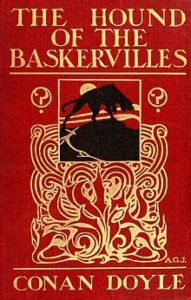
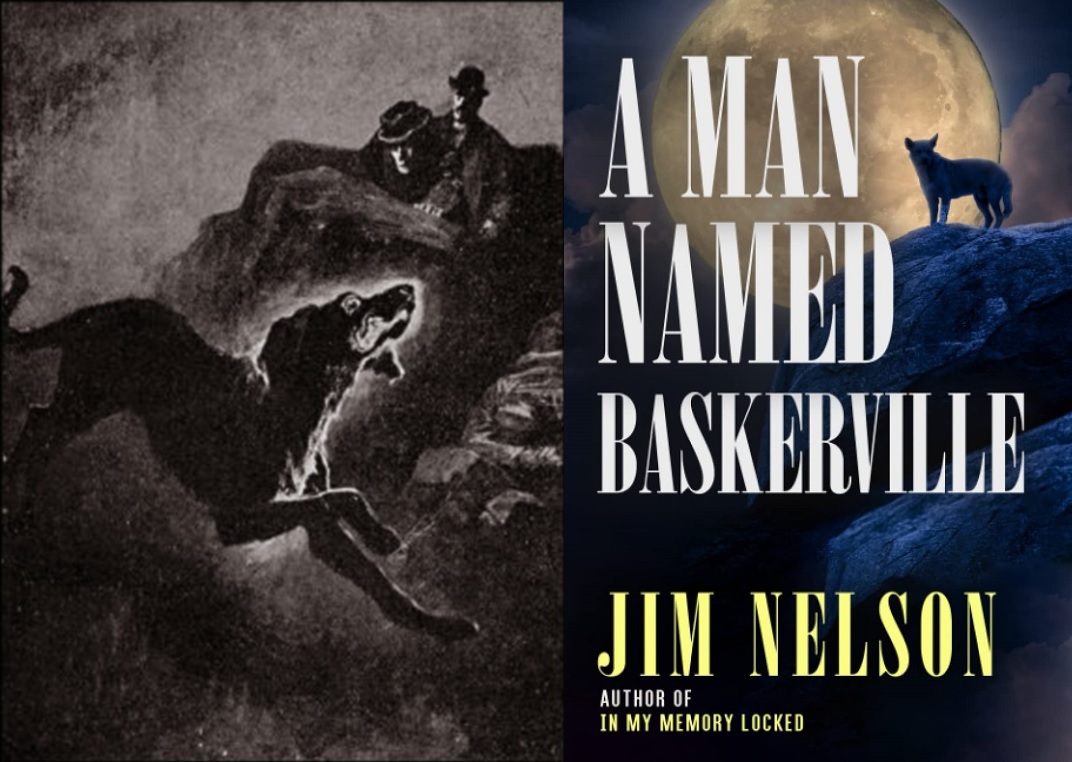
First edition cover of The Hound of the Baskervilles by Arthur Conan Doyle
First edition of The Hound of the Baskervilles

And that’s pretty much the case in The Hound of the Baskervilles. The perpetrator is one we hear precious little about, an absentminded collector of butterflies and moths named Jack Stapleton who lives with his sister (the nineteenth-century equivalent to rooming in your parents’ basement, apparently). He’s not the least elaborated-upon character in the book, but he is pictured as far removed from the crimes and the curse of the Baskervilles. When Holmes and Watson finally suspect his guilt, Doyle spends no time speculating on his motivations in favor of keeping the story moving at a brisk clip.

Doyle knew the reader would eventually demand to know why Stapleton posed under an assumed identity to murder his uncle in such a contrived way, and then attempt the same on his cousin. To sew things up, in Chapter 15, Watson calls on Holmes to explain the background of Jack Stapleton. Holmes launches into fourteen pages of exposition, a matter-of-fact recounting of Rodger’s life from the New World to Devonshire, England.

Much detail is omitted, of course, but Holmes’ reckoning of Rodger’s life is a far more plumbed-out biography than I think any reader expected. After all, Holmes could have simply stated, “He was raised abroad and returned to England to kill his uncle and claim his estate.” Yes, that could be worded more artfully, but Doyle stretched himself to fill in the blanks.

I don’t know why Doyle felt the need to so thoroughly detail Rodger Baskerville’s life. I’m not sure anyone does. In my research for A Man Named Baskerville, I never located a definitive answer to the question. Perhaps in Doyle’s papers, or in a complete treatise on his life and work, an answer may be found. Perhaps it was a modernist faith in the triumph of reason—all things must be explained that can be explained—that led Doyle to stretch himself, much as he uses many pages to lay out the backstory in A Study in Scarlet and some of his short stories.

What I do know is, reading those seemingly superfluous fourteen pages of Rodger’s life struck me as a kind of boggy sinkhole in the tale. It felt Arthur Conan Doyle had wanted to write two books, Rodger’s life story and The Hound of the Baskervilles. Unable or uninterested in writing the first, he wrote the latter and included a précis of the former in the final chapter.

Fascinated, I made copious notes of Holmes’ reckoning of Rodger’s life. Later, I transferred and organized them on my computer. A bell tinkled in my mind, a Pavlovian reaction all writers develop: Is there a novel here? I let the idea stew. Holmes’ reckoning might appear a rich vein to mine, but once I started digging, it might yield little more than a couple of small gems.

And how would readers react to Rodger as a main character? Yes, everyone says they like stories about villains—but too often those so-called villains are more like lovable rogues or bad boys with a soft spot. Was I trying to humanize Rodger Baskerville? That’s exactly what a novel does: It humanizes. Would it be a Victorian “Sympathy for the Devil”?

Maybe, I thought, I should just write the damn thing and see what comes out of the keyboard.

I made a private agreement with myself: I would not write yet another pastiche of Sherlock Holmes, of which there are plenty to pass around. The book would be told in Rodger’s voice and not in imitation of Doyle’s Watson. Of course, that didn’t excuse me from the challenges of writing a historical novel, which include diction, grammar, tone of voice, colloquialisms, and historical accuracy. Nor could I write such a book without featuring Holmes and Watson at some point.

Mostly, though, my doubts centered on originality. Certainly someone had executed on this idea since the publication of Doyle’s book. Internet searches yielded nothing of the sort.

It became a secret too juicy to keep to myself: In the final chapter of The Hound of the Baskervilles, Arthur Conan Doyle embedded a working outline for a novel—a rousing novel, in my estimation—that had been overlooked for over a century. It took me five years to set aside my private doubts and write it.

Yes, it was exhilarating to liberally borrow from a master’s synopsis and expand it into this novel. No, having said synopsis to work from did not make my job any easier.

When I planned A Man Named Baskerville, I failed to see how a man with Rodger’s background would not bring to Dartmoor one or more Central or South American dialects along with his impeccable upper-class English accent. He would also bring with him a rich and varied New World culture as his starting point of reference.

Once in England, around his neck would be the weight of several albatrosses: His father’s suspicious exile; his “ethnic” upbringing and foreign tongue; his lack of secure income; his marriage to a dusky woman most un-Anglo-Saxon. Only his upper-crust accent would save him. It would work in the British Isles like a charge card with no spending limit. After all, he didn’t merely fool the English into thinking he was one of them; he fooled them into thinking he was better than most of them.

Freud’s narcissism of small differences is an underappreciated observation of the continuing human condition. As long as people lift themselves up by cataloging their differences with outsiders, there will always be Rodger Baskervilles walking among us.

That’s why I wrote A Man Named Baskerville.

A MAN NAMED BASKERVILLE reviewed at My Murmuring Bones

A Man Named Baskerville by Jim Nelson

Viktorija over at My Murmuring Bones reviews A Man Named Baskerville as one of the last legs of the Escapist book tour. She offers an enthusiastic review of the book, and I’m more than grateful for it:

Nelson’s style is convincing and engaging, and places his novel firmly shoulder-to-shoulder with the Sherlock Holmes canon. The attention to detail and careful references to the established course of events are striking, and the character of Baskerville is portrayed with startling humanity. By far best of all is the way Baskerville refers to Holmes and Watson, and those passages are delightful to read.

This well-researched, carefully crafted, and absorbing read will delight mystery aficionados and Sherlock Holmes fans, and would very likely give Doyle himself immense joy, not least of all for the treatment of his storied detective. “It’s time someone said it,” he would surely exclaim.

I’m blushing! Check out the full review is at My Murmuring Bones, along with Viktorija’s other reviews of books and film.