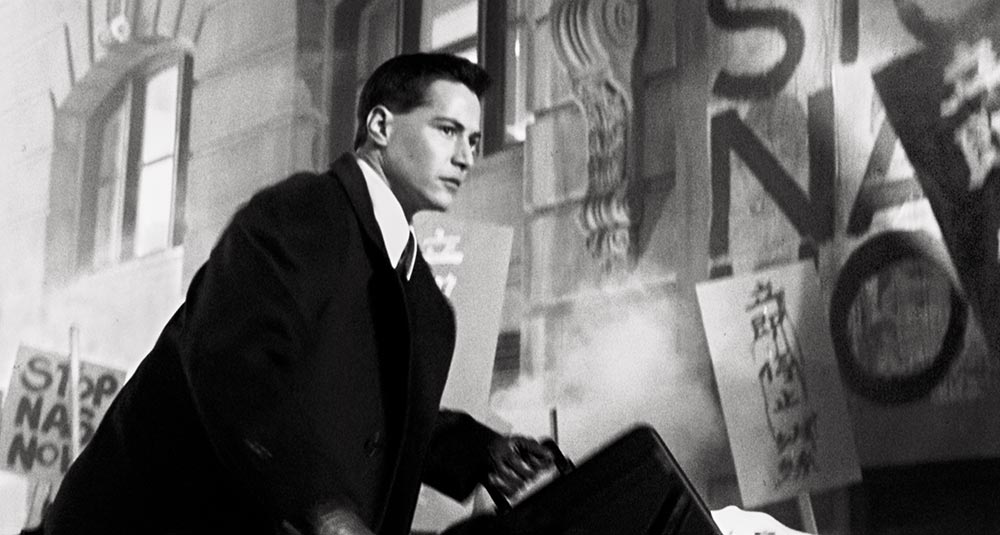
See the “Twenty Writers, Twenty Books” home page for more information on this series.
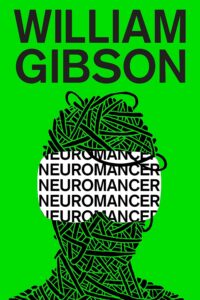
A year ago I asked a simple question: Will we finally see Neuromancer on the screen? This turned out to be an example of Betteridge’s Law of Headlines:
“Any headline that ends in a question mark can be answered by the word no.”
Honestly, I did not foresee this. The stories a year ago about an upcoming Apple TV+ adaptation of William Gibson’s masterpiece seemed more than promising. As I wrote:
The truly big news is that Neuromancer has a reasonable chance of being adapted to the screen. Apple TV+ may not be the leading force in streaming entertainment today, but it’s established a track record of producing high-quality material and taking some risks along the way. I know I sound like the eternal fanboy when I say this, but, “This time it might be real.”
I’m not an avid follower of the Hollywood sausage grinder. Perhaps the project is still being developed, or an incredibly secret production shoot is happening as I write this. All I know is, over the past twelve months I’ve occasionally tried Internet searches hoping to find some evidence of progress. So far: nothing.
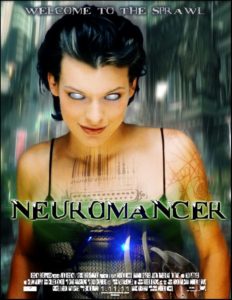
As I wrote last year, the number of failed starts on a Neuromancer adaptations are legion. The Wikipedia section on the topic does not do justice to the number of aborted starts reported over the years. Someone should make a gallery of fan-produced movie posters. Chalk up this latest disappointment as another virtual corpse to throw on the digital pyre. What’s a reader to do?
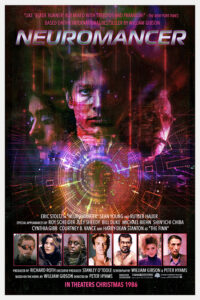
Here’s what you should do: Go and read the book. Don’t wait for a director’s vision, or a big-budget green light. Go straight to the source.
Neuromancer is marketed as Book One of the Sprawl Trilogy, a series which also encompasses Count Zero and Mona Lisa Overdrive. Gibson’s near-future Sprawl is also the setting of several of his earlier short stories, including “Johnny Mnemonic.” (Many of these stories are collected in Burning Chrome.) Thus, Gibson had the advantage of mapping out Neuromancer‘s territory well beforehand. It was in these early forays that he honed his subject and style, the street hustlers with colorful handles and underground operatives rewiring high-tech for subversive means.
The book centers on Case, a console jockey and professional hacker-for-hire. An entanglement with a prior employer has left him unable to connect to the virtual world of cyberspace, an analogue to our Internet that users connect to mentally, rather than via screen and keyboard. Crippled by this punishment, Case scrounges on the streets of Chiba City, Japan, living in coffin hotels and getting by trafficking in stolen tech.
His fortunes change when he meets Molly Millions, a punk street-smart mercenary who sports several body modifications and tech implants. (Molly wound up being a Gibson fan-favorite, and is featured in several other stories and novels.) She introduces Case to the shadowy Armitage, who offers to re-wire Case so he can enter cyberspace once more, on the condition he perform illegal hacking work against megacorporations and the military. Thus, the novel is many things at once: Future noir; a dystopic exploration of a decaying world saturated with computer technology; and, at its core, a heist tale.
Published in 1984, set in the 2030s, the novel has a couple of howlers, such as the protagonist trying to fence “three megabytes of hot RAM.” That was on the high-end of computer memory in PC-compatibles when I first read the book in 1988. Gibson later admitted he used the word “modem” without knowing what it meant. “I was working from the poetics of an emergent language,” he explained. These problems are not actually important and should be set aside.
While we’re setting aside the anachronisms, let’s also set aside some of the hype, such as William Gibson supposedly predicting the Internet (which he’s never claimed). A lot of people inside the technology community had foreseen the rise of a worldwide information network well before Gibson published. Believe it or not, some also predicted mobile, wearable, and even implanted computing devices. Once the early computer pioneers figured out how to connect two computers to exchange data, it wasn’t a great leap of imagination to picture the logical conclusion. (Engelbart’s 1968 “Mother of all Demos” wasn’t about mice and hypertext, but collapsing the distance between man and computing technology.)
Even Gibson has admitted that “wet tech”—direct-connecting a human brain to a computer—is probably a non-starter in our immediate future. And, whenever an interviewer has asked Gibson why he chose the 2030s to set his story, he’s always insisted that he was actually writing about the 1980s.
Instead, focus on Gibson’s imagery and rich settings. He took computers out of the realm of men in lab coats standing over coffin-sized boxes in dust-free rooms. He put tech on the street, in the pockets of skate punks, and the ears of all-night sushi line cooks. Phone phreakers and blue-boxing from the 70s and 80s—the early hacker cultures where the phone company was the dreaded megacorporation—offered Gibson a clear-cut model to scale up from. Instead of a single domineering power to #Resist, he described hundreds of megacorporations colluding to run the world. Instead of an obscure nerd subculture, he gave exotic tech to everyone, even folks sleeping on mattresses on rain-soaked streets. Neuromancer is a book set during a forever war between the haves and have-nots, and the battlefield is cyberspace. His work has a streak of the 70s computing counterculture, mirroring the early days of the Homebrew Computer Club, where small computers were not merely a technology, but liberation.
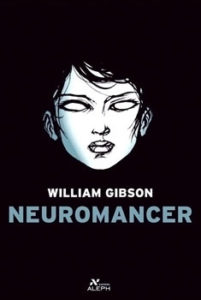
Focus too on Gibson’s language and linguistic style, which weaves the technobabble of computer programmers with Japanese idioms, creating a new kind of poetry. With that he builds the colorful Chandleresque prose of hard people doing hard things. To pull example passages from the first chapter, two of countless throughout the book:
Now he slept in the cheapest coffins, the ones nearest the port, beneath the quartz-halogen floods that lit the docks all night like vast stages; where you couldn’t see the lights of Tokyo for the glare of the television sky, not even the towering hologram logo of the Fuji Electric Company, and Tokyo Bay was a black expanse where gulls wheeled above drifting shoals of white styrofoam. Behind the port lay the city, factory domes dominated by the vast cubes of corporate arcologogies. Port and city were divided by a narrow borderland of older streets, an area with no official name. Night City, with Ninsei its heart. By day, the bars down Ninsei were shuttered and featureless, the neon dead, the holograms inert, waiting, under the poisoned silver sky.
And this:
He passed yakitori stands and massage parlors, a franchised coffee shop called Beautiful Girl, the electronic thunder of an arcade. He stepped out of the way to a let a dark-suited sarariman by, spotting the Mitsubishi–Genentech logo tattooed across the back of the man’s right hand.
Was it authentic? If that’s for real, he thought, he’s in for trouble. If it wasn’t, served him right. M-G employees above a certain level were implanted with advanced microprocessors that monitored mutagen levels in the bloodstream. Gear like that would get you rolled in Night City, rolled straight into a black clinic.
Gibson humanizes the exotic technology without the tedious tendency of other science fiction authors to try and explain it in a calm, reasonable fashion. Gibson understood that the arc of technology development is not a linear one based on orderly, rational, unified reasons. Technology is a mad haggis of vain attempts to solve particular problems, and much of that tech will conflict. (Anyone who tried to use an early wireless phone while microwaving popcorn will understand what I’m talking about.) There is no rational discourse in Gibson’s Sprawl. It’s a madhouse of loners, collectives, NGOs, bureaucrats, and corporations clamoring for their chunk of the digital pie—a situation that sounds quite familiar today.
His characters are at utter ease in the trappings of this disjointed world, and even a bit blasé about it. That three megabytes of hot RAM? It’s stored in a Hitachi deck. Once freed from his life in coffin hotels, Case stays in a luxurious Hilton drinking coffee from a Braun percolator. So often science fiction relies on defamiliarization (where technology familiar to the characters seem magical to us). Gibson reverses that polarity. He uses consumerism to his literary advantage, rather than to make some clumsy ironic comment the way DeLillo and David Foster Wallace feel the need to do.
Neuromancer also puts forth a fragmented society that is at odds with the other major science fiction dystopia, 1984. Contra Orwell’s totalitarian nightmare, Gibson lays out a world of emaciated nation-states muzzled by constipated corporate power and incestuous multi-billionaire families. There is no centralized Big Brother. Meanwhile, the population hides in the shadows, barters on the gray market, and, of course, jacks into cyberspace for fun and profit.
It’s a potent brew—one part hard-boiled cityscape noir, one part philosophical science fiction, and one part a pessimistic vision of unfettered capitalism’s endgame, all told in a gritty, poetic tongue that matches the rain-mirrored, neon-iridescent streets of Chiba City.
Don’t wait for the movie. Don’t wait for the streaming series. If you’ve not read Neuromancer recently, pick up a copy and read it again. And if you’ve not read it at all—what are you waiting for?