Touring the Golden Gate Park Commission Vault

Back in April of this year, I learned of the “Commission Vault Mini Museum” via SFGate.com, the online arm of the San Francisco Chronicle. I immediately booked a reservation to tour the museum, which is so backlogged, it takes month to get in. I only visited on July 9th, three months later.

The Commission in question the San Francisco Park Commission, which governs the city’s Recreation and Parks Department. The museum houses photographs and artifacts from the department’s century and a half tenure, which extends back to 1871.

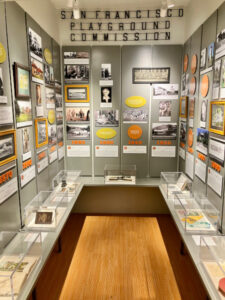
This must be one of the smallest museums on the West Coast—it’s housed inside a walk-in vault. The floor dimensions are perhaps twelve feet by four feet. It’s so compact only four or five people can comfortably stand in it at once. You begin to understand why open reservations are months out.

For me, the tour began when I entered the Commission’s headquarters, located at the eastern entrance to Golden Gate Park, inside McLaren Lodge. It was built in the late 19th century for John McLaren, the most famous and prominent superintendent of San Francisco’s Parks Department. The lodge not only served as offices for his staff, but was also home for him, his family, and personal staff. It was as though all 1,017 acres of Golden Gate Park was his personal backyard.
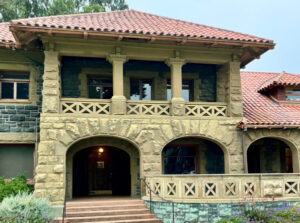
It’s a grand structure, with rustic stone exterior and rough columns and arches, topped with red clay roof tiles. Historian-in-residence Christopher Pollock told me it’s often described as a mixture of Mission Revival and Craftsman architecture, although at least one source dubbed it “Scottish Baronial.” It’s a fitting term for horticulturalist McLaren, who immigrated to America from Scotland in his youth, and was known in his later years as bearing a kind but kingly manner.

Either way, McLaren Lodge’s architecture is oddly familiar but strikingly unusual compared to San Francisco’s other architectural styles. It’s the kind of structure a Hollywood millionaire would build in the mountains near Lake Tahoe, or you read about in The Day of the Locust. In that sense, the lodge is uniquely Californian: A style evocative of another place or time, but not of any other time or place.

As a boomtown, early San Francisco had few public green spaces. The thousand-acre Golden Gate Park on the city’s west side was the solution. The first problem to be solved was the land itself. The acreage was barren and covered in windswept sand dunes blown eastward from the Pacific ocean. (No, really—check out some photos for yourself.)
McLaren and his predecessor William Hammond Hall spent decades terraforming this desolate stretch of wasteland into a woodland reserve, with rose gardens, rhododendron dells, groves of sequoias and Monterey cypress, and wide meadows of Kentucky bluegrass. For entertainment, McLaren installed lakes, fishing holes, lawn bowling courts, horse stables, and much more. Golden Gate Park was California’s first Disneyland, a theme park before there were theme parks, showcasing the state’s natural beauty.

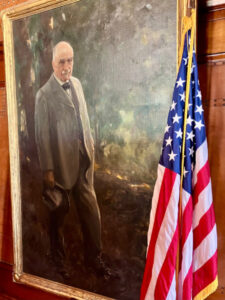
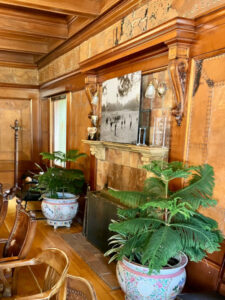
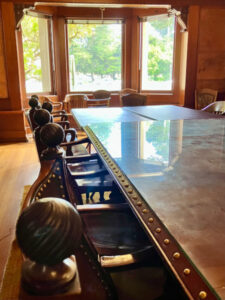
McLaren’s decades of devotion to building the greatest city park in the world, and the resulting grandeur, made him one of the most popular public servants in San Francisco history. The city amended its charter in order to appoint him Park Superintendent for life, a post he held for over four decades. The meeting room where the Vault Museum is found features a prominent portrait of McLaren, still overseeing the Commission’s agenda decades after his passing.
The vault & museum

The vault holding the museum was where the Commission originally stored cash and valuables, from a time when physical currency was more common for things like park permits and payroll. Later, the vault was cleared out and used for storage, which included several filing cabinets of paperwork. Those papers turned out to be historical documents unto themselves. They’re now stored at the San Francisco Public Library.
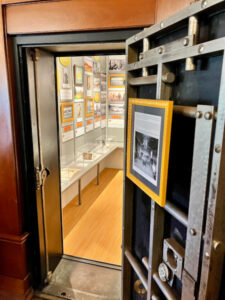
With the vault cleared out, the idea came to use it for a display of the Park’s history, which led to the creation of the Mini Museum.

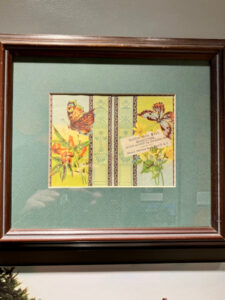
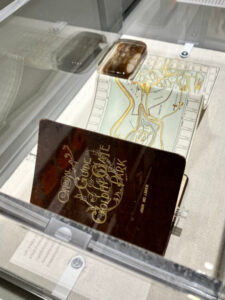
The Museum itself is a picturesque but brief travel through the decades of Golden Gate Park’s long life. Photographs of the early years show the sand dunes that had to be tamed by McLaren and Hall, as well as the cemeteries originally lining the northwestern border of the park. (Those graves would eventually be moved down the peninsula to Colma; some of the broken headstones would wind up lining the pathways and gutters in Buena Vista Park, a few blocks from McLaren Lodge.)

Each decade thereafter depicts the city’s and park’s development, recording the growing population and an increasing number of public parks throughout San Francisco. (One surprise for me: the nondescript Colombia Square, which I gave short shrift to in my “San Francisco streets with confusingly similar names” page, is actually one of the city’s earliest neighborhood parks.) The timeline also shows Golden Gate Park as a civic meeting place and cultural lodestone, such as when it hosted now-legendary rock acts in the late 1960s.
For over a hundred years, San Francisco has been known as a “city of hotels.” It’s also a city of museums and tours, mainstream as well as quirky, cool, odd, and now tiny. It’s hard to call the Commission Vault Mini Museum a must-see for visitors in town for only a few days. I do think it’s worth your while if you love San Francisco history—especially the history of its parks—and can line up a spot for an afternoon viewing. I wasn’t disappointed at all; I’m just unsure if my enthusiasm for Golden Gate Park’s history is widely shared.

Someone on the tour asked if they offered tours of McLaren Lodge itself, which apparently is under consideration. Combining a tour of the vault with a tour of house itself would make an afternoon visit a no-doubter.
No, they won’t get permission first

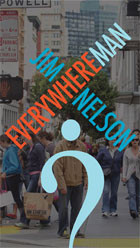
Cover of "Everywhere Man" by Jim Nelson

In 2011, I wrote a novella about a Silicon Valley startup that trains its virtual reality software from tourist photos it scrapes off the Internet. Millions of these photos are stitched together to create a virtual cable car ride across San Francisco.

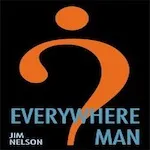
This story became Everywhere Man, which was also recorded as an audiobook that you listened to while riding the actual, real-life cable cars. It was one of several literary tours that Oakland-based Invisible City Audio Tours offered. Their idea was to see cities through the lens of literature, and not as a mere collection of landmarks and commercial sights.

During the development of the book, Invisible City’s publisher asked me: “Wouldn’t the startup need to get permission from the people who took the photos?”

Fourteen years later, we’ve received the answer to her question: “Yes, they should get copyright permission. No, they won’t do that, though.”

Of course, today the startups in question are not producing virtual reality tours. They are AI companies feeding massive amounts of copyrighted data into their Language Learning Models (LLMs), which in turn powers their artificial intelligence behemoths—Chat GPT, Claude, Grok, and so forth.

And just like my fictional Silicon Valley startup, these AI companies are being challenged in regard to their use of intellectual property. Shouldn’t these companies have to get copyright permission before using creative works to build their software?

The answer, predictably, is that they don’t believe they need to:

  • Nick Clegg, former executive for Meta (Facebook): Asking artists’ permission before AI companies scrape copyrighted content will “basically kill the AI industry in this country overnight.”
  • In a statement from Open AI, the creators of Chat GPT, they assert “the federal government can both secure Americans’ freedom to learn from AI and avoid forfeiting our AI lead to the [People’s Republic of China] by preserving American AI models’ ability to learn from copyrighted material.”
  • Meanwhile, “OpenAI and Google are pushing the US government to allow their AI models to train on copyrighted material. Both companies outlined their stances in proposals published this week, with OpenAI arguing that applying fair use protections to AI ‘is a matter of national security.'”

It’s not even a matter of asking permission at this point—these companies have already trained their LLMs with copyrighted material and made their AI available to the public. Their earliest defense was that training on copyrighted material was “transformational” and covered as Fair Use. Later they began to frame the argument as a matter of national security. (OpenAI is particularly prone to this claim.) At some point, they’ve all stated publicly, in so many words, that needing to obtain permission from content creators would destroy their business model. (In Nick Clegg’s case, it’s not even so many words. He came right out and stated it.)

Facebook went so far as to use a massive database of flagrantly pirated texts (called LibGen) to train its AI. An internal company document reveals that they kept the source of their texts secret because “if there is media coverage suggesting we have used a dataset we know to be pirated, such as LibGen, this may undermine our negotiating position with regulators on these issues.”

The Atlantic has helpfully produced a searchable database to see if an author’s work was included among LibGen’s trove of pirated texts. Sure enough, three of my books are in the set: Bridge Daughter, Hagar’s Mother, and—you guessed it—Everywhere Man, a book about a Silicon Valley company using stolen intellectual property to train their software.

There is a familiar smell about all of this. In a recent video on typeface piracy (a practice which goes back hundreds of years), designer Linus Boman observes “every time there is a massive technological shift, intellectual property rights suddenly, and very conveniently, become a blind spot. … Is it only considered piracy if the people who do it lack resources and respectability?” Apparently so.


Maybe it’s time to stop telling ourselves that AI will never produce a passable novel, song, or movie—that AI lacks the fiery human spirit to produce creative work of value. Maybe we should concede that AI is more than capable of producing better-than-mediocre works of art.

The open market tells us this is the case. Writers have been caught using AI to produce tens, even hundreds, of novels, all profitable bestsellers with attentive and loyal fan bases. The reason this is true is that AI is a master of imitating others’ work.

Couldn’t an AI be trained only with public domain texts published on or before 1929, the current cut-off point for copyright protection in the United States? Well, it could, but then all those romance novels it produced would read like Jane Eyre and Wuthering Heights. That’s not going to sell many copies.

AI has practical, world-bettering applications in the sciences, healthcare/medicine, mathematics, and beyond. I’m not arguing against AI as a general technology. But it seems all avenues of creating works with AI leads to less-than-optimal market conditions for AI companies and their users if copyright protections are upheld. Why, though, do their short-term profit margins suddenly erase basic copyright law, a legal concept that goes back to the time of Shakespeare?

Ask yourself: Are you better off reading AI-generated novels? Or listening to AI-produced music, or watching AI-generated movies? I see no evidence that AI-produced work is being sold at a lower price than human-generated content, or offering a better experience. What’s in it for me? Lower-quality mass-produced books sold at the same or higher price than before? How is this progress?

Alternate cover of "Everywhere Man" by Jim Nelson

Bikes to Books Spring 2020 virtual tour

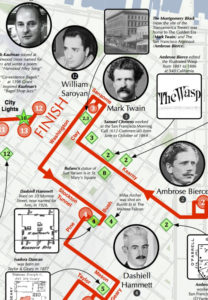
Bikes to Books is a literary bike tour of San Francisco—grab a bike, follow the map, and learn a little about San Francisco’s rich literary history. The tour starts at Jack London Alley and ends at Jack Kerouac Alley, on the way passing all twelve streets named after San Francisco writers. It’s designed to be taken individually or, twice a year in a group led by @enkohl and @burrito_justice.

This spring, for reasons you’ve probably heard about, the bike ride will be done virtually on Twitter rather than in a large group. I’ll be joining the tour this Saturday, live tweeting about the author I read at Bike to Book’s inauguration, Frank Norris (McTeague).

No bike required, no bike helmet required, and no mask required. Join in on Twitter and follow the #BikesToBooks hash tag as @enkohl, @burrito_justice, and more local writers and artists join in reminiscing and reporting on some of the authors that made San Francisco the city it is today.

The virtual ride starts Saturday, May 2nd, from 1pm to 3pm. For more information, check out the announcement at Burrito Justice.

On Don Herron’s Fritz Leiber Tour

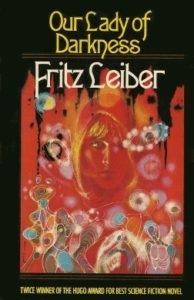
Our Lady of Darkness by Fritz LeiberSaturday I had the pleasure to take Don Herron’s Fritz Leiber Tour. Like his more famous Dashiell Hammett Tour, Herron recreates through personal research, recollection, and local points-of-interest Leiber’s life story and the circumstances that led him to spending his last years in San Francisco.

My attendance in the tour was accidental. In October, while talking with Nicole Gluckstern after the conclusion of the Bikes to Books Tour, I mentioned what can only be called a minor parallel in my life with Fritz Leiber’s, and how I’d been meaning for years now to learn more about this prolific author. Nicole told me she was in talks with Don Herron to have him lead a one-off, by-invite-only Fritz Leiber Tour. I eagerly jumped when she asked if I wanted to attend.

Leiber’s life defies a summary in brief. The child of actor parents (his father appeared in a number of early Hollywood productions), Leiber developed an avid readership over a career of decades with his wide-ranging work—science fiction, fantasy, sword-and-sorcery, horror & the occult, and more. In addition to experience in theater and acting, Leiber was an amateur astronomer and one-time editor of Science Digest, making him the rare science fiction writer with an actual background in science.

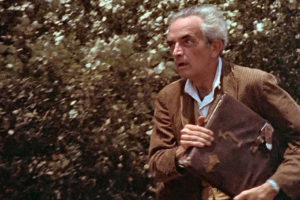
Fritz Leiber as Dr. Arthur Waterman in Equinox: Journey into the Supernatural (1965 or 1966). Will Hart, (CC BY 2.0)

Fritz Leiber as Dr. Arthur Waterman in Equinox: Journey into the Supernatural (1965 or 1966). Still by Will Hart (CC BY 2.0)

As a child and young man, I was familiar with Leiber through his science-fiction short stories (although I don’t recall reading any of his novels). His stories were featured in “best of” collections and back issues of science fiction magazines I dug out of dusty cartons in Livermore’s public library.

Then, via Dungeons & Dragons, I learned of a swords-and-sorcery series featuring Fafhrd and the Gray Mouser, a duo comprised of an oversized swordsman and a diminutive thief. When I saw this series was penned by someone named Fritz Leiber, I distinctly recall thinking, “What a coincidence—there’s a science-fiction writer with the same name.” No coincidence, it turns out. (According to Herron, Leiber coined the phrase “sword-and-sorcery.”)

A personal friend of Leiber and his second wife, Herron is a fount of history and insight into this prolific author. Much like his Hammett tour, Herron led us down and around Geary Street and the Tenderloin (names which might ring familiar to readers of Bridge Daughter). Then we boarded MUNI and trekked up to Corona Heights (and its stunning views of the city) in the Castro District. All locations have some connection to Leiber and his semi-autobiographical Our Lady of Darkness. It’s a Lovecraftian novel that takes place in 1970s San Francisco whose main character endures a battle with the bottle and grief over the death of his wife, just as Leiber was undergoing at the time.

I hope Herron considers permanently reviving the Fritz Leiber tour—but I suspect the only way that would happen is if there was a strong revival of interest in Leiber himself. Personally, I’ve already added Our Lady of Darkness to my reading list, and I plan on searching out more of his work.

About that parallel

When I earlier claimed a parallel with Leiber’s life, I should explain. I don’t mean some personal connection with the author or his work, only that Leiber wrote about an event in his life that rang similar to one of my own.

Eight years ago, after going through what can only be called a divorce immediately followed by a second relationship gone sour, my trials culminated with me busting up my shoulder in a bad accident. I severed all the tendons there, leaving me with a separated shoulder. (To this day it looks like I have “two” shoulder bones.)

I found myself bedridden for six weeks and unable to move my right arm. Day and night I consumed painkillers, delivery Chinese food, and—unwisely—whiskey. (I wrote about this episode for We Still Like‘s “Gravity” issue, a piece titled “Taylor & Redding”.) I spent my time in my apartment, alone, absorbed with Miles Davis and Cal Tjader. I spent my less stuporous hours reading whatever I could get my hands on. In particular, I located at the library a thick collection of Dashiell Hammett’s Continental Op stories, which I consumed cover-to-cover.

To keep from going stir-crazy, I took long walks up and down Nob Hill and through the Tenderloin, often at odd hours of night. Due to the painkillers, sleep was varied and sporadic. Some of these walks were as late as three in the morning, when the insomnia was too much to bear.

On these walks I discovered locations and buildings named in Hammett’s work, all mere blocks from my Geary Street apartment. The old part of San Francisco is rife with short streets and dead-end alleys, too insignificant to be incidentally included in a story for local flavor, yet Hammett would feature them prominently in his work. These names did not come off a map or phone directory, these were streets intimate to Hammett, a writer obsessed with specifics and verisimilitude. Some of the Continental Op’s stories are set in Chinatown. It got so I went out of my way to seek them out.

Humphrey Bogart and "the dingus." (CC BY-SA 2.0)

Humphrey Bogart and “the dingus.” (CC BY-SA 2.0)

This led me to reread Hammett’s The Maltese Falcon (which I’ve written about not just once but twice). There, in this single detective novel, I re-experienced in concentrate everything I’d experienced the prior weeks poring over the Continental Op stories. In The Maltese Falcon Sam Spade walks streets I walked every night, attends theaters down the block from my apartment, eats at restaurants still in operation. Sam Spade, living and breathing in San Francisco circa 2008. My front stoop was backdrop and stage for this classic of American literature.

It’s not merely the rush of casual literary association—similar to the rush of meeting a celebrity—that overwhelmed me. Details of the novel easily overlooked snapped into clear focus. That gunman Thursby is shacked up at Geary & Leavenworth suggests he’s residing on the hairy edge of the Tenderloin, an area rife with flophouses, while the supposedly-delicate Brigid O’Shaughnessy rooms on posh California Street. Sam Spade rides streetcars up and down Geary Street, a notion that defies imagination, as Geary in downtown San Francisco is narrower than the suburban lane I grew up riding my bike on. (The Geary streetcars were known as “Iron Monsters” and phased out in 1956 to make way for America’s love affair with automobiles.)

I’d been forced to move to Geary Street a few years earlier due to a bad break-up and the meager income I drew, living paycheck-to-paycheck tending bar. I wasn’t happy to reside a stone’s throw from the Tenderloin, infamous as San Francisco’s seediest neighborhood. It’s not—there’s a dignity in the TL easily overlooked—and Hammett’s work gave me a second sight, another way of reading my surroundings, and with it came another way to see my own circumstances. I say without qualification, Dashiell Hammett’s writings carried me through one of my lowest periods of my life.

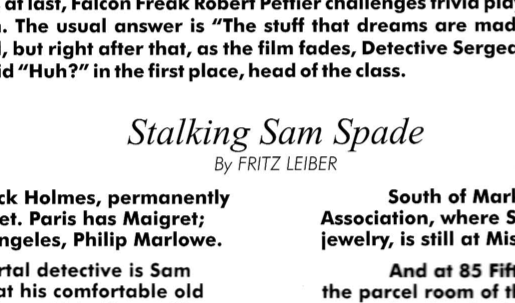
Some time after my recovery—personal and monetary fortunes on the rise—I sat at the bar of John’s Grill in Union Square nursing a drink and waiting for my dinner to arrive. (“Jack LaLanne’s Favorite Salad”—a cold seafood salad with avocado slices, pure protein and fat.) On the back of the menu I found a newspaper article the restaurant had reprinted, “Stalking Sam Spade” written by one Fritz Leiber.

And I distinctly recall thinking, “That’s funny…there was a science fiction writer with that name.”

Stalking Sam Spade

Light reading while waiting for your steak medium-rare at John’s Grill.

After Leiber snapped out of the grief over his wife’s death and started drying up, he too rediscovered the city he lived in by reading it through Hammett’s lens. Geary Street, he wrote, is the “spine” of The Maltese Falcon, and he set out to locate its landmarks much as I’d attempted myself. Leiber was more organized about the project than I ever was, and “Stalking Sam Spade” does a much better job detailing his discoveries. Learning about San Francisco’s past through a detective novel led him to search for the history of the apartment house he lived in, culminating in his building becoming the nexus of Our Lady of Darkness.

Perhaps the allure of “rediscovering” a city through literature is not unique to San Francisco, but it’s certainly an active and avid pastime here. While some people move to San Francisco solely concerned about which address is currently beau chic or which nightspots are ripe for seeing-and-being-seen, I’ve encountered just as many who’ve found themselves ensnared in this game, the game I played those sleepless nights. It’s much as the Baker Street Irregulars “play the game” retracing Sherlock Holmes’ footprints as though he’d lived and breathed. With each step of the game comes the chill of revelation, the buzzing realization you’re walking the streets Hammett, Kerouac, Frank Norris, and others once trod daily. Each San Francisco writer is inspired in very different ways by the same city—a city that reinvents itself every generation, granting each artist who lands here a bed of fresh soil to sow and till. Some waste it, some fail to tend their seedlings. Others grow oak trees still standing today.

As Herron pointed out on our tour, Leiber got one fact wrong in “Stalking Sam Spade”: Spade’s apartment was most likely at Post & Hyde (not Geary & Hyde), the same location as Hammett’s apartment when he lived in San Francisco. A landmark plaque is on that building today, just as there is one at Burritt Alley—the location of the first murder in The Maltese Falcon—a plaque that did not exist when Leiber wrote his article.

Photo by Parker Higgins

Photo by Parker Higgins (CC0)

Another plaque that did not exist at that time is today placed on the Hotel Union at 811 Geary Street. It’s dedicated to Fritz Leiber and the book he wrote while drying up there, Our Lady of Darkness, a book inspired by his quest to re-walk the chapters of Hammett’s San Francisco and see the world anew.

Learn more about Don Herron’s tours and books at donherron.com

Status

Bikes to Books across San Francisco this Sunday

Bikes to BooksThis week marks the third anniversary of Bikes to Books, a self-guided bicycle tour of San Francisco’s literary history. Created by Burrito Justice and journalist Nicole Gluckstern, the seven-mile tour stops at every street in San Francisco named after a famed local author.

This Sunday (October 9th), as part of the LitCrawl festival, Nicole and Burrito Justice will be leading the tour themselves. They’ve arranged for live readings of the respective authors’ works at each stop along the way. The tour starts at 12:45pm at Jack London Alley and ends at 4pm at Jack Kerouac Alley in North Beach.

I’m honored to be one of the local writers reading an excerpt on the tour. I’ll be at Frank Norris St. (in Polk Gulch) reading a selection from his masterpiece McTeague, then joining the after-party at Vesuvio’s at 4pm.

So, if you’re in San Francisco, join the tour or just show up at Vesuvio’s to meet and chat with a lot of local authors and readers who love this city’s rich literary history. Cheers!

More information on Bikes to Books can be found at Burrito Justice and the LitCrawl web site.