Alas, Kindle Press took a pass on Hagar’s Mother (although their editors did pass on to me some rather complimentary and constructive comments).
No matter—I’ll be putting together Hagar’s Mother on my own and publish it soon on Amazon in both Kindle and paperback editions. Keep watching this space (and/or my Facebook and Twitter feeds) for news and updates.
Thank you for your support and patience with me over the past month during the Kindle Scout campaign. Book Two of the Bridge Daughter Cycle is on its way!
I’ll be leading a Q&A on Bookies’ Facebook page this Monday, October 2nd, from 5pm to 7pm (Pacific time). The event is part of Bookies’ #Authorberfest, their yearly October event giving independent authors a chance to meet readers and answer their questions.
This year I will be discussing Bridge Daughter and its upcoming sequel, Hagar’s Mother. I’m also working on a giveaway as part of the Q&A, so come and check it out!
More information about the event is on my Facebook page. Learn more about #Authorberfest at Bookies. If you like and share their announcement, you’ll be entered in a drawing to receive a $10 Amazon gift card.
If you’ve not nominated it yet, your last chance is Sunday, October 1st. Visit the campaign page and vote before it’s too late! At the campaign page you’ll have a chance to learn more about the book, download an excerpt, and read about its background.
And if Amazon selects the book for publication, you’ll receive a free digital copy.
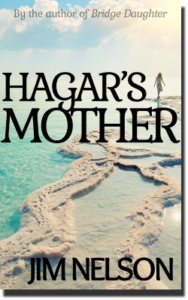
New cover
If you nominated Hagar’s Mother earlier this month, you probably noticed the cover changed. The decision was mine and is purely cosmetic. Two weeks ago I decided to shake things up and offer readers a better idea of the book’s focus and subject matter.
Will I stick with the new cover in the final book? I’m not sure yet. I like the old one. It has a distant, almost whimsical feel to it, but am concerned that’s not the right message to convey.
At this moment, I’m simply eager to cross the finish line and hear back from Amazon their decision. Either way, I’m looking forward to getting the book into reader’s hands.
I’m pleased to announce that Hagar’s Mother, the sequel to Bridge Daughter, is now seeking nominations on Kindle Scout!
Amazon’s Kindle Scout program allows for readers like you to preview and evaluate unpublished books. Your nomination acts as a vote for Kindle Press editors to select the books you like.
If Hagar’s Mother receives enough nominations over the next 30 days, Amazon will publish and promote it across their site.
What’s more, if you vote for Hagar’s Mother and it’s published, you’ll receive a free digital copy! It costs nothing to vote and takes no more than a minute of your time.
Many people have been asking me about the follow-up to Bridge Daughter…I’ve been pretty tight-lipped about the project, but did want to share that I finished the final draft tonight.
Hagar’s Mother clocks in around 90,000 words. It’s a not-quite-direct sequel, in the sense that the events of the book take place a generation later than Bridge Daughter. The history of bridge daughters is explored further as well as the story of Hanna’s family.
Quite exhausted at the moment. I have high hopes for this book. Wish me luck! More news coming soon.
Modern mystery fiction has supplanted 19th-century American regional literature, sometimes known as “writing of local color,” as its dominant form.
Regionalism is most strongly associated with Southern writers, such as Kate Chopin and Joel Chandler Harris. After the American Civil War, local color writing sprung up all over the country. Charlotte Perkins Gilman (“The Yellow Wallpaper”) cataloged New England’s parochialism, while Bret Harte wrote roaring tales set California’s gold country.
(Scholars make distinctions between the terms “regional literature” and “writing of local color,” but I’ll use them interchangeably here.)
Regionalism in American writing faded after the turn of the century, replaced with a more consensus-based literature. Perhaps the twin rise of mass literacy and mass media contributed to regionalism’s fade, although it did not go extinct. Faulkner and Jean Toomer wrote well into the 20th century, and wrote using techniques that would have been foreign to the earlier regional writers, but their fiction is unmistakably grounded in regionalism.
But did regionalism truly fade away? Or was it replaced by something else?
It seems to me that mystery fiction quietly—almost subversively—filled in regionalism’s absence. Every major city in America is host to at least one major crime or detective writer, from Seattle (Aaron Elkins, G. M. Ford) to Boston (Robert Parker, Dennis Lehane) to Chicago (Sara Paretsky) to New Orleans (James Lee Burke), all representing their respective locales through their work. Name almost any place in America today and you’ll find crime writers prowling its dark corners. In the process, they’re introducing the region’s colors and textures to a national audience.
More than any other form of fiction today, mystery is concerned with a grounded setting. Science fiction has almost no restrictions when it comes to setting. Fantasy explicitly takes place elsewhere than the here and now, otherwise it’s not fantasy. Romance fiction has setting too, but its concerns are before the fireplace and in the bedroom.
Even contemporary American literature—”fiction of literary intent,” or so-called slice-of-life realism—is not as connected to setting as mystery fiction. Too often stories printed in the small literary magazines feel as though they could take place in any city or suburb or small farm, so long as the backdrop suits the characters and their emotional arcs.
Perhaps the only other form of American fiction so strongly tied to setting is the Western, a genre that, not coincidentally, shares much in common with the American mystery, particularly the private eye genre.
I’m not saying other forms of fiction don’t possess a setting, or that they don’t concern themselves with setting. I’m saying that, for the form as a whole, mystery adopts a priority for regions—regionalism—other forms do not.
In mystery, scenes unfold on streets with recognizable names, at bars with histories, in towns you can find on a map. A great modern mystery reads like a travelogue. The American mystery has a tradition of hewing to real-world settings, such as the streets of Nob Hill in Hammett’s stories and novels. Ed McBain’s “87th Precinct” police procedurals take place in a fictional New York City borough, but it’s the Big Apple all the same. Sue Grafton’s stand-in for Santa Barbara (“Santa Teresa”) is so Southern California, you can imagine The Eagles cutting a single about it.
This, I say, is the New American Regionalism. Mystery writers delight in bringing alive their surroundings. Local color means local characters and local charm. Look at what stylist Elmore Leonard does so expertly in his Florida novels, capturing all the facets of dialects and cultures in Miami. The Encyclopedia Britannica’s entry of local color emphasizes “the features and peculiarities of a particular locality and its inhabitants.” This fits Florida crime writing to a T, with an emphasis on the peculiarities and particulars of the genre’s always-colorful cast of characters (Leonard, Carl Hiaasen, Edna Buchanan).
My first inkling of the connection between regional writing and mysteries came to me twenty-five years ago, while living in San Luis Obispo, California. An ever-reliable bookstore there stocked a case of local writers, including several mystery series. Perusing the back cover blurbs, it was apparent the writers had mined the peculiarities and particulars of San Luis Obispo County for all it had to offer. My cynical younger self found it ludicrous, these over-boiled private eyes and steely Lt. Detectives walking the mean streets of San Luis Obispo, a place ranked “one of the happiest cities on Earth.”
Over the years I’ve lightened up. I came to realize the mystery writers of SLO Town were merely doing what all regional writers have done in America: Explore, critique, and celebrate they places they live.

 Alas, Kindle Press took a pass on Hagar’s Mother (although their editors did pass on to me some rather complimentary and constructive comments).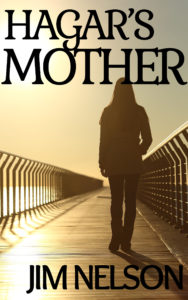
 Will I stick with the new cover in the final book? I’m not sure yet. I like the old one. It has a distant, almost whimsical feel to it, but am concerned that’s not the right message to convey.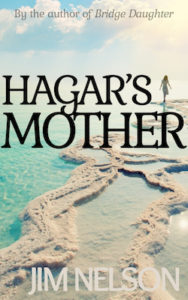
 Many people have been asking me about the follow-up to