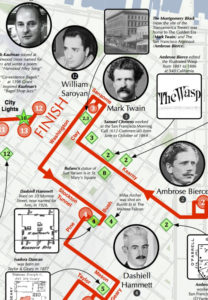
Bikes to Books is a literary bike tour of San Francisco—grab a bike, follow the map, and learn a little about San Francisco’s rich literary history. The tour starts at Jack London Alley and ends at Jack Kerouac Alley, on the way passing all twelve streets named after San Francisco writers. It’s designed to be taken individually or, twice a year in a group led by @enkohl and @burrito_justice.
This spring, for reasons you’ve probably heard about, the bike ride will be done virtually on Twitter rather than in a large group. I’ll be joining the tour this Saturday, live tweeting about the author I read at Bike to Book’s inauguration, Frank Norris (McTeague).
No bike required, no bike helmet required, and no mask required. Join in on Twitter and follow the #BikesToBooks hash tag as @enkohl, @burrito_justice, and more local writers and artists join in reminiscing and reporting on some of the authors that made San Francisco the city it is today.
The virtual ride starts Saturday, May 2nd, from 1pm to 3pm. For more information, check out the announcement at Burrito Justice.
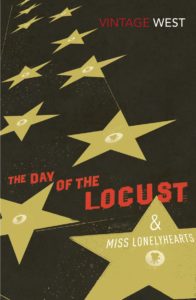
The Day of the Locust‘s reputation as greatest of all time is earned. The opening chapter may be the finest three pages ever written on the absurdities and contradictions of Southern California. Throughout the book, with disgust (and a portion of glee), West holds up for display Hollywood’s winners, as well as the legions of desperate outsiders shut out of Hollywood’s dream factory—those “who came to California to die.” There is plenty of foreshadowing of the novel’s conclusion, yet when the finale arrives it manages to surprise and shock without coming off as a twist ending. It’s not so much a novel about Hollywood, but a novel about those standing on their tiptoes to look over the fence and steal a peek of Hollywood.
West was a New Yorker transplanted to Los Angeles, and his alien status is confirmed on every page. Los Angeles architecture is almost always described as though written with quotation marks. A house is “Spanish” or “New England” or “Moorish.” Hollywood debauchery is not so much of the Playboy Mansion variety, or even Roman bacchanalia. It’s just cheap and pathetic. The airing of a French farce in a Sunset Boulevard cathouse may be the least erotic description of pornography on record. Simulacrums of decadence are mistaken for actual decadence, such as a horse hooves-up at the bottom of a swimming pool during an open-air cocktail party. (No fear, it’s a rubber prop.) California’s artifice, inauthenticity, and halfhearted stabs at opulence are the brick-and-mortar of Locust‘s plot. The first chapter ends noting “Few things are sadder than the truly monstrous,” which may as well be the novel’s thesis statement.
Scene after scene, West lays down an unsparing case damning Hollywood’s emptiness the way a district attorney builds a point-by-point case for the death penalty—but where is the Lot character who escapes the city’s inevitable downfall? West’s ship of fools are uniformly impotent and ineffective. As with West’s other gem, Miss Lonelyhearts, there is little to root for here.
Nathanael West
W. H. Auden identified “West’s Disease” as “a disease of consciousness which renders it incapable of converting wishes into desires.” In Auden’s formulation, wishes are whimsical and ethereal (“I wish I was a movie star”). Actual desire motivates the individual into action: “I’m going to enroll in acting classes and practice three hours a day.” (I’ve written more deeply about “West’s Disease” and W. H. Auden.)
Hollywood’s success as a dream factory is predicated on knowing our wishes and actualizing them on the silver screen. That’s why Hollywood appears a tantalizing cure for West’s Disease. Its siren song drew the characters to California from the humdrum Midwest and the frosty East Coast. Even if West’s misfits could muster up the energy and exert the effort to try and make it big, Hollywood’s antibodies would swarm to keep these ineffectuals distanced from the beautiful, powerful, and well-connected. Besides, Hollywood only depicts desires. It never actually fulfills them. There’s more than a few reasons West’s original title was The Cheated.
The Day of the Locust‘s Hollywood adaptation’s garish movie poster
This inability to generate true desire makes the characters of Locust torpid and submissive. It’s why the book’s finale is so shocking: The characters finally shake off their doldrums, convert whimsical wishes to primal, savage desires—and then act on them. The raw energy of the final pages is all the more pronounced when compared to the impotence of the preceding chapters.
(The movie adaptation of Locust has been called a horror film in disguise. West’s grotesque and helpless characters are a mere audience to their own slide into destruction. This and the suppressed violence released orgasmically in the finale lines up with many horror film tropes.)
Much of The Day of the Locust is based on Nathanael West’s experiences in Los Angeles churning out film noir and adventure screenplays for Republic Productions (known as “Repulsive Productions” among Hollywood insiders; biographer Marion Meade refers to the studio as “Cheapsville.”) His produced scripts were marginally successful. His novels fared considerably less well, at least, in his lifetime.
West’s fortune seemed to be turning around right before he and his new bride were killed in an auto accident. West wasn’t exactly martyrized, but his writer associates did see to it to spread word of his genius. Budd Schulberg praised The Day of the Locust as capturing how “the orgiastic crowd, loving you this moment, destroying you the next, is the very essence of Hollywood—as Hollywood may be the essence of our success-driven culture.” That is to say, Hollywood may be the most American of American industries.
Let’s lay down the ground rules. A Hollywood novel is
a book-length single work of fiction,
regards the American film or TV industry, and
is set in or around Los Angeles, California.
The Hollywood novel should not be confused with the Los Angeles novel, which may be set in similar locations but is not primarily concerned with the film industry. This includes almost all of John Fante’s work (Ask the Dust).
Also eliminated are autobiographies like Robert Towne’s The Kid Stays in the Picture and Julia Phillips’ You’ll Never Eat Lunch in this Town Again, both entirely about the Hollywood film industry and both reportedly nonfiction.
And, sadly, my first rule eliminates Fitzgerald’s superb The Pat Hobby Stories as it’s a story collection, not a novel. (Otherwise, these are some of the finest, and funniest, stories ever produced about Hollywood.)
Wikipedia offers a rather lengthy list of Hollywood novels. Obviously I’ve not read them all, and so the list that follows is not the hands-down decision on the Greatest of All Time, but is a healthy representation of the form.
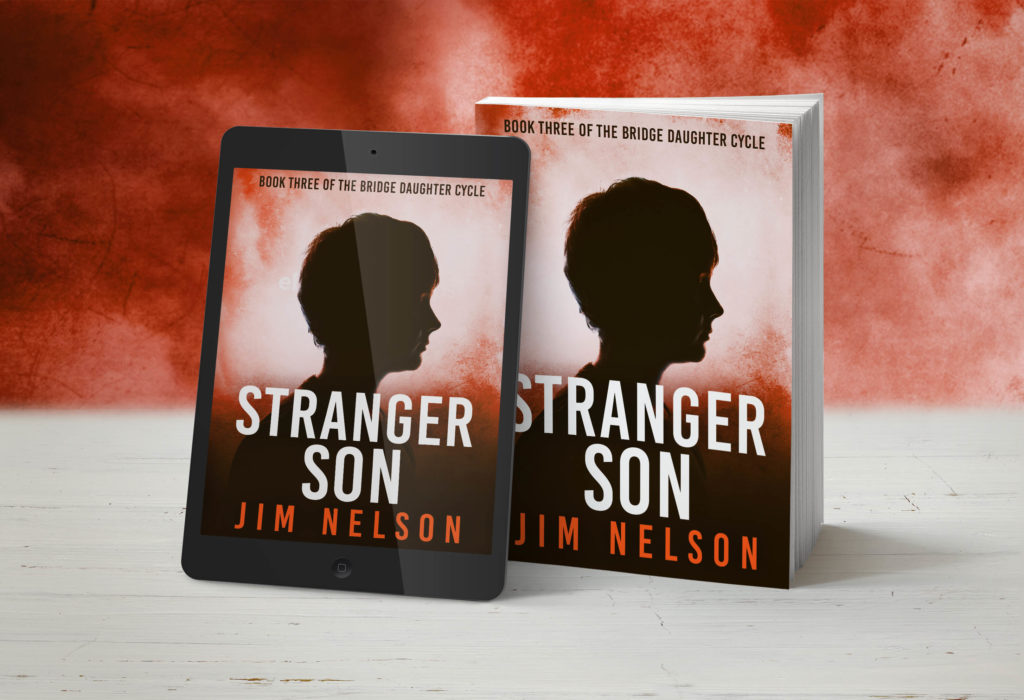
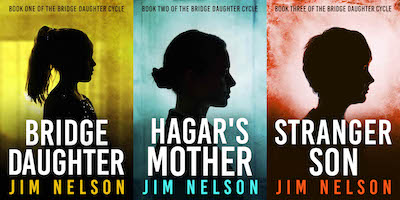
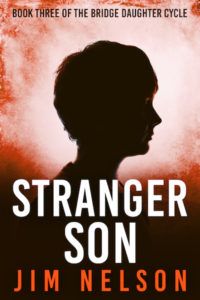
On sale now—STRANGER SON, the third book in the Bridge Daughter Cycle!
STRANGER SON picks up sixteen years after the events of Hagar’s Mother.
Ruby Driscoll is now a Hagar living on the streets and halfway homes
of Southern California. When she was thirteen, her mother was sent to
prison while her younger brother was put up for adoption. Now
twenty-nine and facing her biological mortality, she wants to right a
wrong.
Desperate to locate her brother and reunite her family, Ruby begins
an arduous journey into the heart of her family’s deepest secrets. The
search takes her from Los Angeles to the wealthy enclaves of
California’s Central Coast to the rugged heart of Jefferson, America’s
fifty-first state.
The Kindle edition is priced at 99¢ for only a short time, so order now. Kindle Unlimited subscribers can read STRANGER SON immediately. Paperback edition now available as well!
A Hindu Rakshasa re-imagined in D&D’s Monster Manual
When I was a teen and enamored with Dungeons & Dragons, one treasure I discovered poring over the rules books was Appendix N of the Dungeon Masters Guide. D&D co-creator Gary Gygax lists nearly thirty pulp and genre writers as major influences on the development of the game. “Upon such a base I built my interest in fantasy,” Gygax wrote, “being an avid reader of all science fiction and fantasy literature since 1950.”
In the early 1970s, Gygax and Dave Arneson harvested genre and pulp fiction to invent a new game, one that felt oddly familiar yet unlike any other experience. If “a book is a pocket or portable dreamweaver,” then Gygax and Arneson systematized that dream with charts and rules and catalogs. They took the dream off the paperback page and put it on the tabletop where it can be shared and shaped by a group of people.
If you’re familiar with D&D, most of the authors listed in Gygax’s Appendix N are unsurprising: R. E. Howard (creator of Conan), H. P. Lovecraft, Fritz Leiber (whom I’ve written about before), Michael Moorcock, J. R. R. Tolkien. Some names do surprise though, such as Leigh Brackett, whose screenwriting credits include the film noir The Big Sleep and John Wayne’s Rio Bravo. (Gygax probably included her for her planetary romances set on Mars, however.) Others would have faded into obscurity if not for Gygax’s list.
I don’t recall Appendix N being discussed much by D&D players back in the day. Decades later, the D&D blog Grognardia revealed to me that Appendix N has taken on a life of its own within the community. Gygax’s list has been studied, dissected, and emulated. There’s even an Appendix N Book Club. Blogger James Maliszewski called Appendix N the “literary DNA” of D&D.
And while Appendix N names only 20th-century authors, skimming the various rule books reveals D&D’s literary DNA also includes (in no particular order):
Western European legend, from Charlemagne to the Renaissance (“Matter of France”)
Celtic and Irish folklore
Slavic folklore
Haitian folklore (although D&D’s zombies are more like 1968’s Night of the Living Dead)
Ancient Egypt (although D&D’s mummies owe more to 1932’s The Mummy with Boris Karloff)
Western classic literature (Frankenstein, Paradise Lost, Canterbury Tales, and more)
20th-century genres beyond those listed in Appendix N (horror and science-fiction as well as fantasy, in print and film)
This list is incomplete, but already its breadth is wild. How could a game culled from this haggis hang together in a coherent fashion, let alone grow into a cultural phenomenon played and studied fifty years later? D&D’s pulp fantasy roots help, but some credit must be chalked up to its origins in the gonzo anything-goes 1970s. Another reason is that D&D, like the written word, takes place in the mind rather than on a screen, and so inconsistencies can be papered over by the imagination and a willing suspension of disbelief.
D&D is a cultural mutt, perhaps the ultimate postmodernist pastiche. (As Jeff Rients put it: “You play Conan, I play Gandalf. We team up to fight Dracula.”) As with other collaborative games such as Exquisite Corpse, a session of D&D is never truly finished or closed. The difference is, D&D’s rules and system are open-ended. The game organizer is free to mix-and-match their own inspirations—Gygax and Arneson baked a kind of implied amendment system into their Constitution. “From such sources, as well as any other imaginative writing or screenplay you will be able to pluck kernels from which to grow the fruits of exciting campaigns,” Gygax wrote in Appendix N.
Han Solo and the Millennium Falcon crash-land in the D&D world and need the players’ help? That’ll work.A zombie apocalypse sweeping across a country village? That’ll work. Modern superheroes transported to the age of D&D? That’ll work. Referees can add their own pulpy sources and influences and, somehow, it still holds together.
There were complaints that this melange was ahistorical, especially from players who’d got it in their head D&D was to be a simulation of some sort. At its most basic, the game felt like swords and magic in Ye Olde Merrie England or thereabouts. So why do players fight Jewish golems and Egyptian mummies? Concerted efforts were made to correct Gygax’s “mistakes” and produce more historically-accurate role-playing games, such as Chivalry & Sorcery and Fantasy Wargaming. Those titles drifted into obscurity while D&D’s popularity intensified. Gygax’s and Arneson’s reception to inspiration from all sources—their “lightning rod”—was a feature, not a bug.
Not only does Appendix N indicate how widely-read Gygax and Arneson were, it also suggests how widely-read they expected the players to be. D&D wasn’t merely made by smart people, it was made for smart people.
Gygax could have used Appendix N to recommend movies, TV shows, or comic books, but chose not to. “I would never add other media forms to a reading list,” Gygax wrote in 2007, a year before his death. “If someone is interested in comic books and/or graphic novels, they’re on their own.” For me, this quote seals just how highly Gygax regarded the written word.
STRANGER SON, the newest book of the Bridge Daughter Cycle, is now available for pre-order on Amazon! The official release day is April 15th.
STRANGER SON picks up sixteen years after the events of Hagar’s Mother. Ruby Driscoll is now a Hagar living on the streets and halfway homes of Southern California. When she was thirteen, her mother was sent to prison while her younger brother was put up for adoption. Now twenty-nine and facing her biological mortality, she wants to right a wrong.
Desperate to locate her brother and reunite her family, Ruby begins an arduous journey into the heart of her family’s deepest secrets. The search takes her from Los Angeles to the wealthy enclaves of California’s Central Coast to the rugged heart of Jefferson, America’s fifty-first state.
(Prices will go up after April 15th, so order now. A paperback edition will be released the same day, however, the paperback edition is not available for pre-order.)
Over the past week, the more I tell myself I will not live in fear or succumb to panic, the more I wonder if I’m fooling myself. Such are the unusual times we’re in.
My rule-of-thumb has been to halve whatever heat the press applies to its current hot topic—to recognize it’s in the media’s interests to double a controversial topic’s magnitude to sell more advertising. For the current outbreak of coronavirus, however, dividing by two still yields a large number.
Watching the spread of COVID-19 in near real-time on my computer screen, my thoughts keep returning to a certain class of story, ones that deal with mass disease, plague, and creeping horror.
With social distancing becoming chic and more people staying home nights, here’s a selection of books and movies that offer food for thought for uncertain times:
The Plague
Often read as an allegory of the French Resistance during World War II, it’s just as enriching to read Albert Camus’ classic as a straight accounting of bubonic plague striking an Algerian town.
The novel’s first section reads like a cribbed summary of the past three months. The town government is slow to respond to the first signs of outbreak, and then they attempt to downplay and muzzle news of the disease. The townspeople are initially detached, even sarcastic, about the oncoming epidemic. Doctors hesitate to utter its name. Only when the horror is plain is there a complete lock-down of the city. We haven’t seen food riots or looting—yet—but Camus’ depiction of citizens being shot while escaping quarantine, and paranoia stoking bigotry and violence, naturally makes me wonder which is worse: the disease or its targets.
“A good hour wasted!” the inspector sighed when the door closed behind them. “As you can guess, we’ve other things to think about, what with this fever everybody’s talking of.”
He then asked the doctor if there was any serious danger to the town; Rieux answered that he couldn’t say.
“It must be the weather,” the police officer decided. “That’s what it is.”
What does The Plague depict that we’re not seeing today? Camus’ gallows humor, for one. The San Francisco of thirty years ago would be holding end-of-the-world parties right now, and plague doctors’ masks would be the hot fashion item of the season. Instead, San Francisco went from boom town to ghost town over the course of a single weekend. Camus’ interrogation of God’s will versus nature’s blind force are scarce today too. It appears everyone’s more-or-less agreed on the science behind COVID-19, although conspiracies abound—perhaps our culture’s new religion.
“Well, I know. And I don’t need any post-mortems. I was in China for a good part of my career, and I saw some cases in Paris twenty years ago. Only no one dared to call them by their name on that occasion. The usual taboo, of course; the public mustn’t be alarmed, that would do at all. … ‘It’s unthinkable. Everyone knows it ceased to appear in western Europe.’ Yes, everyone knew that—except the dead men.”
I like to think Camus’ main characters recognized the absurdity of fleas on grungy rats sending an entire city into a locked-down panic. Maybe in the future we’ll have a rounder perspective of the 2019-2020 coronavirus. Not today, apparently.
12 Monkeys
One of my favorite films. In Terry Gilliam’s near future, mankind lives underground after an unnamed virus killed five billion people and made the Earth’s surface uninhabitable. A convict is sent backwards in time not to prevent the near-extinction event, but to gather information about the virus so future scientists may develop a vaccine.
“We did it!” (Jeff Kramer, CC BY 2.0)
As with The Plague, 12 Monkeys is laden with absurdity and irony even though the subject matter is dead-serious. The ending is ambiguous, but one reading is even more fatalistic than Camus’ novel. “All I see are dead people,” the convict mutters as he peers around a thriving 1990s America.
Then there’s the scene where the viral spread is recalled by counting off the cities it was first detected in, much as we’re talking about Wuhan, Italy, King County, and so forth. The 12 Monkeys virus was communicated quickly due to modern airline travel, which again sounds awfully familiar. Of all the titles in this list, 12 Monkeys hews closest to today’s reality.
Orwell’s war-time diaries
While not strictly about plague or pestilence, Orwell’s diaries of London life during World War II have remarkable currency. Reading his private thoughts during the London blitz are Orwell at his most claustrophobic.
Orwell records the daily despairs overheard in pubs and tobacconists, the griping over the stark wartime rationing, and his own dulled sense that he’s grown accustomed to the sound of airplane gunfire. London’s citizens black out their windows and stay at home fretting over the newspaper and beside the radio. Above all, he writes of his suspicions that government censors were holding back embarrassments on England’s progress in the war—and most likely lying through their teeth, although “there is probably more suppression than downright lying.”
The usual Sunday crowds drifting to and fro, perambulators, cycling clubs, people exercising dogs, knots of young men loitering at street corners, with not an indication in any face or in anything that one can overhear that these people grasp that they are likely to be invaded within a few weeks, though today all the Sunday papers are telling them so. The response to renewed appeals for evacuation of children from London has been very poor. Evidently the reasoning is, “The air raids didn’t happen last time, so they won’t happen this time.”
His diaries ring of today’s self-quarantines, the lines at the supermarkets, the daily sense of uncertainty, and each morning checking the Web knowing the infection numbers will only be rising. Our government is now holding public health meetings in secret. At least our press is free enough to report that much.
There are days Orwell sounds resigned to England being overrun by the Nazis, and there are days when he’s even more apocalyptic. Orwell, ever the Socialist, grimly cheers himself up by predicting the end of the war would trigger a workers’ revolution and the end of capitalism. It’s an unusually millenarianist moment for the author of 1984 and Animal Farm, and one where his predictive powers failed him.
Invasion of the Body Snatchers
The 1956 thriller is a classic of Red Scare film-making. The 1976 remake with Donald Sutherland and Leonard Nimoy is creepier and—improbably—campier. Extraterrestrial spores quietly rain down on Earth to infect humans while they sleep. One by one, humanity is replaced with emotionless, purposeless clones.
The 1956 original is interpreted as either a caution against Communism or anti-Communism, making it the ultimate McCarthy-era open text. The 1976 remake is on several lists of post-Watergate conspiracy thrillers, yet it’s even less politically-charged than the original. As with my suggestion about The Plague, what if both were simply viewed through the lenses of infection and contamination?
When the aliens are perfect clones—when an infected person is outwardly healthy—it’s impossible to know who to be wary of, and so people rely on less reliable and less noble signals to judge unclean. By the middle of Body Snatchers, every major and minor character who comes into the shot leaves you asking, “Are they—?” There’s the awful hesitation these days when people shake hands. There’s the dismalness of watching people scurry away from a blown nose or a sneeze.
Meanwhile, Kevin McCarthy’s plea for everyone to listen and see what’s coming sounds eerily like the health care professionals who warned the public of the coming epidemic, especially those who were censored or warned about spreading rumors:
Paranoia—fatalism—taboo—absurdity. I’m not claiming this list will cheer you up. Perhaps it’s helpful to see people at their best and worst when fear is spreading like a disease. Maybe it’s comforting to know we’re not the first to experience this dread. There’s a light, even if it’s not the end of the tunnel.