True story: I started blogging before the word “blog” was coined. In 1995, I created a web site known as Ad Nauseam, where I sporadically vented about the software industry, Silicon Valley, and the rise of the World Wide Web. Like most blogging efforts, I ran out of steam after a few years, and set it aside.
In 2014, I returned to blogging. I told myself this new blog would be different. I wanted a web site to showcase my books, sure, but I also wanted to blog with a focus on writing, literature, and film. I also strove for a softer, more positive tone. No ranting, no finger-pointing (although I do get my hackles up now and then). I’d rather write on things I’m passionate and positive about, under the assumption that there are others out there with similar passions.
Over the next year, I will feature one or two blog posts a month from the past decade that I think shine a little brighter than the rest. The first look back will come in January.
I won’t say this blog has been a smashing success, but after ten years of chugging away at it, it’s in a good place. I’ve put out over two hundred blog posts, with over 100,000 views since I began tracking them in 2015. I’ll discuss more milestones and notable high points (and low points) as the year progresses.
Looking forward to seeing you in 2024. Happy holidays.
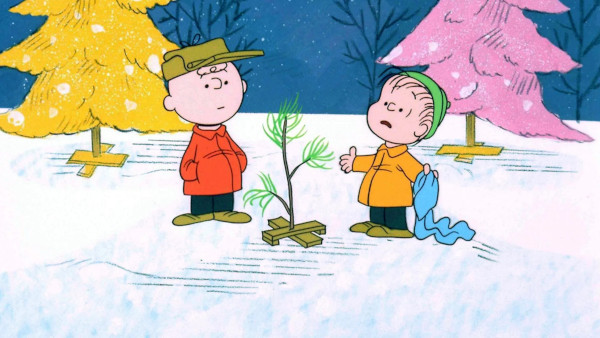
Last night, I saw a live performance of “A Charlie Brown Christmas” at the San Francisco Symphony. One of the people I went with had never seen the original television cartoon—yes, it’s true.
Afterwards, she asked a simple question: “Why did Charlie Brown pick such a bad tree for Christmas?”
As we walked, we talked a bit about Linus’ speech at the end, and how the story asks about the “true” meaning of Christmas. This was all fine, but it merely danced around her question of the tree.
What I said next sprung from me. It wasn’t something I formulated or ever considered before:
“Charlie Brown recognizes something familiar in the tree. It’s been overlooked and doesn’t seem to have much to offer anyone, which is what he’s experienced in life. At the end, the other kids see the beauty in the tree, and in decorating it they’re appreciating Charlie Brown too.”
I don’t claim this is a deep insight, or even an original one, but it came to me all at once. I watched the TV show as a child in the 1970s, and rewatched it countless times over the years, and yet I’m still finding meaning in this Christmas tale.
The XYZZY Awards is one of the oldest video game award on the books. It first started in 1997 and has been held yearly since. It’s often called the Oscars for interactive fiction. If you’ve played even one interactive fiction game first released in 2022, you can nominate a title and vote on the final outcome.
As mentioned, if you played even one outstanding interactive fiction in 2022—parser, choice-based, any story-based game at all, really—you can vote. I encourage you to head over to the XYZZY Awards site and nominate your favorites for the next round of voting. The deadline is December 16th.
In November, Amazon opened a beta program for Kindle Direct Publishing authors called Virtual Voice. It may be the biggest upheaval to independent publishing since Amazon launched KDP over a decade ago.
Virtual Voice uses synthetic (i.e., computer) voice technology to produce audiobooks. On first blush, that sounds like a pretty crappy experience—who wants to listen to a robot narrate a book? Know that automated voice technology has advanced tremendously in recent years, to the point that people have trouble distinguishing between it and a human voice.
It’s tempting to go into my thought process over the pros and cons of synthetic voice audiobooks. At this moment, I’ll just say I find the possibility alluring.
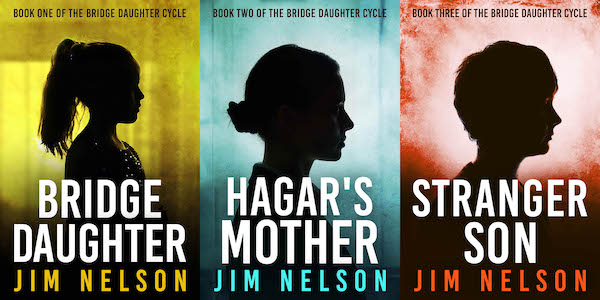
I’ve done audio in the past. I recorded Everywhere Man at Fantasy Studios, a dreamy, once-in-a-lifetime opportunity that was quite expensive and exhausting. A few years ago, I made a concerted effort to hire a voice actor to record Bridge Daughter. I was put off by the terms dictated by every actor who responded to my call for bids. Both experiences impressed on me the risks of producing my own audiobooks, risks of both cost and rights.
Synthetic voice audiobooks eliminate a lot of the question marks. If I’m reading the Amazon announcement correctly, a KDP author chooses a voice from a catalog of voices, previews a sample, and names a sale price. My guess is, the final audiobook will be ready in a few hours. Audiobooks created with synthetic voices are labeled as such on the Amazon market and may be previewed, so the buyer knows what they’re getting.
It sounds like a no-cost, risk-free offer for independent authors. I’m more than curious. Unless Amazon botches the roll-out—a possibility, they’ve botched things before—I predict we’re going to see a Cambrian explosion of audiobooks on the Amazon market soon enough.
“Any headline that ends in a question mark can be answered by the word no.”
Honestly, I did not foresee this. The stories a year ago about an upcoming Apple TV+ adaptation of William Gibson’s masterpiece seemed more than promising. As I wrote:
The truly big news is that Neuromancer has a reasonable chance of being adapted to the screen. Apple TV+ may not be the leading force in streaming entertainment today, but it’s established a track record of producing high-quality material and taking some risks along the way. I know I sound like the eternal fanboy when I say this, but, “This time it might be real.”
I’m not an avid follower of the Hollywood sausage grinder. Perhaps the project is still being developed, or an incredibly secret production shoot is happening as I write this. All I know is, over the past twelve months I’ve occasionally tried Internet searches hoping to find some evidence of progress. So far: nothing.
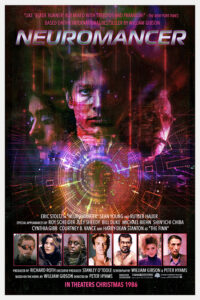
As I wrote last year, the number of failed starts on a Neuromancer adaptations are legion. The Wikipedia section on the topic does not do justice to the number of aborted starts reported over the years. Someone should make a gallery of fan-produced movie posters. Chalk up this latest disappointment as another virtual corpse to throw on the digital pyre. What’s a reader to do?
What-if film poster for a nonexistent production of Neuromancer (Peter Stults)
Here’s what you should do: Go and read the book. Don’t wait for a director’s vision, or a big-budget green light. Go straight to the source.
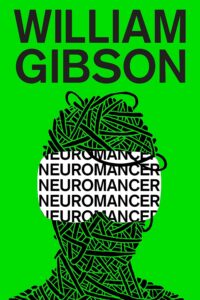
Neuromancer is marketed as Book One of the Sprawl Trilogy, a series which also encompasses Count Zero and Mona Lisa Overdrive. Gibson’s near-future Sprawl is also the setting of several of his earlier short stories, including “Johnny Mnemonic.” (Many of these stories are collected in Burning Chrome.) Thus, Gibson had the advantage of mapping out Neuromancer‘s territory well beforehand. It was in these early forays that he honed his subject and style, the street hustlers with colorful handles and underground operatives rewiring high-tech for subversive means.
The book centers on Case, a console jockey and professional hacker-for-hire. An entanglement with a prior employer has left him unable to connect to the virtual world of cyberspace, an analogue to our Internet that users connect to mentally, rather than via screen and keyboard. Crippled by this punishment, Case scrounges on the streets of Chiba City, Japan, living in coffin hotels and getting by trafficking in stolen tech.
His fortunes change when he meets Molly Millions, a punk street-smart mercenary who sports several body modifications and tech implants. (Molly wound up being a Gibson fan-favorite, and is featured in several other stories and novels.) She introduces Case to the shadowy Armitage, who offers to re-wire Case so he can enter cyberspace once more, on the condition he perform illegal hacking work against megacorporations and the military. Thus, the novel is many things at once: Future noir; a dystopic exploration of a decaying world saturated with computer technology; and, at its core, a heist tale.
Published in 1984, set in the 2030s, the novel has a couple of howlers, such as the protagonist trying to fence “three megabytes of hot RAM.” That was on the high-end of computer memory in PC-compatibles when I first read the book in 1988. Gibson later admitted he used the word “modem” without knowing what it meant. “I was working from the poetics of an emergent language,” he explained. These problems are not actually important and should be set aside.
While we’re setting aside the anachronisms, let’s also set aside some of the hype, such as William Gibson supposedly predicting the Internet (which he’s never claimed). A lot of people inside the technology community had foreseen the rise of a worldwide information network well before Gibson published. Believe it or not, some also predicted mobile, wearable, and even implanted computing devices. Once the early computer pioneers figured out how to connect two computers to exchange data, it wasn’t a great leap of imagination to picture the logical conclusion. (Engelbart’s 1968 “Mother of all Demos” wasn’t about mice and hypertext, but collapsing the distance between man and computing technology.)
Even Gibson has admitted that “wet tech”—direct-connecting a human brain to a computer—is probably a non-starter in our immediate future. And, whenever an interviewer has asked Gibson why he chose the 2030s to set his story, he’s always insisted that he was actually writing about the 1980s.
Instead, focus on Gibson’s imagery and rich settings. He took computers out of the realm of men in lab coats standing over coffin-sized boxes in dust-free rooms. He put tech on the street, in the pockets of skate punks, and the ears of all-night sushi line cooks. Phone phreakers and blue-boxing from the 70s and 80s—the early hacker cultures where the phone company was the dreaded megacorporation—offered Gibson a clear-cut model to scale up from. Instead of a single domineering power to #Resist, he described hundreds of megacorporations colluding to run the world. Instead of an obscure nerd subculture, he gave exotic tech to everyone, even folks sleeping on mattresses on rain-soaked streets. Neuromancer is a book set during a forever war between the haves and have-nots, and the battlefield is cyberspace. His work has a streak of the 70s computing counterculture, mirroring the early days of the Homebrew Computer Club, where small computers were not merely a technology, but liberation.
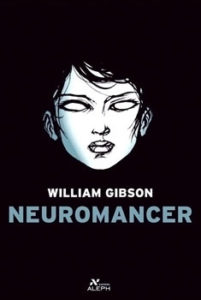
Brazilian edition of Neuromancer
Focus too on Gibson’s language and linguistic style, which weaves the technobabble of computer programmers with Japanese idioms, creating a new kind of poetry. With that he builds the colorful Chandleresque prose of hard people doing hard things. To pull example passages from the first chapter, two of countless throughout the book:
Now he slept in the cheapest coffins, the ones nearest the port, beneath the quartz-halogen floods that lit the docks all night like vast stages; where you couldn’t see the lights of Tokyo for the glare of the television sky, not even the towering hologram logo of the Fuji Electric Company, and Tokyo Bay was a black expanse where gulls wheeled above drifting shoals of white styrofoam. Behind the port lay the city, factory domes dominated by the vast cubes of corporate arcologogies. Port and city were divided by a narrow borderland of older streets, an area with no official name. Night City, with Ninsei its heart. By day, the bars down Ninsei were shuttered and featureless, the neon dead, the holograms inert, waiting, under the poisoned silver sky.
And this:
He passed yakitori stands and massage parlors, a franchised coffee shop called Beautiful Girl, the electronic thunder of an arcade. He stepped out of the way to a let a dark-suited sarariman by, spotting the Mitsubishi–Genentech logo tattooed across the back of the man’s right hand.
Was it authentic? If that’s for real, he thought, he’s in for trouble. If it wasn’t, served him right. M-G employees above a certain level were implanted with advanced microprocessors that monitored mutagen levels in the bloodstream. Gear like that would get you rolled in Night City, rolled straight into a black clinic.
Gibson humanizes the exotic technology without the tedious tendency of other science fiction authors to try and explain it in a calm, reasonable fashion. Gibson understood that the arc of technology development is not a linear one based on orderly, rational, unified reasons. Technology is a mad haggis of vain attempts to solve particular problems, and much of that tech will conflict. (Anyone who tried to use an early wireless phone while microwaving popcorn will understand what I’m talking about.) There is no rational discourse in Gibson’s Sprawl. It’s a madhouse of loners, collectives, NGOs, bureaucrats, and corporations clamoring for their chunk of the digital pie—a situation that sounds quite familiar today.
His characters are at utter ease in the trappings of this disjointed world, and even a bit blasé about it. That three megabytes of hot RAM? It’s stored in a Hitachi deck. Once freed from his life in coffin hotels, Case stays in a luxurious Hilton drinking coffee from a Braun percolator. So often science fiction relies on defamiliarization (where technology familiar to the characters seem magical to us). Gibson reverses that polarity. He uses consumerism to his literary advantage, rather than to make some clumsy ironic comment the way DeLillo and David Foster Wallace feel the need to do.
Neuromancer also puts forth a fragmented society that is at odds with the other major science fiction dystopia, 1984. Contra Orwell’s totalitarian nightmare, Gibson lays out a world of emaciated nation-states muzzled by constipated corporate power and incestuous multi-billionaire families. There is no centralized Big Brother. Meanwhile, the population hides in the shadows, barters on the gray market, and, of course, jacks into cyberspace for fun and profit.
It’s a potent brew—one part hard-boiled cityscape noir, one part philosophical science fiction, and one part a pessimistic vision of unfettered capitalism’s endgame, all told in a gritty, poetic tongue that matches the rain-mirrored, neon-iridescent streets of Chiba City.
Don’t wait for the movie. Don’t wait for the streaming series. If you’ve not read Neuromancer recently, pick up a copy and read it again. And if you’ve not read it at all—what are you waiting for?
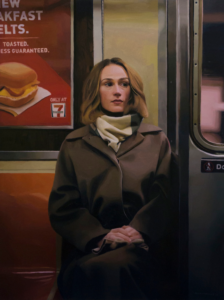
A little more than a week ago, I wrote a review of an art show by the artist and TikTok sensation Devon Rodriguez, best known for live drawing subway riders. He is, by some measures, the most famous artist in the world, with many millions of social media followers. He did not like the review.
It went up on a Friday. On Saturday morning, I woke up to a tidal wave of anger from Rodriguez on Instagram, tagging me across scores of posts. Hundreds of his followers went on the attack.
Davis gives a more nuanced and thoughtful analysis of his hellish situation than should be expected from someone who received death threats over, of all things, a review of an art show. He reasons
the only way I can understand Rodriguez’s incredibly thin-skinned reaction to my article is that he has managed to rise to this status of apex visibility without any kind of critical writing about him at all. It’s all just been feel-good profiles, so that the first critical word feels like a huge crisis. That’s a relatively new kind of situation for an artist to be in…
In the past, artists had to pass through the gatekeepers of museums and art galleries before becoming well-known to the public. Even Basquiat had to break through the establishment before securing his place in the art world. In today’s digital world, it’s possible, even desirable, to hurdle over the gatekeepers and go straight to the masses with one’s output.
A similar dynamic is at play in the world of publishing, as I’ve written about a fewtimes. This desire to stand above criticism is, in my mind, the root motivation for dysfunctional narratives. The tenor of the attacks Ben Davis withstood sounds much like the way dysfunctional narratives are defended, such as the Rodriguez fan who snapped at Davis, “What if he was your son??”
Davis links this reaction to the notion of “parasocial relationships,” that is, “the imaginary, one-sided friendships people develop with celebrities and influencers in their heads.” This cuts to the “transitive logic” I wrote in 2019 about an all-too-similar event involving Sarah Dessen and her followers when they attacked a college student who posted a relatively innocuous criticism of Dessen’s work: “The logic magnified an innocuous criticism of a single YA author to an attack on all YA fiction and its readers. Thus, the logic went, if you’re a reader of YA fiction, it’s a personal attack on you.”
Author Sarah Dessen
“Parasocial relationships” is the best term I’ve seen to describe how Dessen’s followers rose up and hounded the college student offline. Much of the outrage seemed rooted in the feeling that Dessen was not merely a YA author, but their friend. Any why not? These new, online super-authors are
not merely authors, they’re brands. Many of these YA authors have crafted an online persona of a confidant and sympathizing mentor. You don’t merely read their books, you hear from them everyday. You see their vacation photos and learn about their pets. You share their ups and downs in the real world.
Wikipedia says that the term parasocial interactions was first coined in 1956, no doubt in part inspired by the rise of television in the United States. The researchers described them existing prior to mass media, such as people emotionally bonding to gods, supernatural spirits, or saints. They are telling examples.
It requires no divination skills to predict these social media brouhahas will continue so long as artists and writers can organically grow their followings. Certainly I don’t see these kerfuffles as justification for returning to the pre-digital way, where editors and publishers decided over Negroni lunches who got published and who got to languish. But being thin-skinned to criticism, and using one’s followers to “cancel” the critic, is a bad choice no matter how you look at it.
As Davis predicts:
If there’s no criticism of [Rodriguez’s art], here’s what I think will happen: All the marketing companies and PR people looking to piggyback on Rodriguez’s popularity will stuff his feed with more and more cringe celebrity content and half-baked promo ideas until his social-media presence is bled dry of whatever charm it has.
Illustration from Erotic Review for “At the White Sands Motel, 1956”
I once wrote erotica by accident. Writing and getting the story published is a wild tale.
If you know of anything of my output—my novels, my interactive fiction—that might surprise you. You’ve probably never read anything by me that remotely involves the sex act: No kinky sex, no ho-hum sex, not even missionary style. Generally, I shy away from that kind of thing. Getting a story published in an erotica magazine still tickles me to this day.
The story-behind-the-story begins in a creative writing class. The instructor offered us a list of writing prompts. We were to select one and write an opening.
The first speed bump in this tale is that these prompts were communicated to us orally. The prompt I selected regarded a teenage lifeguard named Hamke. Years later, I learned I had misheard the details. The prompt did not include the name “Hamke” or anything about a lifeguard. How I managed to screw up so much remains a mystery lost to the shroud of time.
In any event, the name and occupation stuck. I assumed it was a German name, as I’d never heard of it before. (Apparently, I’m not alone.) While I enjoy swimming, I’ve never known a lifeguard nor worked as one. Why this prompt caught my interest, I do not know. Over the following week I roughed out a first draft about a teenage Hamke standing guard over a motel pool in Nevada. In need of a title, I jammed one onto the front page of the manuscript: “Living It Up at the White Sands Motel.” (I believe it was a riff on the quip about a cheap lodging being a “low-rent Shangri-la.”)
Around this time, I dated a woman also enrolled in the creative writing program. She was experimenting with poetry about the body. She read many of my stories, which is generous—even when you’re dating a writer, that’s no guarantee they’ll actually read your output. She called my work cerebral, and noted that my characters seemed “detached” from their physical nature. She challenged me to write a story where the main character’s physicality is centered.
Now, this doesn’t necessarily mean “write about sex” or “write about someone with a smokin’ bod.” It could mean the main character is physically challenged, or has suffered some grievous physical damage they’re recovering from. It could mean some aspect of their body defines them in a material way (which is something I had in mind as I wrote my Bridge Daughter series of books.)
In this case, I went for the obvious: Hamke would have sex. More than that, he would lose his virginity.
I poked and prodded at the manuscript—draft after draft—trying to tune all the off-key notes. In workshops, peer writers would scratch their heads trying to figure out what to make of this strange story. There was a lifeguard with a flat-top and a weird name, an empty motel in the desert, and an older couple from New Jersey who invites him to their air-conditioned room for an afternoon romp. By this time I’d renamed it (still flailing for a proper title) “At the White Sands Motel, 1956.”
I submitted to the usual literary magazines, searching high and low for a place to land it. The rejection slips came back a bit more quickly than the other stories I’d sent out. Perhaps the complaints I heard in in the workshops (“‘Hamke?’ Is that Jewish?”) was now confounding editors. The sex was not graphic, but it was on the page and not merely alluded to. The wife was acidic and domineering, and her husband frustratingly passive. Wide-eyed Hamke, who was simply “along for the ride” (so to speak), was not a character to stand up and cheer for.
Enter London-based writer Saskia Vogel. By chance, she came into the bar I tended while working through graduate school. She was working on a study of kink; I despaired over a short story about a lifeguard losing his virginity. We swapped email addresses and kept in touch after she returned to England.
Around this time, fellow grad student Lizzy Acker mentioned off-the-cuff she was developing a new San Francisco reading series with the theme “funny / sexy / sad.” The work writers presented had to feature one of those elements.
“You know,” I said, not entirely innocently, “I have a story that’s funny, sexy, and sad.”
It’s true: Hamke’s fumbling and awkward loss of innocence is funny. The wife impatiently orders Hamke across a tour of her body as though teaching him to drive a stick shift. It’s sad, too. As one workshop instructor remarked, the boy is robbed of a positive formative experience.
Lizzy included me in the series’ opening night line-up, and the reading went uproariously well. Maxfield’s House of Caffeine was packed. The audience reacted with every twist and turn of Hamke’s awkward journey. They burst out laughing at all the right moments. Red-faced parents held their hands over their children’s tender ears. People were moved by the ending, and a couple of tears were shed. The applause knocked me off my feet. It was, by every measure, the best reading I ever gave.
How the hell could I not get this story published?
Then, an interregnum. I separated from the girlfriend who challenged me to write about the body. I separated from my appendix, and a few months later, I busted up my right shoulder. I separated from graduate school. (Well, a degree was conferred, how’s that.) Hamke’s story remained a magnet for rejection slips. Meanwhile, medical bills ate through my meager bartender savings.
With no more excuses, I returned to full-time employment. The first year with my new company, the sector we were involved in hosted their annual conference in, of all places, the Canary Islands.
La Palmas de Gran Canaria. (Photo by the author.)
That’s how, six months after staring down bankruptcy and unemployment, I found myself on a semi-tropical island in the Atlantic a mere 500 miles from Marrakesh. I rented a cheap open-air room overlooking the Las Palmas promenade and a pristine sunning beach. After the conference concluded, I stayed for another week to explore the island and write.
During this vacation I received an email from Saskia Vogel in London. She heard from an editor friend that the UK-based Erotic Review was in need of fiction. Didn’t I have a story about a guy having sex for the first time?
In that low-rent Shangri-la, the couch doubling as my bed and the drapes billowing from the breeze coming off the beach, I hustled one more edit pass out of my aging Hamke story. Thankfully I brought my writing notebook computer with me. This was not a time when Wi-Fi was a sure thing in a rented room, especially in an out-of-the-way place like Gran Canaria, but I in this case I was set. I emailed my little story to editor and publisher Jamie Maclean.
Before I did that, though, I used the Wi-Fi to study up on just whom I was submitting to. My search revealed I was not soliciting some amateur outfit. ER had been around since before 1995, and had published numerous erotic books on top of a monthly subscription-based magazine. Their readers spanned the UK and North America. Not only had I never published a work of erotica, I’d never been published by a magazine that survived solely off subscriptions.
With a healthy taste of self-doubt in the back of my mouth, I pressed the Send button. Then I did what I usually do after submitting a piece to a magazine: I got my mind off things. I went downstairs. I walked the promenade. I had a couple of drinks at a beach bar, and got my toes in some sand.
When I returned to the room, I of course checked my email, fully expecting to find nothing. Instead, an acceptance email waited in my inbox. Compared to the usual turnaround times for literary magazines—one sent me a rejection two years after submission—this was lightning fast. Later it dawned on me that my accidental vacation spot had contributed to the quick response: I was in the same time zone as London, where ER was published.
Three months later, a contributor’s copy of Erotic Review and an international money transfer arrived at my apartment in California. My Hamke story was out there.
And that’s how I became a writer of erotica, scribbler of filth and peddler of smut.
Postscript:
My tale might be seen as a reversal of Ray Bradbury’s strategy to seek out unusual places for his work (such as Gourmet publishing his “Dandelion Wine”). I sought out unusual places to publish an erotica story, and eventually found a natural home for it.
Being published in an erotica magazine has become a point of pride for me. I never set out to write erotica, and I’ve never considered pursuing it since. I once read that no one writes erotica under their real name. Well, I did, although when you have as generic a name as “Jim Nelson,” perhaps it doesn’t matter.
Erotic Review is a class act. They continued to stay in touch. I received editorial updates and invites to ER parties (which, sadly, were all in London). They even sent digital Christmas cards, such as the one above.
Recently ER changed hands and is now retooling under a new editorial staff. If you’re interested in supporting the relaunch, visit them at ermagazine.com.