If there’s one trope of the mystery that stands out among all other types of stories—perhaps the single element that defines the mystery—it’s the solution being announced at the conclusion.
Almost all story leads the reader to a suspenseful ending. The mystery is unique in that the main character is responsible for explaining the prior events back to the reader in such a way as to make sense of them all. There are plenty of poorly-written books that open with a great dump of exposition to get the reader up to speed. Mystery has pretty much cornered the market on stories ending with an exposition dump.
This leads to mystery readers’ inevitable slaying of a story: “I knew who did it before I reached the end.” Usually this is put at some great insult or shut-down of the writer.
I’m going to go out on a limb and guess most mystery writers don’t cringe when a reader claims to have solved the whodunnnit before the last page. Why?
Magician Eric Mead describes a bit of inside baseball for his craft:
…if a magician shows somebody a trick and ninety percent of that trick fools them but there is a little ten percent sliver over here that does not fool them, the average person will say that the trick did not fool them even though they can’t explain ninety percent of it.
…if that same magician shows that same trick to his fellow conjurers, it only takes that ten percent sliver for them to admit that they were fooled.
The same could be said for mystery writers and their craft. The problem of penning a mystery novel isn’t managing to befuddle the reader to the point of utter despair before they reach the last page. If you want to experience such confusion, try Gertude Stein’s Blood on the Dining-Room Floor, a novella one reviewer notes “since it’s more or less impossible to work out who any of the characters are, up to and including the person whose blood is on the dining-room floor…then it can only be called a detective novel in the loosest sense conceivable.”
For almost every other mystery book written, fooling the reader is kind of a side quest for the novelist. Even in an Agatha Christie book where six shady suspects roam the English country house, the reader has a better than fifteen percent chance of simply guessing the murder by yanking a name from a hat. And when a reader claims to have deduced the murderer before the final chapter, I would ask in return, can you fully explain the who’s, what’s, where’s, and when’s of the crime? Or are you merely working on a hunch, one that may have to do with meta-analysis of the book? (“The writer keeps making this character seem innocent. I bet they’re the one.”) Or did you suspect the character at one point in the story, fleetingly, before moving on to other suspicions, and later told yourself you’d figured it out? Be honest here.
This is Eric Mead’s 90%, the part of the mystery other novelists don’t fret over when reading someone else’s work.
The 10% most readers overlook but keeps other novelists up at nights? Writing a novel that readers will pick up in the first place; writing a novel that will carry readers to the last page; filling pages with knockdown dialogue, tight scenes, and wonderful prose; and the perennial dream, writing a novel people are still talking about fifty years later. This is the sliver novelists concern themselves with when admiring (or critiquing) another mystery writer’s work. This 10% does require storytelling sleight of hand, and when it’s working it’s all-but-invisible to the reader.
One fascinating (Vonnegut-esque?) tidbit in his interviews was an offhand moment in a 1971 profile by Richard Todd (New York Times Magazine):
The class began in a surprising way. Vonnegut remarked that last time they had been talking about form, and he walked to the blackboard and drew there a question mark, an exclamation point and a period. He said these bits of punctuation were the outline of a three act play or story:
? ! .
A student asked if the end might be “Dot, dot, dot.” Vonnegut agreed.
? ! …
So maybe this is a gimmicky or silly way to describe story structure, but I’m game to play along.
I’ve written about organizing structure to motivate my fiction, so this little lesson in punctuation caught my attention. The way I organize my thinking, the three acts of story (really, four) look something like this:
Act 1: Setup
Act 2A: Complication
Act 2B: Confrontation
Act 3: Resolution
This list comes from my reading of Syd Field’s books on film structure, which I’ve modified (slightly) for the purposes of writing fiction, especially novels.
Syd Field
I agree with Vonnegut that most stories, if not all, open with question marks. Even if I’ve read a book two dozen times—and there are books I can make that claim—the pleasure of the opening chapters is the illusion I do not know what is coming. (I would say this is related in spirit to Coleridge’s willing suspension of disbelief.) There are numerous, sometimes playful, ways to pose those questions when a story opens, but those questions are almost always there. Rare if ever does an interesting story open with all the questions answered and the main characters in possession of all the facts. Jim Thompson said there was only one type of story: “Things are not what they seem.” That is another way to say stories open with question marks.
Vonnegut’s exclamation point jibes with what I’ve labeled 2A, Complication. Exclamation points do not have to be action or cliffhangers. Sometimes a quiet revelation or admission can turn a story on its head and rearrange how we see the main character and their situation. I hold a pet theory that the art of storytelling lays in reversals (perhaps I’ll post about that some day). The exclamation point is one such reversal for the characters: a well-kept secret revealed, a surprising discovery, a fortune amassed, a fortune lost, and so on.
Vonnegut’s three punctuation marks (and most of his story shapes) imply three acts. I wondered if my idea about a fourth act, Confrontation, could fit into his punctuation-as-story-structure?
Confrontation, I think, could be expressed as an em-dash. Tension draws taut in the confrontation phase of a story. More than any other part of a story, confrontation is where the reader should be asking herself “Wait—what happens next?” In contrast, final acts are generally not “What next?” but rather “How will it end?”
With an em-dash, then, Vonnegut’s story structure could be punctuated like this:
Last week, I finished my fourth novel. I used my phone throughout the entire writing process: developing, researching, outlining, plotting, and revision, all the way to my final draft. For all purposes, my phone was my writing notebook for this novel.
I didn’t write the novel on my phone. I’ll probably never do that. When I’m writing I want the full typewriter experience, real keys designed for human hands, the tactile sense physical buttons offer, the whole shebang. And I need a screen display that at least approximates the size of manuscript paper, and not one the size of an index card.
But planning and revising a novel on your phone is certainly possible, and my latest book is proof of that.
In the past I’ve relied on paper-and-ink writing notebooks. A writing notebook is a tool I evangelize to anyone who will listen, mostly because I believe it functions as a kind of “inspiration laboratory” for writers. However, towards the end of my previous novel (Hagar’s Mother) I found myself turning to digital note-taking tools during the editing process.
In the final stretch of editing a novel, a torrent of small details begin erupting. The only way to keep the problems and details organized is with a writing notebook of some manner. When the edits are coming hot and heavy I find removing my hands from the keyboard to be a distraction, so I began using a free note-taking software packaged with my MacBook Air, Apple Notes. Rather than reach for a pen and my trusty notebook, I would ⌘+Tab to Notes and add a bullet point to a little checklist I kept. As I kept working, I would periodically consult my checklist and be sure the appropriate changes were made.
Well, Apple Notes is also available on my iPhone. Thanks to the Internet, at all times my writing notes were synchronized between my computer and my phone. That meant I could review my notes while at work, on the bus, even in bed. It also meant I could add more ideas at any time. Later, when I returned to my computer to resume writing, they were there waiting for me.
That’s the hard reality I faced, one I’m certain other writers face as well: While I sometimes leave the house without my writing notebook, I never leave without my phone. These little devices are simply invaluable to us (which is why I encourage writers to keep them in mind when writing their own fiction).
After Hagar’s Mother, I decided to try an experiment and use Notes as my primary writing notebook for my next novel. I told myself if I had the slightest of problems I would bail out and revert back to my old paper-and-ink notebook. It seemed a risk-free experiment.
Well, I finished my novel and I’m here to tell you: I’m sold. Yes, you can plan, write, and revise your next novel using your phone as a notebook. What’s more, you don’t need to spend an extra dime on additional software so long as you’re using a reasonably up-to-date computer and smart phone. The note-taking software already installed is probably good enough, and if it’s not, there are free alternatives available.
Ways of note-taking
Let me get this out of the way: I’m not a shill for Apple. I’m happy with Apple Notes and how cleanly it intersected with my creative process. That doesn’t mean you should use Notes if you don’t own Apple products, or if you want to try something else. (I list some alternatives below.)
Looking back over my notes, I see three “types” of pages I developed, each representing a period of time in the novel-writing process.
The earliest pages are scrapbooks of ideas, thoughts, and research. Random notions fill these pages alongside bits of dialogue, descriptions, even character names. (With my fiction, I try on character names the way I would try on a pair of pants.) For every novel I will read up on related subject matter to ensure I’m getting basic facts and terminology correct. Using my phone’s Share button I could add any page—Wikipedia, a news article, even a word in my phone’s dictionary—to a note. Although the foundations of the book are laid here, much of this primordial stew didn’t wind up in the final draft.
Later in the writing process, the pages start becoming more organized and less free-form. Here I was thinking about scenes I was developing. Dialogue and descriptions on these pages often reached the final draft. I also began roughing out timelines in these pages, primarily to flesh out the backstory of the main character.
The last note pages are highly organized. The novel was gelling; the big ideas are down on the page and I was more concerned about the small details and tightening up the narrative. In this stage, my note pages are mostly checklists of changes to be made. The pages are broken up into sections: Characters, Details, Terminology, Important, and so on. When I made the edit, I would check off the item.
This stage is where I wrote a final character list (to keep track of names and relationships) and lists of terminology and spelling (useful in a novel with imaginary technology). I also built a final master timeline which incorporated the chronology of the novel into the backstory—useful to avoid the problem of a character is talking about an event as happening the day before when it actually occurred two days before.
A few points here. First, notice the pages are structureless because the process is structureless. Even the later page’s organization is more-or-less free-form. The notebook met whatever need I had at the moment. It never imposed a system on me. Some writing software wants to guide you through steps or categories for organizing your work. I’m not sold on that idea. I could use the digital note pages for anything I wanted to preserve for later. Make your writing notebook a tabula rasa.
Likewise, avoid reminder or to-do style software. Yes, I use checklists in my writing notebook, but I also used it for so much more. Task software imposes organization on your creative output. (“Mark this task High, Medium, or Low?”) That’s not what you’re looking for with a writing notebook.
These notes did not happen in concerted bursts. They represent hundreds of points in time, some slivers of seconds used to type out an idea. At any point in the novel’s progress, I was adding notes on the bus, at work (shh), in my easy chair, even at the gym, sweating and madly tapping a thought that came to me on the treadmill. The phone was always there. Losing even a single story idea to the frailty of human memory and our shortening attention spans is a loss.
Before you start
If you’ve read this far, you might be excited to start using your phone for your next big writing project. There are downsides to keep in mind.
First, be aware you’re entrusting your precious creative output with a third-party corporation. Apple (or Google, or Microsoft, or whomever) could, at any time and with no warning, discontinue the software, discontinue their services, or even go out of business. Whatever software you work with, be sure you can export your data, even if it’s nothing more than printing out your notes or saving them as a PDF. You absolutely do not want to wind up in a situation where a corporation has your precious creative output locked up—or has deleted it.
Just as you protect your word processing files, make periodical backups of your notes in case of disaster. Most modern note-taking software has some method of doing this in such a way that the backups can be restored later if necessary.
Do a little research into your software’s data security practices. While you’re at it, make sure you’re using a strong password. No, I’m not worried about another author “stealing” my ideas, but I do worry about unknown persons accessing my notes without my consent. My writing notebook is a creative and freeing place. Part of that freedom rides on an expectation of privacy.
Recommendations
If you’re curious or excited to start using your phone as a writing notebook, your first step is choosing your software. My checklist for baseline features it should include are:
It should run on your phone and your writing computer. While you could turn to your phone while typing on your writing computer, I found it invaluable to be able to read and update my notes without leaving the screen. Being able to Alt+Tab to my notes and Alt+Tab back to my word processor was invaluable when the story was flowing and I couldn’t type fast enough.
Your notes should synchronize between every computer you use. In the 1990s synchronizing data between computers required specialized software and arcane cables. These days synchronizing should occur across the Internet, all-but-invisible to you.
Your notes should be available on the Web. It’s handy to be able to access your notes from anywhere. In the case of Apple, I can login to icloud.com. Your software should have this feature as well.
…but you should be able to access your notes without being connected to the Internet. As I’ll explain in a moment, it’s quite useful if your note-taking tool has it’s own app and doesn’t require using a Web browser.
You’ll notice that the above three points revolve around a single convenience: access. The key to my success with note-taking software was that I could access it at any time. You never know when or where inspiration will strike. Recording inspiration and returning to it later is the entire reason for keeping a writing notebook.
The reason I like accessing my notes outside of a Web browser is simple: I turn off WiFi when writing. Disabling Internet access is a great way to avoid temptation and whittle away the day surfing around. Disabling your WiFi also removes distractions while writing, such as new email, social media alerts, and so on.
(While I’m on the topic, I also recommend looking into how to turn off all notifications on your phone and computer while writing. Disabling WiFi doesn’t disable your phone from receiving text messages, for example.)
Those are my top-tier must-haves for a digital writing notebook. Features I think are desirable include:
Checklists. It’s great to be able to add checkboxes next to the edits I need to make. It’s even better to check them off when they’re done.
Scrapbooking. Surprisingly, I found myself harvesting ideas from Web pages more often than I expected. Being able to store links, photos, dictionary definitions—even maps—was invaluable.
Folders & note organization. Eventually I would fill a page with so much raw material I needed to create a second page to continue, and subsequently a third. Organizing all these pages into distinct folders is invaluable.
Other features to look for:
Drawing or sketching. If you like to doodle in your writing notebook, you might seek out software that supports drawing. (Alternately, you could use a separate sketchpad app and add it to your notes.)
Audio notes. Some note-taking software can attach voice memos to a note. It’s not how I work, but it might be yours.
Searching. It’s surprising how many times I remembered a keyword but could not find the exact note for it.
Collaboration. Some software allows you to share your notes with one or more people. If you’re collaborating on a novel with another writer (or illustrator, or editor), this might be a real need for you.
If you’re not an Apple user or seeking alternatives to Apple Notes, there are other options you can investigate. I’ve not had a chance to use any of these but they seem promising:
English translation of La Planète des singes (1963), Pierre Boulle.
A guilty pleasure of mine is Planet of the Apes. I’m speaking of the original movie—not the 1970s sequels, not the remakes, not the one with the Golden Gate Bridge, and not the one everyone hates with Mark Wahlberg. I am a fan of the 1968 film that launched them all, the Charlton Heston vehicle spawning over fifty years of sequels, reboots, “re-imaginings,” TV shows, and comic books. The others have little draw for me. It’s the original I return to time and again.
The first Planet of the Apes is campy, riveting, preachy, and provocative— Franklin J. Schaffner’s sci-fi classic is the very definition of middle-brow entertainment, in that it pleases the senses while challenging the mind. The film has only grown on me over the years. I’ve come to appreciate its complexities and contradictions, even as its flaws have become more apparent as well.
Although I find it difficult to believe any person in the industrialized world today is not a little familiar with Planet of the Apes and its shocking ending, let me open by saying:Spoilers follow.
Seriously: If you’ve not watched the original 1968 film, do not continue reading. The ending is simply that stunning. I hate to think I would spoil it for anyone.
Background of the Apes
It’s sometimes said Planet of the Apes is the rare instance of the film being better than the book. I’m not so certain, although I’m convinced the film’s impact is the stronger of the two. A better description, I think, is that the novel and film are different approaches to the same source material, much as the gospels of Matthew and Luke are thought to draw upon common material from an earlier source known to scholars as Q.
The original novel—Pierre Boulle’s epistolary La Planète des singes—regards a space traveler named Ulysee who finds himself stranded on a planet circling the distant star Betelgeuse. There he discovers a modern ape civilization that enjoys all the trappings of 20th century man. The simians smoke tobacco, drive cars, shop for clothes, take walks in parks. The humans on this planet are mute, savage, and hunted for trophy. To the apes the narrator is a freak, this human who can talk and reason and claims to have fallen from the sky.
The Q Document for Boulle’s lean novel would seem to be Jonathan Swift’s Gulliver’s Travels, in particular Gulliver’s final voyage to the land of Houyhnhnms. Swift’s race of intelligent and speaking horses administrate an orderly and rational society on their island. Like Boulle’s apes, the Houyhnhnms are plagued by the Yahoos, mute and savage humans who rape and kill with abandon. The Houyhnhnms shocking final solution for this plague is what today we would call genocide: Their Assembly votes to exterminate the Yahoos. The apes on Boulle’s planet seem to be building toward a similar resolution.
In Bright Eyes, Ape City: Examining the Planet of the Apes Mythos, a recent critical examination of all things Ape, contributor Stephen R. Bissette reveals a number of antecedents to Boulle’s slim novel of apes running a world. In particular, he focuses on the popular 1904 French short story “Le Gorilloide et Autres Contes de L’Avenir.” This story and its author, Edmond Haraucourt, were so popular in the first half of the 20th century, Bissette notes “it is impossible to read ‘Le Gorilloide’ for the first time and not be rocked by the realization that Pierre Boulle had to have read this story, or at least heard of it. … This is the Holy Grail for Apes devotees.” Furthermore, Bissette catalogs an entire corpus of ape-world stories predating Boulle’s novel, from science-fiction shorts to comic books.
These earlier ape-world stories would seem to dilute the originality of Boulle’s novel. From Bissette’s capsule summaries, none of these earlier authors seemed to have the same ambition as Boulle, making La Planète des singes a kind of sui generis in the intersection of science fiction and “social fantasy,” as Boulle himself called it.
While I can’t offer any direct literary evidence Boulle was working out of Swift’s mode of satire, it seems rather obvious he was. The other stories cataloged by Bissette make much of apes running a planet; Boulle made much about a man being treated as an animal because he is an animal, which corresponds neatly with Swift’s dark worldview.
Like Gulliver, Boulle’s protagonist Ulysee is a wide-eyed narrator brimming with wonder and curiosity. The common device of animals with human-like qualities allows Swift and Boulle to hold a polished mirror up to man’s violence, avarice, and ignorance, to interrogate our supposed civilized rise over the beasts, and to show our vices for what they are. Ulysee and Gulliver adapt to the animals’ ways, even going so far as to adopt their language, culture, and mannerisms. Both animal societies are generally better-run than man’s, although Boulle and Swift are smart enough to give their respective animal races blind spots. For Boulle’s apes, it’s unquestioned faith; for Swift’s horses, excessive pride.
“I shot an arrow into the air”
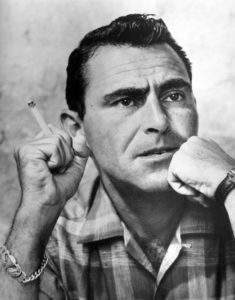
Rod Serling, 1959.
Shortly after publication of Boulle’s novel, Rod Serling of Twilight Zone fame was tapped to write a big-screen adaptation. Serling kept the device of an astronaut landing on a planet run by apes—how could he not?—as well as Ulysee’s crueler treatment at the hands of the apes. He also carried forward the main ape characters, scientists Zira and Cornelius, and Dr. Zaius, the authoritarian keeper of ape law. Beyond that, Serling jettisoned most of Boulle’s novel in favor of a darker, more cynical territory.
Because the movie’s credits list Michael Wilson before Serling, there was a long-running question of how much of the movie emerged from the Twlight Zone creator’s pen. Wilson’s silver screen credits include such monuments as Lawrence of Arabia, Boulle’s The Bridge on the River Kwai, and A Place in the Sun. Some wondered if Serling’s contributions had been overplayed compared to this seasoned Hollywood writer.
A 1998 issue of Creative Screenwriter settled the question by examining Serling’s early scripts. They show Serling definitely shaped the novel into what the movie finally resembled, including his idea for the stunning final moment, one of the most shocking endings in Hollywood history.
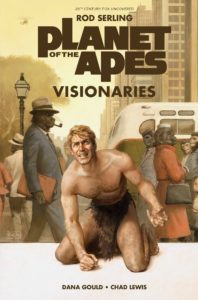
Serling also carried forward Boulle’s concept of apes living in a modern world much like our own, which was abandoned before production began. The final movie’s apes inhabit mud huts on the edge of a desert. They make do with horseback travel and wooden carts and dirt roads. This change was apparently due to studio budget restrictions, and Michael Wilson’s revisions accorded this limitation. Wilson or another writer (probably John T. Kelley) also “punched up” Serling’s dialogue, yielding several groan-inducing aphorisms (“I never met an ape I didn’t like”, “human see, human do”). Later drafts also introduced the teenage ape Lucius, who preposterously carpet-bombs the last act of the film with anachronistic counterculture lingo. Leaving these “improvements” on the cutting room floor would have done much to polish the final film.
Still, the artistic compromise of a pre-industrial ape society fortuitously contributed to, rather than detracted from, Serling’s vision. In the film, the apes maintain an austere, Puritanical social structure. They live close to the field, close to the well, and close to their scripture. Zira’s and Cornelius’ claim of discovering a man who can talk doesn’t merely fly in the face of scientific thinking (as in Boulle’s novel), but against religious orthodoxy, adding an Inherit the Wind subtext that supercharges the movie’s stakes.
Planet of the Apes: Visionaries by Dana Gould & Chad Lewis adapts Rod Serling’s original screenplay. The cover illustrates the original concept of apes living in a modern rather than agrarian world.
As with the original novel, Gulliver’s Travels seems to be a source for the film, and not merely the device of man trapped in an animal society. Swift’s misanthropy is far stronger in Serling’s vision than Boulle’s. When the Houyhynms vote to destroy the Yahoos, it’s not a stretch to think Swift is advocating for the destruction of the actual human race. This level of misanthropy is nowhere to be found in Boulle’s work; Serling’s script is marinated in it. Serling’s nicotine-addled gaze and his penchant for purple dialogue means the script affords more time for damning philosophizing than in Boulle’s work.
The vehicle for Serling’s misanthropy is Taylor (Charlton Heston), a red-blooded, cigar-chomping astronaut who replaces Boulle’s wide-eyed French explorer. Unlike Ulysee and Gulliver, Taylor never lowers himself to the ape’s level—or, perhaps, he never rises to their stature. Considering the European backgrounds of Swift and Boulle, perhaps Serling’s choice of a hardheaded “cowboy” astronaut is indicative of Serling’s American-ness. Or, perhaps Serling was making a statement about the hubris of his countrymen. America was deep in the Vietnam War by this point. American exceptionalism was being questioned from all sides.
“I leave the 20th century with no regrets”
Although some critics knock the movie as pretentious action-adventure fare, the film’s sensitive opening doesn’t line up with such dismissive claims. Staring out a spaceship’s viewport at an expanse of stars, astronaut Taylor notes that, due to Einsteinian relativity, hundreds of years have passed on Earth although the crew has only been traveling for six months of ship time. Speaking into a black box recorder, the cynical Taylor announces “I leave the 20th century with no regrets.”
Then he admits
“Seen from out here, everything seems different. Time bends. Space is boundless. It squashes a man’s ego. I feel lonely.”
Before slipping into extended stasis for the final leg of their journey, Taylor offers the listener of his voice recorder—whomever it may be—his final thoughts:
“Does man, that marvel of the universe, that glorious paradox that sent me to the stars, still make war against his brother? Keep his neighbor’s children starving?”
Serling’s script opens not with high action or tense drama. It doesn’t even open with the inciting incident, a bang to set the story into motion. Taylor’s admission before falling into hypersleep sounds like a confession from a man not in the habit of making confessions.
Charlton Heston, from a promotional still for Planet of the Apes (1968)
After the opening credits, the crew awakens to discover they’ve crash-landed on a desolate planet. Taylor’s vigorous misanthropy immediately fills the screen. He taunts the others for holding any faith in the survival of America or even civilization. He declares mankind all-but-extinct, and with the only female crew member dead, its destruction now seems assured. He boasts how satisfied he is to leave Earth behind, and wonders if the remaining crew will last a week on this daunting new planet.
It’s Taylor’s private admission to the black box—”It squashes a man’s ego. I feel lonely”—that reveals his confident cynicism is to some degree a facade. Not coincidentally, packed inside those two sentences is a concise foreshadowing of the film’s conclusion.
“I’ve always feared man”
Taylor, one of the last examples of “that marvel of the universe, that glorious paradox,” is hunted and captured by the apes. He’s subjected daily to humiliations fit for a laboratory animal: Stored in a cage, rewarded with food, washed down from a hose (a movie visual sickeningly similar to a strategy police used in the 1960s on peaceful civil rights protestors), and given a mate to encourage breeding. The threat of castration and lobotomization looms in the background (the latter a trendy topic in a decade preoccupied with the treatment of mental illness).
Charlton Heston turns in a rather physical performance as he’s stripped naked, manacled, chained, gagged, and paraded through streets on a leash. Due to a throat injury Taylor literally has no voice against his captors. When he regains his voice—the campy “Take your stinkin’ paws off me, you damn dirty ape!”—he discovers he still has no say in this society of apes, where he’s regarded as an ignorant freak of nature.
Taylor’s hatred of man isn’t challenged by the apes or ape society, it’s reinforced. As with the lands Gulliver travels to, evidence of man’s failings abound on this supposedly backwards planet. The apes don’t kill each other. They seem to have no war or famine or deprivation to speak of. While not perfect, they seem to have built a more egalitarian society than the world Taylor left behind. And yet Taylor can’t help but see himself as their equal. Soon his human ego leads him to believe he’s their superior. This shift is so subtle and smooth the viewer doesn’t even sense it.
Serling is a cruel god to his creation. It’s not ironic enough for misanthropic Taylor to entertain notions of equality with the apes. Serling forces Taylor to defend mankind as intelligent and rational while standing naked and unwashed before a tribunal of jeering, dismissive apes. When Taylor visits an archeological dig and proves man ruled the planet before the apes, his defense seems all the more credible. Headstrong Taylor makes much hay over his victory.
Consider the film’s opening once more. In his voice recorder, Taylor’s questions—”Does man still make war on his brother? Keep his neighbor’s children starving?”—are obviously not questions at all. Taylor believes man is incapable of changing his basic nature. After crash-landing on the ape planet, Taylor mocks the notion mankind might have survived the five thousand-year span. His attitude is one of good riddance: “I leave the 20th century with no regrets.” Yet by the third act, this man is sneering down on the apes and declaring man was better, stronger, and most importantly, first.
With Taylor’s hubris reaching a crescendo, he twists out this admission from Dr. Zaius:
“I’ve always feared man. From the evidence, his wisdom must have walked hand-in-hand with his idiocy. His emotions must rule his brain. He must be a warlike creature who gives battle to everything around him. Even himself.”
At this point, Taylor has won. He’s gained his freedom as well as an admission of man’s primacy from the ape’s top authority. If the movie ended with Taylor riding his horse into the horizon, perfectly free, it would have been a tidy, if unsatisfying, ending.
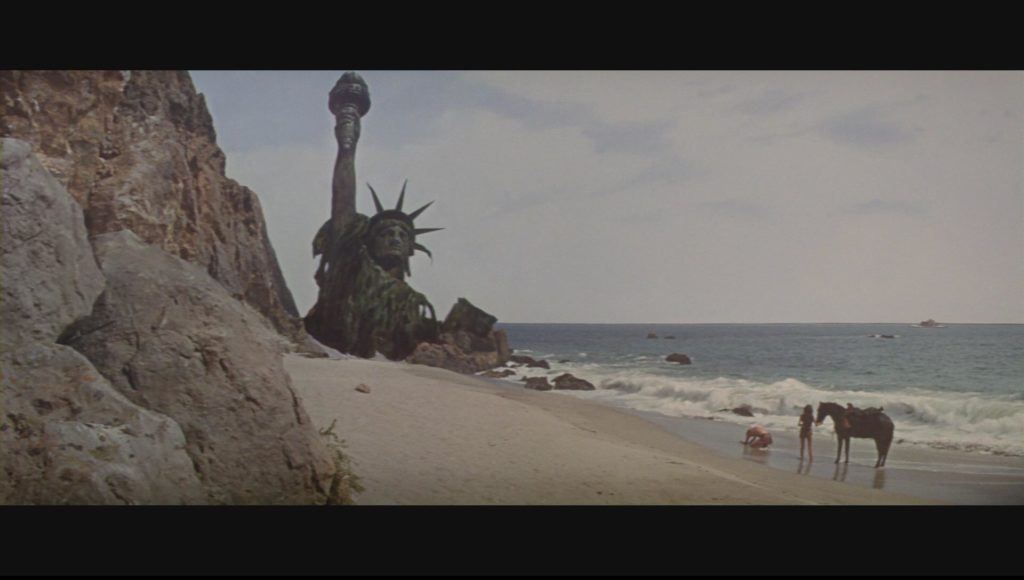
Discovering the Statue of Liberty is the door slamming shut on Taylor. Cowering on the beach naked as Adam, he realizes
“I’m back. I’m home. All the time it was—”
Taylor’s character arc is one of the cruelest, most severe punishments I’ve ever seen in film or literature. Gulliver leaves the island of the horse Houyhnhnms unable to stand the sight or smell of other humans, but his change is orders of magnitude less than Taylor’s crushing defeat at the foot of the Statue of Liberty. Taylor’s misanthropy has been scooped out of his black heart and fed back to him in a dog’s bowl.
In the first act, one of the surviving astronauts attempts to plant a tiny American flag in the dirt of their newly-discovered planet. Taylor roars in laughter at the absurd futility. In the final scene, another American symbol in ruins towers over him, with Taylor on the beach like a meager, limp flag planted in the sand. He’s the object of amusement now, and his climb from misanthropist to philanthropist has collapsed and crushed him whole.
My friend Dustin Heron and his family lost much in Paradise, California due to the recent fires. He’s selling copies of his book Paradise Stories to raise money for himself and victims of the Camp Fire.
It’s a fantastic collection of short stories and your money goes toward an urgent cause.
Nicolas Gattig of The Japan Timesreviews Murakami’s Underground, a collection of interviews with victims of the Tokyo subway sarin attacks as well as members of the cult who perpetrated it:
In an attack that killed 13 and sickened and traumatized thousands, the supposedly peace-seeking cult had turned violently against Japanese society.
Murakami was shocked by the news. About to return permanently to Japan after years of living abroad, he felt the attacks could not be explained as a product of simple “evil.” They were a failing, he thought, of society as a whole. The Japanese sense of self would have to integrate Aum.
Unwilling to move on, Murakami set out to portray the people involved, both victims and members of the cult, and thus “to probe deep into the heart of my estranged country.”
Professor Mayumi Fukunaga of the University of Tokyo on the attacks:
“Aum was a place for dissatisfied young elites, who saw the bubble economy as superficial consumption,” she explains. “Aum followers had seen the failure of leftist movements, but still wanted social reforms. At the same time, they knew they’d never enjoy the rewards of the bubble. … In Japan, the struggle of belonging continues.”
The entire article is well worth the read, especially how Gattig connects Underground‘s characters and themes to Murakami’s fictional work.



.jpg)

.jpg)