Ten years of blogging: Flaubertian three-dimensionalism

Flannery O’Connor

Previously: Writer’s block
Next: A unique manifesto

The year that was 2020 will most likely go down as one of the most turbulent years of my life: The COVID-19 pandemic, lock-downs and masking, the murder of George Floyd and the ensuing riots, all leading up to the most contentious presidential election in memory that some still deny was properly tabulated.

In contrast, 2019 had been for me a rather productive year creatively, and I wound up publishing two novels in 2020 back-to-back: Stranger Son in April, followed by In My Memory Locked in June.

That aside, as 2020 trudged onward and the pandemic fevered on, it grew apparent normalcy would not make an appearance any time soon. I began to suffer a low-grade depression, a toothy rat gnawing at the ankles of my mental health. I needed to do something creative to keep a hold on my fragile state.

I made a personal goal of putting out a compact book—my previous two were unusually lengthy for me, with In My Memory Locked clocking in at 120,000 words. I had been binging on streamed movies (and who didn’t that year?) Viewing the masterful The Day of the Jackal motivated me to pick up Frederick Forsythe’s original novel, which I learned was inspired by his tenure as a journalist in Paris reporting on the assassination attempts made on Charles De Gaulle’s life.

I committed myself to write a taut thriller about the pandemic and lock-downs, short and sweet, with as little fat as possible, and saturated with paranoia and claustrophobia. The result was Man in the Middle, published in November 2020 and my most overlooked book. I’m proud of it, though, especially considering the conditions I was working under. I also believe it to be the first novel published expressly about the COVID-19 pandemic—but I cannot prove that.

As for blogging in 2020, I put out a number of short series which garnered some interest. At the start of the year, I did a mini-series on Dungeons & Dragons, including my take on Gary Gygax’s Appendix N, which was the book recommendations he included in the first AD&D Dungeon Master’s Guide. Another series took at look at Hollywood novels, which gave me a chance to write on a few books I’ve been meaning to cover for some time, such as The Day of the Locust and They Shoot Horses, Don’t They?

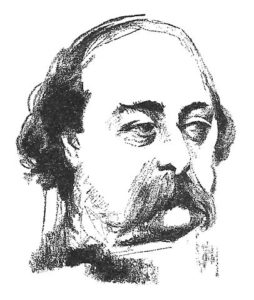
Gustave Flaubert
Gustave Flaubert

But the post I’m most proud of from 2020 regarded a bit of writing advice I’ve heard on and off for years now in writing groups and at writing conferences: “Use three senses to make a scene come alive.” Invariably, this advice is attributed to Gustave Flaubert.

As far as writing lore goes, this one is rather economical in expression. It’s also not altogether obvious why it’s true. Why three senses, and not four or five, or even two? The resulting blog post was satisfying to write because investigating the origins of this saying led to explaining why it appears to be true.

I could find no evidence Flaubert ever made this statement, at least, not in such a direct manner. Rather, the textual evidence is that it originated from Flannery O’Connor, who in turn was summarizing a observation made by her mentor, Caroline Gordon.

Now, I’ve read many of Flannery O’Connor’s short stories. Anyone who’s taken a few creative writing classes will eventually read “A Good Man is Hard to Find,” her most anthologized work. I had never read anything by Caroline Gordon, however, so it was fascinating to delve briefly into her work.

It’s a shame Gordon is not more well-read today. It’s probably due to her work not taking the tangents and experiments that other American modernists risked (such as Faulkner and Jean Toomer). She remained a formalist to the end. Her How to Read a Novel is an enlightening book, and while a tad dated, would make fine reading for anyone serious about writing a full-bodied, red-blooded novel.

Mostly, my pride for “Use three senses to make a scene come alive” is that it’s a solid essay: It starts out with an interesting question that leads to more questions, takes a couple of detours and unexpected side-roads on its journey, and ends on a note of successful discovery. It’s about all I can aspire to when I sit down to write.

“Use three senses to make a scene come alive”

“Under the Cognomen of Edgar Allan Poe” reviewed at The Final Arc

Under the Cognomen of Edgar Allan Poe by Jim Nelson

My Interactive Fiction Competition entry Under the Cognomen of Edgar Allan Poe was reviewed by Justin Kim at The Final Arc. Highlights:

On one hand, it’s a game about dealing with the duality of superficial popularity vs meaningful respect as a career writer. On another hand, it’s a mystery about the last days of famed author and poet Edgar Allan Poe. On yet another hand, it’s dealing with the fallout of making a Faustian deal.

And:

You begin in the modern day as a writer, waking up after an explosion. This character’s past is unveiled as you find clues in Baltimore, Maryland, in the year 1849 as a European who discovers the secret of Poe’s disappearance for his own agenda.

It’s a really great write-up, and I appreciate Justin’s kind words.

I met Justin at NarraScope 2023 where we discussed my last interactive fiction, According to Cain. This year, he volunteered to beta test Cognomen and had a number of important suggestions for me to fix. Thanks, Justin!

Check out more from The Final Arc, including their coverage of other IF Comp entries.

IF Comp 2024: Under the Cognomen of Edgar Allan Poe

Under the Cognomen of Edgar Allan Poe, by Jim Nelson

Today is the start of the Interactive Fiction (IF) Competition 2024, which includes my latest IF title, Under the Cognomen of Edgar Allan Poe. Over 67 titles are entered in the competition this year.

The great thing about IF Comp is that anyone can play and be a judge. If you’re interested, you’ll need to play at least five of the entries to submit a ballot. I recommend reading over the judging rules before looking over the full slate of titles. Note that many of these games can be played within your browser without downloading any software.

Voting is entirely optional. You’re free to play as many or as few of these games as you like. All are free to download and play.

Here’s my entry’s blurb:

“There are some secrets that do not permit themselves to be told.”

In 1849, Edgar Allan Poe disappeared among the back alleys of Baltimore. A week later, he was found delirious and in disarray. The mystery of his death has remained unsolved for 175 years.

Now it’s your chance to decipher the macabre enigma enshrouding the final days of Edgar Allan Poe—a tale of Faustian bargains, artistic ambition, and immortality…

It’s a parser game, meaning you enter commands as free-form text, which the software interprets as commands and acts upon. Total play time is a little over two hours or so, depending on how well you do.

You can play Under the Cognomen of Edgar Allan Poe directly from the IF Comp game list. If you want a more customizable experience, in terms of colors and fonts, or you want to listen to the game’s soundtrack while you play, I recommend installing the QTads interpreter and downloading the game file to your local machine.

Here’s to a great competition!

Ten years of blogging: Writer’s block

John Turturro in Barton Fink

Previously: An all-too-familiar utopia
Next: Flaubertian three-dimensionalism

From a novel-writing perspective, 2018 and 2019 was a creative interregnum. After publishing Hagar’s Mother in late 2017, I found myself juggling energy between two books. One was the third installment of the Bridge Daughter series, the other a futuristic detective novel where society has essentially become a giant social media simulation. While working on the former, 2018 fizzled away with a fearful lack of progress. As 2019 marched on, a slow panic developed inside me. Would I burn off a second year with nothing to show for it?

I learned a hard lesson: Writer’s block is real. Before this, I’d read articles by well-known writers who either denied it existed, or called it a semi-phony condition covering for laziness. The cure for supposed writer’s block, they explained, was to turn off your Internet, silence your phone, and write.

The early chapters of the Bridge Daughter sequel emerged in fits and spurts. Like a teenager learning how to drive a stick shift, I couldn’t find second gear and launch the story forward. Eventually I admitted that I’d hit something like writer’s block. I recalled what the Coen Brothers did when they were blocked developing Miller’s Crossing: They wrote a movie about writer’s block, Barton Fink.

While I didn’t go that meta, I used the problem to pivot to my science-fiction detective novel. Encouragingly, I was far more productive. It was also a much longer story. As a tightly-wound mystery, it was vital the chronologies of the different characters matched up, as story events were occurring in the background that the detective only learned about later. This required a fair amount of revision to clean up and synchronize.

The pivot did unblock me, and in a big way. During a stay in Tokyo at the end of 2019, I finished the remainder of the third Bridge Daughter book over a six-week sprint. Unlike the grind of the detective novel, Stranger Son spilled forth all at once. It and In My Memory Locked were published in 2020.

Photo of cappuccino with leaves drawn in the foam
Cappucino by Scott Rocher (CC-BY-NC 2.0)

The other writing outlet I used over 2019 to break my writer’s block was this blog. It’s no surprise my focus that year would be on the writing process itself. I blogged about keeping a writing notebook on your phone, story revision, story structure, and even on (bad) cover letters. Basically, any problem I faced while writing, I at least attempted to compose a post about it. (Most were never published, trapped forever in my blog software’s Drafts folder.)

So desperate to write anything to keep the blood flowing, I even wrote about writing in cafes. It couldn’t have been more flagrant: Sitting in a cafe, desperate to jump-start the creative engine, I started writing about what I saw around me. What began as a lark grew into a lengthy diatribe on the different cafes I’d written in over two-and-a-half decades, and the varieties of cafe patrons and owners I’ve had to put up with.

The cafe I wrote that post in was near-perfect for my writing habit. Plenty of seating, open late, electrical outlets, free Wi-Fi, good drinks, good food, reasonable prices, a cozy college student vibe—and a mere one block from my apartment. That’s why at the end of the post I didn’t reveal its name. I feared it would be discovered and ruined.

Well, not long after posting, the cafe changed owners. One by one, the wonderful perks disappeared, prices crept upwards, and hours were reduced. By the end of 2019, I was on the hunt for a new cafe.

A few months later, my preference for writing in public spaces would become a very distant problem.

A quarter-century writing in cafes

Summer sale: Four books available for 99¢

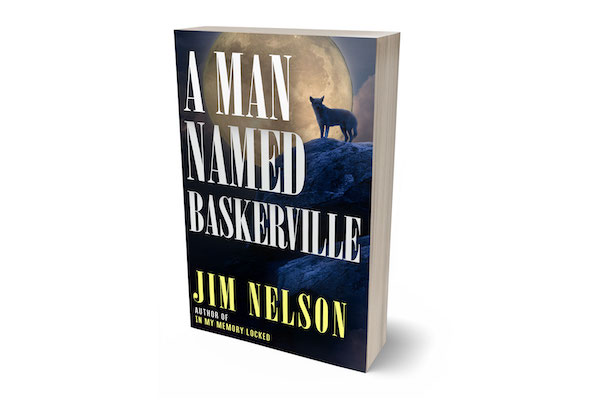
Cover of "A Man Named Baskerville" by Jim Nelson

With the dog days of summer upon us, four of my novels are now available on Amazon for the low price of 99¢.

Follow the links below to view sample chapters or purchase:

All are available in the Kindle Unlimited program, meaning KU members may read them for free.

And, remember that Man in the Middle is free if you sign up for my newsletter.

Have a good summer!

In My Memory Locked by Jim Nelson
Man in the Middle, by Jim Nelson

The Bridge Daughter Cycle covers
Quote

Exploring the Best Games: According to Cain

Cover image for "According to Cain" by Jim Nelson

On the Interactive Fiction Community Forum, author Brian Rushton has been at work completing his series reviewing every game to win the XYZZY and IF Comp awards. He recently posted his review of According to Cain, the most recent game to win the XYZZY:

Your game, the player’s, while fraught with occasional physical danger, is slow-paced and thoughtful. The remembered past, though, is filled with arguments, violence, deception, starvation, betrayal, and jealousy. Just like the previous year’s winner, What Heart Heard of, Ghost Guessed, progression in this game occurs through unlocking horrifying memories of a past family.

His full write-up can be read on the IF forum. More information on Cain, including how to play, can be found here.

Ten years of blogging: An all-too-familiar utopia

Rod Serling, 1959.
Rod Serling, 1959. Serling penned the early drafts of the script for the Planet of the Apes film.

Previously: A literary eulogy
Next: Writer’s block

Earlier when I’ve paged through my past blog posts to locate my favorite for a particular year, one usually jumped out at me. For 2018, I find myself torn between two favorites. The tiebreaker in a case like this is: Do I have anything more to say on the subject?

On one hand is my write-up of Cat’s Cradle, a book I’ve adored and been fascinated with since I was young. I could easily write another 5,000 words on the many dimensions and subtleties of Vonnegut’s greatest work—yes, even greater than Slaughterhouse-Five. For the purposes of this series (a look back on my favorite posts over the last ten years), I’m willing to stand pat. My 2018 post doesn’t express everything I could say about the novel, but it touches on what I think are its most salient aspects.

Cover of "Cat's Cradle" by Kurt Vonnegut
1970s edition I purchased in junior high school. I still have it on my bookshelf.

The other post from 2018 I’m proud of regards Planet of the Apes—the original 1968 film, and not any of the sequels in what has become a rather exhausted movie franchise. I opened that write-up copping to the film being “a guilty pleasure,” that it is

campy, riveting, preachy, and provocative— Franklin J. Schaffner’s sci-fi classic is the very definition of middle-brow entertainment, in that it pleases the senses while challenging the mind.

It turns out that, yes, I do have a little more to say on the subject.

Often when I gear up to write about a book, I’ll go back and re-read it so it’s fresh in my mind. For my Apes post, I didn’t re-watch the movie, but rather read Pierre Boulle’s original 1963 novel, which I’d never picked up before. I didn’t spend too much time discussing the book, though, since my focus was on the film. That’s a shame, because the novel is quite the curiosity.

Boulle dismissed attempts to label his Apes as science-fiction, preferring to call it a “social fantasy.” The term comes across like a hipster pose, but it makes sense. Much as Gulliver’s Travels isn’t really about seafaring, the interstellar aspect of Apes is a literary contrivance for explaining how his character Ulysee winds up in a society run by simians.

Structurally, the book reads something like utopian literature. In works such as Ecotopia, The Dispossessed, or, obviously, Thomas More’s Utopia, the narrative is not centered around character(s) dropped into a tight situation and navigating conflicts toward some kind of resolution. Rather, utopian works spool out pages of exposition to detail the clockwork innards of a fictional society operating on principles quite different from our own.

Cover of "Planet of the Apes" by Pierre Boulle

Boulle likewise spends many precious pages explaining how the simians live, work, compete, and cooperate. So, is Planet of the Apes a utopian novel? It’s not so simple. As with the film, the human astronaut Ulysee is feared by the simians, who view his existence as a threat to their comprehension of the universe. Their plans for him are not kind.

While that might make the book sound dystopian instead, that’s a difficult label too. Prior to Ulysee falling from the sky onto their planet, things seem to be going pretty well for the apes. Their society isn’t bleak or oppressive or authoritarian. They merely have an all-too-recognizable reaction to the unexplainable, this human that talks and reasons, a creature they normally hunt for sport and trophy.

The genius of Boulle’s book is that it’s structured like a utopian novel, but instead of describing an alternate society, it describes our society, with humans swapped out for apes. (Unlike the film, the apes of the novel live in a mid-twentieth century world, with cars, telephones, and even tobacco.) Boulle’s clever twist permitted him to write about our world as though it was an exotic place. In the terminology of critical theory, it defamiliarized our society. That, in turn, permitted him to write about us from a distance. As with the movie series, the ape device became a powerful fulcrum for criticizing all manner of human activity, from animal cruelty to racism, from religion to capitalism.

I remain surprised how under-appreciated the book is today—another sad example of a successful Hollywood adaptation smothering out its source material.

From Chimpan-A to Chimpanzee: The Swiftian genius of Planet of the Apes