Sandra “Jeanz” of Jeanz Book Read ‘n’ Review has posted a wonderful review of Bridge Daughter. She also graciously interviewed me about the book, both its background and inspiration as well as the future of Bridge Daughter as a book series.
From her review:
Would I want to read another book in the series? Yesss! I would read the next book now if I could. In my opinion this book genuinely is a strong start to a potentially brilliant series. so I definitely want . . no need to read more.
Would I want to read other titles by Jim Nelson? I will certainly take a look at anything written by this author, especially if it is more like titles similar to this.
And from her interview with me:
What made you chose a Sci-Fi, dystopian genre?
The genre kind of came and found me. This is my first science fiction novel. When the inspiration for bridge daughters hit me, it came as a surprise—where did that come from?—but I wasn’t shy to explore the idea. I was a huge fan of science fiction when I was young, although I shifted away from it in my twenties. Today writing science fiction feels a little like returning to my home town.
Although I can’t imagine any of the characters in the film Slacker being terribly nostalgic about anything, it’s worth noting this year marks the 25th anniversary of Richard Linklater’s gem. Sanctified in The Onion A.V. Club’s “New Cult Canon” and topping numerous critics’ “best indie film of all-time” rankings, Slacker is an odd addition to any best-of list. After all, this is seemingly a film about not giving a shit.
At least, that’s the most immediate impression on first viewing Slacker and its nontraditional film narrative. Slacker doesn’t follow a story arc of one or two characters, and it’s not a collection of marginally intertwined stories like Altman’s Short Cuts or the animated Heavy Metal. In Slacker, the camera floats from one group of people to the next, eavesdropping for a minute here or ten minutes there, taking snapshots of the lives of tens of people connected only by the slenderest of threads—in sum, documenting a day in the life of Austin, Texas, circa 1991. Often these moments have no distinguishable beginning or ending, just slices of time in the company of hipsters, cafe philosophers, amateur conspiracy theorists, guys trying to get laid, and girls trying to be taken seriously. Like I said: Slacker is a movie about people who don’t give a shit.
Entirely linear, Slacker never flashes back or forward, always remaining in the moment, giving the film a kind of bald, unprotected sensation. We have the opportunity to watch and listen to the various Austin hipsters the camera encounters, but the film leaves it entirely for us to surmise backstories and histories. Then, as one or two people in the group grow fidgety or distracted—or bored—they move on, as does the camera, riding along with them to the next transition, where a new person, or group of people are encountered. There’s no soundtrack to speak of, only the occasional background music from a radio or club band. The camera is the star of Slacker. It took me years to realize it.
The film opens with a young man (director Linklater himself) arriving in Austin. He launches into a chain of free-form ruminations on a dream he had the night before while the uninterested taxi driver takes him into town. (The dream is a wispy summary of the movie to follow, but most viewers will miss that, even after repeated viewings.) The film closes with a raucous group of friends driving a convertible to the mountains outside of town and, in a final pique, throwing the camera—the star of the movie—down a cliff. In between, the camera shifts between perhaps fifty different vignettes, eavesdropping on everything from the inane and mundane to the fantastical and bizarre.
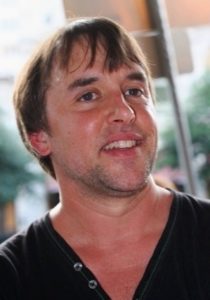
Director Richard Linklater. (Photo by K.E.B.)
Impossibly, each of these moments is wonderful in its own right. Some of the episodes reach farther than the others. Everyone who’s watched Slacker remembers its most famous scene, the overly-familiar young woman (Teresa Taylor, drummer for the Butthole Surfers!) fencing a stolen jar containing Madonna’s pap smear, pubic hair and all. My personal favorite remains the inept burglar caught in the act within an elderly bohemian’s house, only to receive a gentle education on the history of anarchism in America. It’s the most complete and well-rounded episode in the film, a luxurious Carveresque vignette with a beginning, a middle, and an end. It’s also unlike every other vignette in the film. It comes near the midpoint, giving the audience a kind of narrative breather before Linklater’s tour of Austin’s alt-underground bestiary continues.
Considering its unconventional narrative style, Slacker is refreshingly unselfconscious (and unselfcongratulatory) in its rule-breaking. The opening with Linklater in the cab may be the only “meta” moment in the film. For all the rules this self-financed film breaks, it’s comfortable and comforting viewing, the absolute opposite of the avant garde. That’s another reason Slacker sustains after twenty-five years. It’s hard to mock a film-school film and its no-name cast when it’s so relaxed in its own skin.
Any review or retrospective of Slacker is bound to name-drop “Generation X,” and I won’t disappoint on that count. (After all, I’ve got some skin in the game.) Slacker is often called the definitive film of my generation. But when I think of the “great” movies of a generation—Easy Rider and The Big Chill for the Baby Boomers, The Social Network for the Millennials—I see yellowing, curling Polaroids losing their currency with each passing minute; movies of like-aged, like-minded, similarly-groomed people bellyaching they’ve not gotten their due. Slacker is not that film.
Critics sometimes make hay that this is not truly a Generation X film because not every character is of that age. It’s true, but it’s also true the older characters are treated more reverentially than the Gen-X hipsters and artists and kooks. In films like Easy Rider and The Social Network, the older generation is sniffed at with disdain and suspicion. In Slacker, those suspicions are reversed. An age-worn hitchhiker and the elderly anarchist mentioned earlier are voices afforded the opportunity to air their wisdom to a welcome audience, while the specious logics of the younger generation are treated as little more than clever amusements. In the film’s final moments, an elderly man strolls down a street narrating into a tape recorder the quiet poetic wisdom of a long, full life—only to be interrupted by a young man, 20 or 21 (i.e., Generation X), driving an electioneering truck with mounted loudspeakers blaring empty rage about guns and knives solving all political problems. It’s obvious where this film’s sympathies lie. It’s also why this film truly is the definitive Generation X movie: We’re so suspicious of inauthenticity and hollow idealism, we don’t trust ourselves. We don’t even trust our distrust.
For the A.V. Club’s “New Cult Canon” review, Scott Tobias puts his finger on why Slacker is distinguished from other generation-defining movies:
It isn’t enough to think of Gen-Xers as merely jaded and sarcastic; indeed, there’s little of that attitude on display in Linklater’s film. But there is a sense of profound disconnection, a refusal by young people to participate in a system that will bring them no joy and wither their souls. As one character puts it, “Every single commodity you produce is a piece of your own death.”
My personal introduction to Slacker was in 1992, not long after its release, watching the movie on VHS at a Saturday night pasta feed. Eight or nine of us were crowded into a San Luis Obispo duplex’s living room, me and my college-aged friends. Some folks I knew well, some only slightly. In particular, the singer and rhythm guitarist of my band was there. (We were going to be big, but no one understood what our music was doing.) We feasted on plates of red-sauce spaghetti and hot garlic bread. One of the women had made her easy-bake Apple Brown Betty. Others brought ice cream and red wine and bottles of the local beer. Dinner and a movie, on the cheap.
The singer was engaged to marry one of women there, the Brown Betty baker who was a housemate of mine. I was becoming involved with another woman in the room, a second housemate of mine that I would go on to live with for thirteen years. There were likely other sub-plots in that room I was unaware of. We were all young and about to grow old.
We knew, collectively and subconsciously, of the inevitable. We were about to be dropped on a high-speed conveyor belt and told to run as fast as we could to keep up. “Getting ahead” sounded an awful lot like “falling behind” to our ears. Some of the people in that room thought they could step off the belt and steer clear of the inevitable. The rest of us knew, it’s called inevitable for a reason. We were resigned to what was coming, and resigned to it in our own ways.
That’s why Linklater’s cafe au lait Dostoevskys and tin-foil hat savants engage twenty-five years later. The game for the viewer is not teasing apart thought-provoking insights or brilliant dissections of American culture. Most of the musings in Slacker are, in fact, well-adorned horseshit. The game is piecing together how reasonably-educated people would arrive at such philosophies—and everyone in this film has their own philosophy, make no mistake. There’s a postmodern dignity that comes with assembling a personal credo from piece-parts and staying true to it, no matter how whacked-out it may be. And that’s what’s going on in this film, with zero irony and zero sarcasm.
Pre-Internet and pre-Seinfeld, Slacker appears to be a grungy sun-drenched film of a drearier, less-snarky age. I say Linklater offers blueprints for examined lives—not the examined life, but examples of them. This is an earnest film of multiplicity and pluralities. With few exceptions, the characters in Slacker withhold judgment of each other. They give each other the benefit of the doubt. Even when it’s obvious one of them is babbling nonsense from out in the weeds—”We’ve been on the moon since the ’50s!”—the other characters give them their space. There’s a moment in the film where a character takes a swipe at Texas Libertarians. It seems to me that Slacker‘s code of live-and-let-live stands not far off.
Most critics pick up on a line uttered late in the film: “Withdrawing in disgust is not the same thing as apathy.” It’s often interpreted as the film announcing its own thesis statement, possibly the only other “meta” moment. It’s worth taking a closer look.
I don’t see a lot of disgust in Slacker. There’s a bit of it sprinkled around: the roustabout hitchhiker (“I may live badly, but at least I don’t have to work to do it”), a mouthy “anti-artist” berating a hipster at two in the morning, the enraged polemicist in an old-fashioned electioneering sound truck. That may be about it in the disgust department, though.
Slacker 2011, a “re-imagining” produced by the Austin Film Society for the 20th anniversary of the original film.
Listening to the director’s commentary recorded for Slacker‘s 20th anniversary, I gather Linklater’s not terribly interested in elevating emotions like disgust, rage, vengeance, or hatred. His anecdotes regarding Slacker are soft recollections of easier days: A buddy who came through with film equipment, good times working in a T-shirt shop, an ex-girlfriend actor he’s still friends with, that sort of thing. Slacker is a Baedeker for a particular way of life familiar to many a Gen-Xer. Sleeping on couches, trips to dusty used-books stores, pick-up games of Ultimate, the quest for the best burrito—any town with a robust college or arts school has this scene. For people living this life, Slacker is a documentary.
Returning to that immortal line—”Withdrawing in disgust is not the same thing as apathy”—I don’t even think there’s much apathy in the film, at least in its purest form. Shrugging off others’ pet theories or forgoing a work ethic is not apathy. Questioning whether ex-convicts should be denied the right to vote, or wondering if the media used Smurfs to inculcate America’s youth—both voiced in the film—doesn’t strike me as apathetic either.
Withdrawal, however, is definitely the common filament of Slacker, the third rail powering the camera’s dolly as it journeys across Austin. The closest Slacker gets to engagement is a gung-ho “cultural terrorist” selling T-shirts on the street. Slacker‘s characters don’t merely question, they question the act of questioning. The film about not giving a shit is more subversive than most people think.
What did E. M. Forster write in Howards End? “Only connect”? Slacker is “only connect” put to film.
Twenty-five years on, I’ve lost touch with the folks in that San Luis Obispo duplex introduced to Slacker‘s ethos over glasses of red wine. Over the years I intersected with a few of those people, connecting briefly before moving on.
I’ll be bold and surmise that back then, laughing and marveling over Linklater’s creation, none of us wanted to leave San Luis Obispo. We didn’t even want to leave that room. Perhaps some of us never truly left it behind.
I suppose that’s why I rewatch Slacker every few years, just as I reread certain books which have deeply affected me. Rewatching Slacker is reconnecting with a past and making it a present, even if only for a moment. It keeps alive within me a little bit of that necessary withdrawal. It reminds me to only connect.
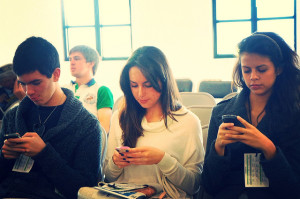
One of my complaints about literary magazines—both the small lit mags of university English departments and the literary lions like New Yorker, Tin House, and so forth—is the peculiar absence of up-to-date technology in their fiction. Characters don’t send much email. People rarely text each other. Voicemail is about the most modern of the Information Age conveniences in contemporary literature, and even then, it’s usually summarized by the narrator rather than “heard” by the reader. Why?
It’s no longer cyberpunk for your characters to have instant access to cyberspace in their coat pocket. It’s not science fiction for your character to read the morning news on a handheld view screen. Literary fiction often preens itself as being “realistic” compared to genre fiction, but how realistic is it today for a mother of two in Long Island not to have a 4G touch tablet in her purse or a FitBit on her wrist reminding her she’s not burned enough calories today?
Unless it’s set in the past or some truly remote locale, you forfeit your right to call your story a work of realism if your characters don’t have access to the Internet and they’re not using it fairly regularly. Digital access is simply that pervasive, worldwide. Yes, there are exceptions. I’m certain some writers think their characters or their settings are those exceptions. Probably not, though.
One reason for technology’s absence in literary fiction, I suspect, is that modern tech screws with storytelling. As greater minds than me have pointed out, we live in a age bereft of bar bets. The Guinness Book of World Records was originally conceived to settle pub arguments, but it was Wikipedia that ultimately fulfilled that burning need. Any question we have about the world or history, the answer can be located in an instant.
It carries into personal relationships as well. People no longer craft letters and post them in a box, then anxiously await a reply over the next days or weeks. When I was young, a friend might say he would call at eight—and so I would have to wait by the phone in the kitchen at eight o’clock, telling everyone else in the house not to make a call because I was waiting for one. My parents would wake my brother and I up in the middle of the night to say hello to our Midwestern relatives because the long-distance rates dropped after 11pm. (Remember paying a premium for long distance calls?) For years, many of my extended family members were nothing more than a tinny voice at the other end of a phone line and a yellowing Kodachrome print in my mother’s photo albums.
For all the nostalgia value of these tales, I’m happy to no longer be bound by such ancient analog technology. The key word of modern communications is instant. Unfortunately, such friction-free gratification often runs counter to a lot of storytelling precepts, things like tension (which involves time) and desire (which involves immediacy).
But mostly I suspect the writers of contemporary literature simply don’t like modern tech. Receiving a pop-up on your phone for an email explaining a long-forgotten lover’s death lacks a certain airy elegance that a hand-penned note on hospital letterhead offers. The terseness of SMS and instant messaging grates against the literary author’s desires for eloquence and nuance.
More broadly, there’s a general disdain for popular American culture in our contemporary literature. SUVs and dining at Olive Garden are often literary code words for boorish, crass people. Sympathetic characters tend to read the New York Times on Sunday mornings, walk to work, raise a vegetable garden, and run into friends at farmers’ markets.
This is one reason why I don’t buy the assertion that contemporary American literature is realistic. Too often it presents a world the writer (and their readers) would like to live in. That’s not hard realism. And this restrictive view of proper living feeds back on itself: literary magazines print these stories, developing writers read these stories and think they represent “correct” fiction, and so they write and submit likewise.
Give your characters the technology they deserve. If you’re writing about the past, that’s one thing, but if your story is set in modern times, don’t shortchange your characters’ resources.
Instead of viewing commonplace technology as a liability to storytelling, consider how vital the technology has become for us. Watch this magic trick, from Penn & Teller’s Fool Us:
The audience feels the risks the emcee is taking when instructed to place his own phone in an envelope. The surprise when the mallet is brought out, the tension it raises. Look at the audience’s visceral reaction when the mobile phones are hammered up. Even though Penn & Teller see through the act, there’s a kind of narrative structure to the magician’s “story.” At each step of the act, the stakes are raised.
Do this: The next time you’re out with a group (people you know and people you’ve just been introduced to), pull up a photo or a message on your smart phone, and then hand your phone to someone else. (Or, if someone offers you their phone, take it, twiddle with it, and hand it to another person.) Rare is the person comfortable with this. We don’t like these little things leaving our grasp.
That means, as writers, these devices are a goldmine.
We are wed to our new conveniences in ways we never were with “old” modern technology like microwaves, refrigerators, or even automobiles. Americans may love their cars, but they are married to their smart phones. Our mobile devices are lock-boxes of email and text messages, safe deposit boxes of our secrets and our genuine desires (versus the ones we signal to our friends and followers). Gossipy emails, intimate address books, bank accounts, baby pictures, lovers and lusts—our lives are secreted inside modern technology. This is rich soil for a writer to churn up, this confluence of personal power and emotional vulnerability.
Why dismiss or ignore this? Why not take advantage of it in your next story?
Early reviews for Bridge Daughter are already coming in:
“Hauntingly beautiful…a disturbing view of an alternate America where children bear their parents’ children for them.” – K. McCutchen, 4-star Amazon review
“I was invested in this story from the first page to the last.” – Lino Mascarucci, 5-star Amazon review
“I read it with tears rolling down my face. … The story will stick with you long after you’ve read the last page.” – RPurvis, 5-star Amazon review
“…makes you think about love, children, and morality. How do you give birth to and raise a daughter until she is 14, only for her to give birth to your ‘real’ child and then die?” – Leah Labbe, 4-star Goodreads review
Remember, if you nominated Bridge Daughter on Kindle Scout, you should have received an email from Amazon with information on how you can obtain your free early copy.
Purchase your digital copy of Bridge Daughter now for $2.99 and have it automatically downloaded to your Kindle on June 7th.
A paperback edition will be available shortly after June 7th. (Keep watching my web site for details or sign up for my mailing list.)
If you nominated Bridge Daughter on Kindle Scout, you should have received an email from Amazon with information on how you can obtain your free early copy.
And thank you for the nomination! You’re the reason Bridge Daughter is being published.
With PKD I remain hamstrung: he’s more speculative and philosophical than the run-of-the-mill hard sci-fi writer. This is right up my alley. I absolutely love PKD’s questions of existence, identity, and freewill that lay the foundations of his novels; and he’s a Bay Area writer to boot. Yet I find him to be a flawed writer, one who was so-very-close to writing perfect novels but had trouble overcoming basic hurdles, such as with cardboard characters and sci-fi’s obsession with “ideas” over story.
(For the record, my list of great PKD novels, in no order, remain A Scanner Darkly and The Man in the High Castle. I’m sure PKD’s fans find that list ridiculously short and astoundingly obvious. I still pick up his work now and then, so who knows, maybe I’ll find another one to add. PKD was more than prolific.)
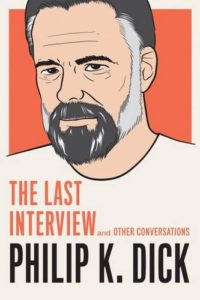
In The Last Interview, PKD mentions to interviewer Arthur Byron Cover his early affinity for A. E. van Vogt. (I recall being fascinated with van Vogt’s Slan in junior high school, a book built from much the same brick as Heinlein’s Stranger in a Strange Land.) PKD observes:
Dick: There was in van Vogt’s writing a mysterious quality, and this was especially true in The World of Null-A. All the parts of that book do not add up; all the ingredients did not make a coherency. Now some people are put off by that. They think it’s sloppy and wrong, but the thing that fascinated me so much was that this resembled reality more than anybody else’s writing inside or outside science fiction.
Cover: What about Damon Knight’s famous article criticizing van Vogt?
Dick: Damon feels that it’s bad artistry when you build those funky universes where people fall through the floor.
It’s like he’s viewing a story the way a building inspector would when he’s building your house. But reality is a mess, and yet it’s exciting. The basic thing is, how frightened are you of chaos? And how happy are you with order? Van Vogt influenced me so much because he made me appreciate a mysterious chaotic quality in the universe that is not to be feared. [Emphasis mine.]
It’s the questions after my emphasis that make the book’s back cover (“How frightened are you of chaos? How happy are you with order?”), and for good reason: They strike near to the heart of the questions asked in all of PKD’s work.
But I’m interested in the line about the building inspector. Damon’s review of Null-A is dismissively brief (although I suspect what’s being referred to here is Knight’s essay “Cosmic Jerrybuilder”). I’ve not read Null-A, but in principle I line up behind PKD on this one.
Reality is not as sane and orderly as many writers would have us believe. If I’m critical of contemporary American literature’s obsession with “hard realism”, it’s because I think PKD has put his finger on a deep and unrecognized truth: Reality is a fragile facade, but what a thorough facade it provides. It’s one thing for the average person to think they have total understanding of things they have no access to—the heart of a politician, the mind of a celebrity, the duplicity of a boss or coworker—but it’s truly tragic when a writer writes as though they have this reality thing all sewn up.
In contemporary literature, there are often moments where the narrator will have some moment of clarity into another person’s life. Usually this moment is presented as the epiphany, although it’s rarely epiphanic. (See Charles Baxter’s “Against Epiphanies” for a better argument on this point than I’m capable of producing.) Never mind that these pseudo-epiphanies are the inverse of contemporary lit’s obsession with quiet realism and slight personal movement. These mini-epiphanies are the literature’s cult of poignancy, and they’re often not interesting because they’re predictable, rational, and orderly.
There is chaos in our world, and it produces strangeness and unexpectedness that is neither poignant nor tied to fussy notions of realism. This, I think, is what PKD was referring to.
My only quibble with PKD’s observation is that I don’t see chaos as an external dark force in the universe. We are the chaos. We produce it. I’m less concerned about the wobble in Mercury’s orbit than the ability for just about anybody to murder given the right circumstances. (See the 2015 film Circle for an exploration of just that.)
The human psyche is like a computer performing billions of calculations a second. Most of the results are wrong, some are off by orders of magnitude, but the computer smooths out the errors to walk a thin line of existence and consistency. Even with these errors, the human psyche assures itself that its footing is steady and sure, when in fact it’s walking on the foam of statistical noise. The number of calculations it gets right are the rounding error.
The noise and errors do not matter. Our minds have the cognitive plasticity to bind contradictions into coherency. We can absorb chaos and make sense of it. This, I think, is close to the heart of PKD’s novels.
Van Vogt has just revealed, for the first time as far as I know, that during this period [while writing Null-A] he made a practice of dreaming about his stories and waking himself up every ninety minutes to take notes. This explains a good deal about the stories, and suggests that it is really useless to attack them by conventional standards. If the stories have a dream consistency which affects readers powerfully, it is probably irrelevant that they lack ordinary consistency.
Reading closely, Damon isn’t exactly agreeing with PKD’s comments (or mine, for that matter), but he does concede some flexibility on the supposed rigid strictures of fiction writing.
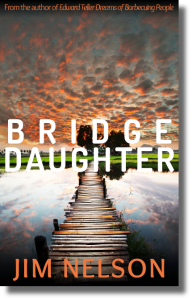
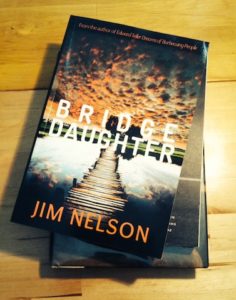
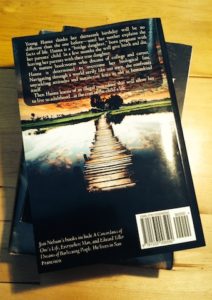
The paperback proof of Bridge Daughter arrived on Thursday. I am, as the kids say, majorly stoked:
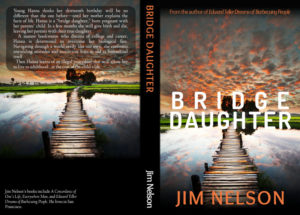
The paperback will be published through Amazon’s CreateSpace service. I must say, I’m impressed with what I’m seeing with this proof. I picked up a CreateSpace sample book a few years ago (at an AWP) and something about it didn’t “feel” right. This copy, however, looks and feels great. The cover photo is vibrant, the interior print is even and crisp across the page, and the binding feels firm. Print-on-demand technology had its problems when it was introduced, but it appears the technology has stabilized since then.
Still awaiting word from Kindle Press on the novel’s pre-release and release dates, which drives the availability of the ebook and paperback. I’ll be announcing those dates here on my blog as well as on my mailing list and Facebook page.

 Sandra “Jeanz” of Jeanz Book Read ‘n’ Review has posted a wonderful review of Bridge Daughter. She also graciously interviewed me about the book, both its background and inspiration as well as the future of Bridge Daughter as a book series.