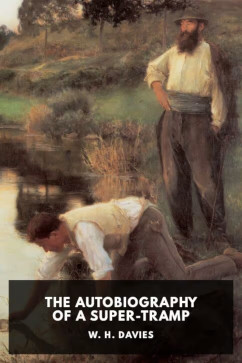
Last month, Standard Ebooks published a new edition of The Autobiography of a Super-Tramp by W. H. Davies. I’m announcing it here because I produced the edition, which entailed formatting, proofreading, assembling the metadata, and handing it off to the Standard Ebooks team for publication.
I’ve wanted to produce a book for Standard Ebooks since I first learned of their organization years ago. Getting an ebook over the finish line and accepted by them is a milestone for me.
If you’re unfamiliar with Standard Ebooks, they’re an open-source, volunteer-driven project producing high-quality ebooks of works unencumbered by copyrights. They’ve put out editions ranging from modern genre fiction to classical and ancient literature. They have a rigorous style guide, which makes these ebooks handsome, polished, and a pleasure to read. (I’ve found them to be of even higher quality than ebooks from some major publishers.) Best of all, their ebooks are free for anyone to download and keep.
I was thoroughly impressed by Standard Ebooks’ support. Not only do they have comprehensive documentation for building the ebook, but also the style guides I mentioned, and custom tooling for assembling and proofing the work. Whenever I ran into trouble, they were always quick to respond on their newsgroup.
Take a gander at their catalog. If you’re a curious reader, you’re bound to find something striking your fancy. If you’re interested in contributing, check out how you can get involved.
“Hobohemia”
I tend not to discuss my works-in-progress until they near completion, but I’ll make an exception here. My next novel (assuming I finish it!) regards a drifter wandering the Pacific coast between the world wars. My research led me to Davies’ Super-Tramp, which Standard Ebooks did not offer at the time, but had listed on their wanted list. I realized I could read the book as I worked on it. Two birds, one stone.
My work-in-progress is set in 1925, about seventeen years after Davies’ autobiography was first published. 1925 was also near the end of a period in American history where significant numbers of tramps and hoboes traveled the country. They sought work, relief, or simply a chance to experience all the natural beauty the United States had to offer. As H. L. Menken put it,
Tramps and hobos are commonly lumped together, but see themselves as sharply differentiated. A hobo or bo is simply a migratory laborer; he may take some longish holidays, but sooner or later he returns to work. A tramp never works if it can be avoided; he simply travels.
A recent article by Caroline Fraser in New York Review of Books covers this period of hobos and tramps in better detail than I can offer. She describes what might be called the Golden Age of Vagrancy:
A hundred years ago, it seemed as if everyone wanted to be a hobo… Dreams of a tramp utopia, once termed “hobohemia,” produced classics of Americana. Recorded in the 1920s by [Harry] McClintock, the rollicking hobo anthem “Big Rock Candy Mountain” [sic] envisions an itinerants’ paradise where cigarette trees bloom and streams of alcohol trickle down the rocks. … The contradictory nature of the hobo, a character without home or possessions who embodied good-natured liberty and a gap-toothed joie de vivre, gave rise to a persistent sense of envy.
Davies appeared smack in the middle of this age of tramps and hoboes. These impoverished migrants were not uniformly uneducated or illiterate, as his autobiography shows.
Super-Tramp is a remarkable read, unadorned and understated in even the most shocking of situations, such as when Davies loses his foot in a train accident. This event, which curtailed his tramping days, is described so obliquely, and with such calm, I had to reread the passage to make sure he wrote what I thought he wrote.
Davies was not the only tramp documenting this way of life. Bart Kennedy also wrote several books on life spent on road and rail, with A Man Adrift being his most important by several accounts. Like Davies, Kennedy opens his book young and penniless in England, drawn to wander the United States out of a sense of awe for the young country’s purported freedoms and boundless natural beauty.
For my purposes—writing a novel about a loner drifting freely across the western United States—the most significant chapter in Kennedy’s book is the appropriately-titled “On Tramp”:
To be penniless and on tramp is a curious experience. You care for no one, and no one cares for you. Things about you seem vague and elusive. You are in a mental chaos. You are a link dissevered from the human chain. And you wander hardly knowing or caring where you wander. … Who you are or what you were matters not. You may be a man with a past, you may be a man with a future. You may be one who has belonged to the topmost class; you may be a labourer, or a man from out the filth of the slums, or a dispirited low-down thief.
Kennedy’s bleak outlook, which veers into a cynical romanticism, stands in almost direct contrast to Davies’ even-keeled account. Davies is less philosophical, and less analytical, but no less thoughtful than Kennedy:
Although I had at this time become lazy, losing almost all sense of respectability, I often reproached Brum for the aimlessness of this existence; telling him we must seek work and attend to other wants than those of the body. I would tell him of the arts, and how the cultivation of them was lost to us through a continual lack of funds. I told him of the pleasures of reading, visiting picture galleries, museums and theatres, and of the wonders of instrumental music, and of the human voice. …
We often go for days without reading matter, and we know not what the world is saying; nor what the world is doing. The beauty of nature is forever before my eyes, but I am certainly not enriching my mind, for who can contemplate nature with any profit in the presence of others. I have no leisure to make notes in hopes of future use, and am so overpacking my memory with all these scenes, that when their time comes for use, they will not then take definite shape. I must go to work for some months, so that I may live sparingly on my savings in some large city, where I can cultivate my mind.
These insights from Davies and Kennedy come nowhere near the common caricature of tramps, jolly homeless men in shabby clothes, bearing five o’clock shadow and an alcoholic’s rosacea nose, smoking discarded cigars and carrying handkerchief bindles.
Davies’ autobiography has the lens of a documentarian, a plain-speaking record of incidents and happenstance set against a pastoral backdrop of North America at the turn of the last century. (It is not a leap to compare it to Orwell’s Down and Out in Paris and London.) While Davies’ contemporaries were producing fin de siècles of decadence and decay, Davies described an earnest America on the rise, for the better or worse.
Breakfast in America
Although Davies and Kennedy hail from the British Isles, their books contribute important links in the history of American wanderlust literature.
Getting off the grid has an auspicious history in this country: From Transcendentalists like Walt Whitman and Thoreau, through the Age of Vagrancy documented by Davies and Kennedy, and into the 1950s and 60s, where no less than three styles of “life on the tramp” appeared in popular culture: the escapist beachcombers of Tiki and exotica music, the Kerouackian road-trip sagas popular with college students, and the middle-class tales of men ducking out of their button-up, chained-down lives, such as Updike’s Rabbit, Run.
If all-American wanderlust ever peaked, it would be among the counterculture of the 1960s, a mass youth movement essentially defined by the impulse to up and leave, recreating one’s identity in the process. Fraser points this out in her review when she recounts Bob Dylan’s youthful zeal to restyle himself a modern-day hobo-philosopher once he’d arrived in New York City.
Although a century has passed since Davies and Kennedy, the romanticized tramp’s life has not diminished in the modern popular imagination. The temptations of the wandering life are hardy and durable. You’ll find it among couch-surfers, backpackers wandering the Third World (with Alex Garland’s The Beach being its finest example), and the #vanlife movement.
The most extreme resurgence has to be with Christopher McCandless, the young man who abandoned an easy well-heeled life, drifted across the western United States, and died in the Alaskan interior after making a go at subsistence living there. McCandless admired Davies, going so far as to adopt the moniker “Alexander Supertramp.” (This is how I first learned of Davies’ autobiography, and have long wanted to write about such a character.) His example inspired countless young people, with many dying in a vain attempt to, in McCandless’ words, “Kill The False Being Within.”
As I’ve written before, the debate over the cause of McCandless’ death has become a decades-long fixture in America’s culture war. It centers on the very questions that Thoreau, Davies, Kennedy, and even the #vanlife movement have faced:
Should we admire or damn those who dare to escape their responsibilities to live a freer life? When they fail, should we honor their attempt? Or, should we hold them up as a warning for those curious to follow?
And if you look back at the list I’ve compiled here, just about all of them failed or collapsed in some way. Not only did Davies have to set aside his wanderlust due to injury, other tramps he meets find the demands of life on the road unsustainable. The hippy communes have all shuttered; the #vanlife movement has suffered; and Rabbit wound up not running very far. Even Walden has been used as a warning, not a blueprint, for subsequent generations toying with their own ideas of living off the grid.
Of Walden, E. B. White wrote it’s “the report of a man torn by two powerful and opposing drives—the desire to enjoy the world…and the urge to set the world straight.”
The same can be said of Davies’ autobiography. Contrary to George Bernard Shaw’s preface, Super-Tramp is not quite the unrepentant declaration of an anarchist’s credo he makes it out to be. It concludes with Davies settling down in an English country house, a return to the domesticated life he elected to abandon at the outset. There he writes,
People are not to be blamed for their doubts, but that they make no effort to arrive at the truth. However much people of a higher standing may doubt the veracity of certain matters, I have the one consolation to know that many a poor man, who is without talent or means to make his experiences public, knows what I have written to be the truth.
A desire to enjoy the world, and the urge to set the world straight: This is the tramp’s life.