
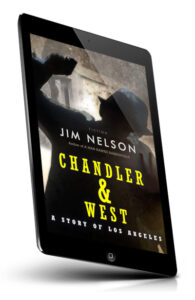
A Goodreads giveaway for fifty Kindle editions of Chandler & West has started.
There’s no cost or obligation to enter. Sign up for your chance to win!
The giveaway ends May 19th, when the winners are announced.
A Goodreads giveaway for fifty Kindle editions of Chandler & West has started.
There’s no cost or obligation to enter. Sign up for your chance to win!
The giveaway ends May 19th, when the winners are announced.
Back in 2007, I had an unusual encounter at the Geary Club, a San Francisco bar near Union Square. A guy on the barstool beside me laid out his big idea—it was an era of Big Ideas—called dublit.com, a web site for people to freely upload and listen to spoken word recordings. It was to be a repository of audio essays, non-fiction, short stories, chapters from books, and so on.
I told him I was a writer, and I was interested in supporting it, if I could.
Fast forward one year: dublit.com’s launch party was a smashing success, and I vowed to make good on my pledge. Using nothing more than my iBook’s microphone and built-in audio software, I recorded two of my short stories, “Of Potential” and “Some of the Things He Thought That Year” (both available in my collection, A Concordance of One’s Life).
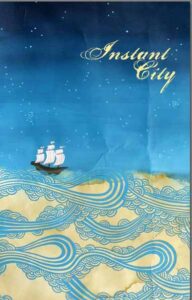
Later, San Francisco lit mag Instant City published my ode to The Owl Tree (another Union Square bar) and its recently-deceased proprietor, a lifelong city bartender and colorful character named C. Bobby. I read the remembrance at the magazine’s release party, which was recorded and made its way onto dublit.com as well.
I recently discovered these old spoken word recordings on a backup. (I thought they’d been lost.) I uploaded them to the Internet Archive, where they should remain available for years to come.
You’re free to listen or download them. I’ve included a PDF of each short story alongside the audio, if you prefer to read or read along:
Sadly, many of the beautiful and sublime things I’ve mentioned are now gone: Geary Club, C. Bobby and The Owl Tree, the original dublit.com, even Instant City. So much loss against the wages of time, which ruthlessly spends down our youth with no regard for our future.

I’ve added a new page to this site, a little side-project I’ve been working on for a while now called “A somewhat subjective list of San Francisco streets with confusingly similar names.”
It’s pretty much what’s printed on the tin, but with a few surprises. Why are there two Mason Streets in the city? If Division Street divides two neighborhoods, what does Divisadero Street divide (if anything)? And is it true that two of the numbered east-west streets actually intersect?
It’s a goofy but fun way to look at San Francisco’s layout and history. I hope you get as much out of reading it as I did putting it together.
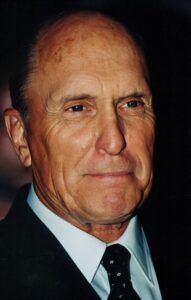
Twice in the past twelve months I’ve found myself taken aback by the death of a Hollywood actor.
First was the death of Gene Hackman, and then earlier this month, the passing of Robert Duvall. Both were generation-defining actors who played some of the most memorable Hollywood roles in the last fifty years.
They were also the kind of resilient actors who brought a hushed, understated presence to their roles. While masculinity is under attack in certain quarters for its toxicity, these men portrayed a quieter, sturdier kind of masculinity worth emulating.
However, I’m not here to discuss their work. I want to point out the Associated Press obituary of Robert Duvall, which offers this endnote:
Former Associated Press Hollywood correspondent Bob Thomas, who died in 2014, was the primary writer of this obituary.
In other words, the writer of Duvall’s obituary died twelve years before Duvall’s obituary was published.
I’ve long been fascinated with the writing process behind obituaries. It’s a journalistic art form clouded by a professional secrecy uncharacteristic of journalism and its desire for transparency. (“Democracy dies in darkness.”)
Obituaries for the powerful and famous are written years in advance of the person’s passing. These obits are not complete, however. A pending obituary remains open and subject to further edits if some new and significant chapter of the person’s life blooms.
Papers and wire services will prepare and sit on hundreds, even thousands, of unfinished obituaries, each a miniature biography-in-development of a full and public life. Newspapers and wire services jealousy guard this corpus of material, not even acknowledging they’re preparing an obit for any particular person. Only death seals an obituary shut, like nailing a coffin closed.
All this prep work is due to journalism’s tight deadlines, since an obituary is expected to be published within hours, not weeks, of the subject’s death. These realities shroud the whole process with a morbid pragmatism that borders on the absurd.
This is what led me to write my short story “The Obituarist,” published by North American Review and collected in my book A Concordance of One’s Life. The story regards a professional obituary writer who, faced with his own mortality, contributes an interview to be used for his own obit.
From the story:
My editors and my fellow obituarists have a little list, The Nearly Departed we call it, celebrities and politicians and artists and authors whom we agree are not long for this world. The unlucky are crossed off the list the same day their obit hits the back pages of the Times. The unluckier are those added when that slot opens. There is no announcement, no press release of their addition. My subjects are not informed privately.
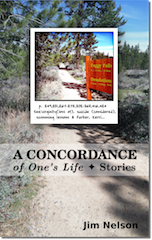
A few years after NAR published “The Obituarist,” I wrote a post for their blog explaining my inspiration for the story, as well as the peculiarities of the obituary writing process.
One peculiarity is when the obituary’s subject outlives the writer, such as what happened to Bob Thomas and Robert Duvall. Back in 2014, I learned that a similar situation happened when Mickey Rooney passed away. I’m certain there’s many other examples to be found.
Sometimes the paper prints the obituary while the subject is still alive. This famously happened to Mark Twain (“The report of my death was an exaggeration”), but also to Axl Rose, Abe Vigoda, Alfred Nobel, and more. One of my favorites is the note Rudyard Kipling sent to the paper which printed his obituary: “I’ve just read that I am dead. Don’t forget to delete me from your list of subscribers.”
Another peculiarity is much rarer than the prior two, that is, when the subject is permitted to read his obituary before his death. In at least one case, a paper acquiesced to publishing an obit knowing that the subject was not dead: Huckster and showman P. T. Barnum convinced a New York newspaper to print his, just so he could read it before passing away a few days later.
So, while I mourn the death of Robert Duvall, I also tip my hat to AP writer Bob Thomas, who passes into infamy in a manner unique to the career of an obituary writer.

The day has arrived—my new novel Chandler & West: A Story of Los Angeles is now available.
As I’ve written previously, this is a passion project, a novel about two writers I’ve read and admired and studied for years now. My book centers on a fictional meeting of hard-boiled writer Raymond Chandler, banging out the manuscript to his debut The Big Sleep, and Nathanael West, himself working on his opus The Day of the Locust.
Chandler & West is also a love letter to Los Angeles, especially the L.A. during the Golden Age of Hollywood.
Pre-release sales have been better than expected. They’re so good, yesterday I noticed the book sitting at #37 on Amazon’s U.S. Biographical Literary Fiction best sellers chart:
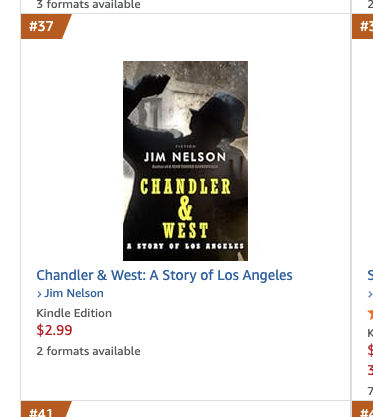
The Kindle edition is available at a special limited-time price of $2.99, which will go up later this month. A paperback edition is also available. And, Kindle Unlimited subscribers may read it for free.
You can learn more about the novel on Amazon, or by reading its page here on my web site. There’s a sample chapter available as well.
Exciting times—this book took quite a while to finish, and I’m relieved to finally have it out there.
I was raised in a house brimming with books. Children’s books especially, but plenty of books for teens as well. I inhaled these books, reading some three or four times, just so I could reenter their worlds and experience them one more time. My brother and I were never in want of books, although my parents were not especially well-to-do back then.
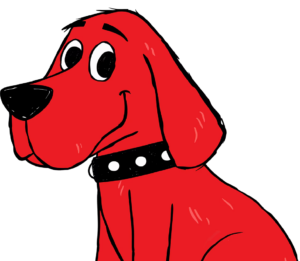
The reason for this surplus is that my mother worked for Scholastic Books—yes, the Scholastic Books that hosted book fairs at your school when you were young, the company that published evergreen classics like Clifford the Big Red Dog, Goosebumps, and Encyclopedia Brown, Boy Detective. She did not work at the company’s New York editorial offices—what a different childhood that would have been—but rather at a West Coast distribution warehouse located in sleepy Pleasanton, California. She was in her early twenties when she landed her position at Scholastic, and it was a bit of a dream job for her.
My mother was a voracious reader, and she wanted to pass her love of books on to her children. Her determination paid dividends. I could read by age three, although I was not an active reader. I preferred running around our quiet suburban neighborhood, playing kickball and riding my Big Wheel from one neighbor’s home to the next. I was one of those fearless/clueless kids that would walk up to a front door, ring the bell, and ask the parent if their child could come out and play. (I often did this during dinner time, much to the annoyance of my friends’ parents.)
It was in this suburban idyll that my mother introduced me to books. Scholastic permitted employees to take home a small number of remaindered and returned titles from the warehouse. When my mother came home from work, she occasionally would be carrying a children’s book or two. I was completely uninterested at first, and so these books were stocked away in a hallway closet, unread.
Finally, when I was five or six, my mother suggested I might enjoy Encyclopedia Brown Solves Them All by Donald J. Sobel. For whatever reason, I picked it up, lay on the couch, and consumed the book from start to finish in one read-through.
For those who don’t know, Encyclopedia Brown is a child sleuth who runs a detective agency out of the garage in his home. Propitiously enough, his father is also Chief of Police for the Smalltown, USA suburbia Encyclopedia’s family lives in. Each book in the series features ten (so so) short kid-centric mysteries, such as stolen ice skates and missing hamsters. Right before Encyclopedia Brown solves the “crime,” the reader is asked to guess the solution before turning to the answer in the back of the book. (In this way, Encyclopedia Brown mirrors the Golden Age of Detective Fiction, where books also halted the narrative to challenge the reader to solve the mystery before continuing.)
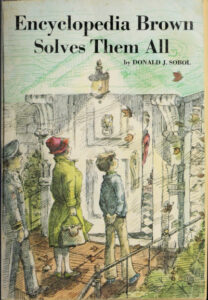
Hooked, I read as many books in the series as she could bring home. From there, my reading habit grew outward. My mother happily brought home more challenging work for me to read.
The cultural, racial, and sexual shifts in America made the 1970s a rather shaggy and complicated time to be a child. This employee’s perk of bringing home remaindered books meant a great many of the titles I read were published in the 1950s and early 60s. The illustrations depicted working dads in ties and wingtips, and homemaker mothers in dresses and pearls carrying spatulas. Boys had haircuts like Marine recruits, or wore coonskin caps. Girls practiced ballet, rode horses, or, if they were a tomboy, tagged along with the boys on whatever wild adventure they cooked up. Some of these books had been published a mere ten years earlier, yet they read like they’d arrived via a bookmobile time machine.
Damn or praise these books on their political merits, the point is, I became an active reader at a young age. My reading diet quickly grew omnivorous.
I began to read the newspaper every morning. Not merely the comics page, but much of the front section, and especially the Opinion and Op-Ed pages. When I was bored, I would pick a volume of an encyclopedia off our family room shelf and simply browse it, page by page, until I found some topic I wanted to read more about. Later, I did the same with the colossal People’s Almanac #2, which I honestly believe I read in its entirety. (Not from front to back, but by dipping into articles as they suited me over the years.) All of this came about thanks to my exposure to Scholastic’s books.
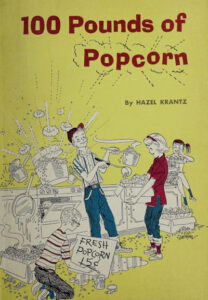
This Flickr collection of titles sold by Scholastic Books in the 1960s and 70s really takes me back. I’ve not read all these titles, but I recognize the covers of almost the entire collection. As a young boy, books about fancy dolls and show horses were not really my thing, but I still treasured anything written by Beverley Cleary and Judy Blume, as well as the intense psychological portrait of Harriet the Spy. Encyclopedia Brown made me want to be a detective; Alvin Fernald made me want to be an inventor; 100 Pounds of Popcorn made me want to be an entrepreneur. Every young person who read the Mad Scientists’ Club’s books wanted to join.
There are other books that stayed with me, but whose titles I’ve forgotten. One was about a boy blinded by a firecracker who has to learn Braille and navigate the world with a seeing-eye dog. Another regarded a pudgy boy who lives in a New York skyscraper with his fitness-obsessed parents. They want to send him to a “fat camp” boarding school which, he learns in confidence from an admission counselor, doesn’t actually care what the kids eat, or even if they exercise. The boy spends his summer break devouring ice cream sundaes and perfecting his admissions essay. It’s a subversive little book, and definitely the product of 1970s, and not 1950s, America. My young mind, raised on the coy cynicism of Looney Tunes and MAD magazine, was magnetically attracted to anything eager to thumb its nose at authority.
Over time, my mother got to know many of the Scholastic editorial staff in New York City, even if their friendship was purely via long-distance telephone conversations. She knew R. L. Stine, for example, creator of Goosebumps. (He was more familiar to me as Jovial Bob Stine, editor of Scholastic’s Bananas magazine, their family-friendly substitute for MAD.) Somewhere in my parents’ house is a copy of Clifford the Big Red Dog signed by Norman Bridwell.
My mother loved working for Scholastic, because she cherished children and wanted every child to have books. She did that by providing free books to our school’s Scholastic Books Fairs, to ensure no one went home empty-handed. And she made sure our teachers’ classrooms had things like children’s dictionaries on their shelves, or any other reference material they lacked.
She grew up on a ramshackle farm in the Mississippi Delta, raised by her grandparents, where the muddy soil was tilled by mules and mosquitoes clouded the muggy marsh air. For her, books were a cheap way to escape penury and live vicariously in another world, if even only for a few hours at a time. Books were “portable dreamweavers,” and she wanted to share their dreams.
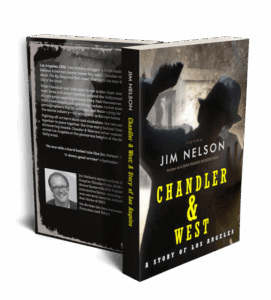
It’s here—the Kindle and paperback editions of my latest novel, Chandler & West: A Story of Los Angeles, may now be reserved on Amazon.
The Kindle edition is available at a special limited-time price of $2.99, which will go up after the book has been released. If you order now, it will appear on your Kindle reader the day of its release (February 9th, 2026).
This is my latest passion project, a novel about two writers I’ve read and studied for many years now. It centers on a fictional meeting of hard-boiled writer Raymond Chandler, banging out the manuscript to his debut The Big Sleep, and Nathanael West, himself working on his own magnum opus The Day of the Locust. Together, they scour the landscape of Los Angeles, 1939, which was a rich and dynamic time in the history of the city.
You can learn more about the novel on Amazon, or by reading its page here on my web site. There’s a sample chapter available for reading as well.