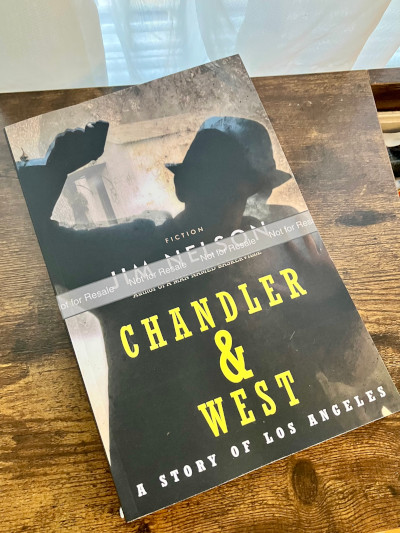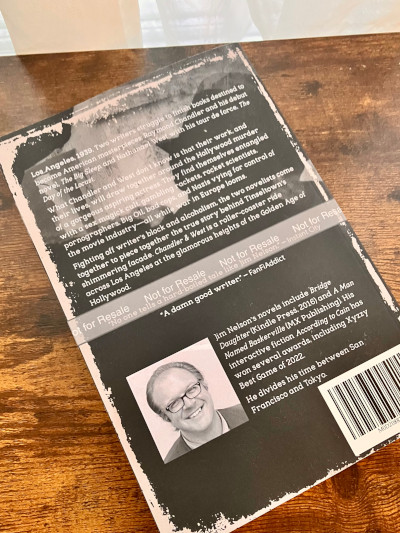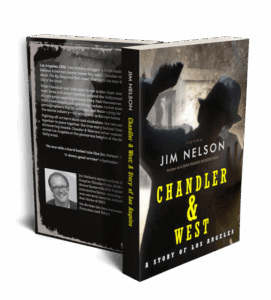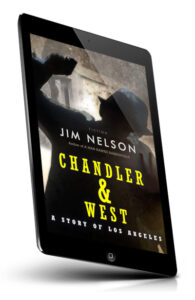
Some exciting news—here’s the proof copy of the paperback for Chandler & West, my upcoming novel.
If you haven’t been following along, Chandler & West is a new novel about two of Los Angeles’ greatest writers—Raymond Chandler and Nathanael West—and set in 1939 Hollywood.
It’s a new crime novel about two of Los Angeles’ greatest writers under unusual conditions, while they toil to finish their novels (Raymond Chandler’s The Big Sleep, and Nathanael West’s The Day of the Locust).
I’ve now posted a sample chapter from the novel, available to read online. It gives a good taste of what the book’s about, especially as a snapshot of Raymond Chandler’s life around 1939.
If you’d like more information, please consider subscribing to my newsletter. Otherwise, keep watching this space for announcements as the release date approaches.
I’m proud to announce my next upcoming book, Chandler & West: A Story of Los Angeles. It’s a new crime novel about two of Los Angeles’ greatest writers, set in the Golden Age of Hollywood.
This book has been a true labor of love, in terms of research and preparation, but also in the writing. Getting this book over the goal line has meant dealing with numerous hurdles, but the moment has finally arrived.
I anticipate to release Kindle and paperback editions in the first quarter of 2026.
If you’re interested in learning more, I encourage you to sign up for my newsletter. (You’ll be able to download a free book in the process!) I’m sharing sneak previews and sample chapters with newsletter subscribers, as well as a chance to sign up for Advance Review Copies (ARCs) of the book prior to its release.
Keep watching this space for more information on my latest endeavor.
Non-stop tweets and retweets promoting their books, as well as books by their friends. “What you call ‘social media,’ we call ‘free ad space.'” Apparently, there’s no such thing as too many hash tags in a tweet.
Two: The hustler
They pepper your timeline with tweets documenting their perpetual-motion writer’s life: Workshops, retreats, conferences, book signings, phone calls with editors, selfies with other indie authors. They’re living la vida loca, baby.
Three: The charmed life
Anecdotes about their cats. Magazine-style photos of perfect chai lattes. Dream-vacation photos of rolling green European countrysides. Oh, yes—did they mention they’re spending four weeks in Key West to develop their next novel?
Four: The political animal
Screw books, they’re on Twitter to snark about every D.C. dust-up du jour. Following even one of these accounts will poison your timeline with screaming matches between people who refer to politicians by their initials.
Five: The mover and shaker
Lots of screenshots of Kindle sales reports and KU normalized page counts. Tweet-threads on how to exploit Amazon book keywords and categories. The occasional nostalgia post on finagling that sweet BookBub Daily Deal years ago.
Six: The tea sipper
Drops a tweet every two to six weeks about something absurdly human that happened to them on the way to the pub. For some reason, this type is always British.
Seven: The old oak
Daily pronouncements about how the indie writing scene has changed since they got in on the ground floor waaay back in 2019. Had one bestseller back when you could game the system and get on USA Today‘s bestseller list for a week.
Eight: The unrepentant one
Laughingly brags about using AI to write eight-dozen books a month, all moneymakers. “You suckers are doing this the hard way.” Oddly, they have nothing of substance to say about any other book on the planet, even obvious ones like The Firm, Fight Club, or Green Eggs & Ham. Not an actual author.
Nine: The griper
Never happy with any rating below five stars, and never happy with any review that mentions a problem with their story. What does it take to satisfy these damn readers, a back massage? Stand back, this type is a ticking time bomb.
Ten: The agented
In case you didn’t hear the news, they added it to their account name: “Joe Blow is Agented.” Casually drops tidbits from their latest phone call with their agent, who is agenting them. Offers followers soothing tweets that, one day, if they work hard, they’ll all manage to rise from the trenches and find an agent.
Eleven: A star is stillborn
Mission accomplished! Agent acceptance, book contract signed, manuscript sent off to the editor—this type is last seen boarding the rocket ship to fame and success. Nine months later, they’ve mysteriously deleted all those tweets and switched their account to selling scented bath oils online.
Twelve: Yet another bot
Likes six posts you wrote months ago, follows you, and DM’s you, all in a span of seconds. Has an @-handle with more numerals than your Social Security number. Account name is a Big and Famous writer, who (in real life) has better things to do than maintain a presence on X/Twitter.
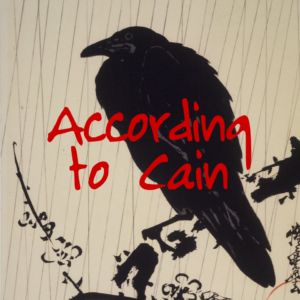
A brilliant oddity, According to Cain puts you in the shoes of a detective who has to go back and solve humanity’s first murder. It prizes observation and forces you to turn your brain on, which is true of all the best interactive fiction. It’s sharp as a slayer’s knife and gorgeously rendered. Go ahead and play it first. Or last if you’re the kind of person who likes to save the best for that one final plunge into the darkness of a long winter’s night.
Published on December 28, 2024, this is like finding a nice unopened Christmas present overlooked until the end of the next summer. Thanks, Winter is Coming. Ho-ho-ho!
Follow this link for more information on Cain, including how to download it or play it in your browser, if you’ve not already.
There’s a software industry maxim: “Always be shipping.” That means, if you’re not writing software, you’re not shipping software.
The same thinking applies for writing novels, short stories, self-help guides, biographies, and so on. If you’re not writing (or editing, or proofing), you’re not moving closer to getting your work published.
The following advice will sound familiar to anyone who’s read a book or taken a class on how to write a novel:
“Write an hour everyday.”
The idea behind this bit of sage counsel is that, by writing a little bit everyday, you will eventually reach your goal of writing a novel (or a short story, or a movie script). Another way I’ve seen this phrased is, “If a novel manuscript is 350 pages long, that means if you write a page everyday, you’ll have your novel finished in under a year.”
I’m not a fan of these hard-and-fast rules of writing. For one, they’re often difficult to stick to. Like a strict diet or physical exercise regimen, missing a day or two usually leaves behind a sizable amount of guilt. Guilt may get you back to the keyboard and typing, but it’s a horrible emotion to overcome when you should be focused on your characters and their challenges.
Let me offer a slight twist. Instead of “write an hour everyday” or “write a page a day,” find a regular writing schedule and stick to it. In other words, come up with a schedule right for you.
Once a week
I don’t write everyday. I tried it on a number of occasions. It was not productive.
After a lot of experimentation, I found my best work came when I wrote once a week. I’ve written a number of novels over the past ten-plus years, all while maintaining a weekly, not daily, schedule.
With that one allotted day, though, I spend eight hours writing. That’s writing with minimal interruptions for eight hours straight, like an office worker in a cubicle. And note that I do not require a certain number of pages or words be written in those eight hours. I do my best. That’s all I can ask of myself.
Over the course of my writing day, I’ll pause for lunch. I eat at my computer and go over what I’ve produced so far that morning. Usually I write at cafes, although during the pandemic, I learned how to write at home without interruptions.
The people in my life know that one day a week is off-limits. If something comes up that interrupts my schedule, I make arrangements to write on a different day. It takes a lot to pry that one day from my grip.
Plus, the way I write, I’m usually just starting to cook when I reach my first hour writing. “Write one hour a day?” Juices start flowing at the end of the first hour, and words are still coming at a fast and steady pace. Why stop right when things are going well? I’d rather bank those seven hours a week into a single day, and add another hour on top of them for good measure.
I’ve encountered some skepticism from other budding writers about my routine. Like most writing lore, “write an hour everyday” has become ingrained as one rule among dozens for becoming a successful writer—a kind of mantric or devotional routine that guarantees results. Your novel was rejected? Well, did you skip a day while you were writing it? Also, did you open your book with weather?
“Write an hour a day,” is sound advice in spirit, but not in practice. Better advice is to find a productive writing routine, and stick to it.
A second job
This is the important part: It’s not a wasted day. As I’ve told my family, writing is my second job. It’s not a great-paying job, but it is a job.
Time to write doesn’t magically appear. People in your life will always find some other priority for you. They’ll tell you that you can write later. You have to be firm on this point.
You don’t have to spend a full day a week writing to produce a novel. If you can set aside a few hours twice a week—say, two dedicated evenings—you’ll be surprised how much writing you can get done. But you will want to stick to your schedule for it to work.
One writer I admire is comic book legend Peter Bagge. Apparently, Bagge is infamous in the comics industry for his work ethic. Every morning he rises, dresses in business-casual clothes, and go to his home office to produce comics. He’s not working from home. His office just happens to be in his home. He puts in a full day, five days a week.
I don’t have the success to write everyday and make a living wage off my work. Still, I made a commitment to myself that I would treat the one day a week I had free as a work day, just like Bagge does. I rise, eat breakfast, head to the computer, and write, just as if I was heading to the office.
Silence your phone. Close the door to the room. Put on a pair of headphones. Turn off your computer’s Wi-Fi to avoid the temptation to surf social media.
If you’re not writing, you’re not producing. Make the time to write.
At an AWP panel discussion in 2014, Lawrence Block related a bit of wisdom he’d learned from another author: “Take care of your backlist, and your backlist takes care of you.” He added the advice had served him well over his writing career.
By that point, I’d been writing fiction for several years. I’d met many authors (aspiring and published), attended numerous workshops (formal and informal) and worked with many writing teachers in different genres. Yet, in all that time, I’d never heard this piece of advice. I found Block’s advice to be quite sage, and I continue to believe in it. (It’s also a rare example of writing lore that is worth paying attention to.)
The problem was, in 2014, I didn’t have a backlist. How could I take care of that which does not exist?
(Quick terminology clarification: The standard use of the term “backlist” or “back catalog” refers to a publisher’s catalog of titles released in prior years but still in print or stock. I took Block’s usage to indicate the sum of an author’s work, in print or otherwise.)
He went on and told the panel audience that, when he investigated Amazon’s Kindle Publishing, he realized he could release all his out-of-print books in electronic form and sell them direct without having to shop them around for a publisher. He went through his old contracts and reacquired rights for books his publishers had let lapse. He even paid his agent fifteen percent of the royalties he earned on his direct-sale ebooks “because it was the right thing to do.”
This is a great example of taking care of one’s backlist.
In many ways, Lawrence Block persuaded me to jump onto the Kindle bandwagon. On my way home from the conference, it occurred to me that I was selling myself short. I’d published several short stories in literary journals in the U.S. and Britain, enough to put together a story collection. A few years earlier, a small non-profit in Oakland published a short run of a novella they’d commissioned from me. A big-name author might not call it much of a backlist, but for a small-fry like me, it was a start.
And it was a significant start. I turned my oh-so-modest backlist into two Kindle ebooks. The experience reinvigorated me to finish my first novel, a book I’d been working on and stewing over for nearly fifteen years.
Today, I’ve written seven novels, and have an eighth on the way. I’m hardly an active blogger, but over the last decade-plus, I’ve put out over three hundred blog posts, including many book reviews and critical analyses that I’m proud of. All of that is backlist.
Eleven years after first hearing it, Block’s advice returned to me when I decided to “go wide” and move my backlist to Kobo. And I was thinking of Block when I sent an email to MX Publishing in London inquiring if they’d be interested in taking on A Man Named Baskerville, which I’d already put out as an ebook and in paperback. They accepted—and produced a hardcover and a fantastic audiobook edition, which I brag about to everyone I know, even strangers on the street.
The words you’re reading right now are from my backlist. Years ago, I took a stab at running a Substack. It didn’t work out, but a few of those newsletters are still pertinent, including this one. I freshened it up and posted it here.
Taking care of your backlist
Anything you’ve written and published—an old blog, a book review a university journal printed, that thing you wrote for a neighborhood newsletter—is part of your backlist. Scour your computer’s “Documents” folder. Dig up old clippings. Make a list of everything you’ve written to completion.
Some ideas for taking care of your backlist:
If you’re building a book series, bundle them into a ebook boxed set edition.
Take a hard look at your older books. Is it time for a fresh cover? Is that title really catching the reader’s attention?
Also take a look at your books’ metadata—are they listed with the right keywords and categories?
Is there a publisher out there that might be interested in taking on one of your old books or series?
Is it time to go wide and make you books available in more markets?
Collect your short stories into a book. That short story you couldn’t place? Dig it up and polish it as well. Even the short story collections of big name writers often include unpublished work.
Convert your blog into a book. Over the years, I’ve written a number of entries on book, film, and television. I’m thinking about gathering them up and producing an essay collection.
Work with writers you know, who live in your area, or who write in the same genre. Assemble a collection of short stories or first chapters as a sampler. Each author can include a short bio and links for readers to buy more of their work.
YouTube, audiobooks, translations, Substack, and podcasts offer new ways to make your work available.
What’s the point of all this? Will it make you money? Will it sell more books?
Maybe…and maybe not. Don’t overlook using your backlist to increase your exposure. Short story collections don’t sell particularly well—they never have—but you can offer a collection as an incentive for people to sign up for your mailing list. Services like Patreon are always asking you to think creatively about sharing premium or subscriber-only work with your patrons. Plus, a few additional titles on your web site and social media profile doesn’t hurt.
You never know when one of these side avenues piques a reader’s interest and leads them to try your more recent work. Even one new reader is a success. I rejoice every time someone reads one of my books. For me, that’s the whole purpose of this crazy focus in my life.