Deutschland 83, SDI, and the birth of the modern era

Deutschland 83Tonight a new television series premieres on the Sundance Network, Deutschland 83. My cable package doesn’t include Sundance, so I won’t be able to watch the show in its first run, but so far I like what I’ve read about it. More than that, it’s exciting to read about its premise and development, as much of it reminds me of the impetuses that drove me to write Edward Teller Dreams of Barbecuing People.

The Cold War

Deutschland 83 and Edward Teller Dreams are both Cold War stories featuring individuals caught on the front line of a war that had no front lines. For Deutschland 83, the main character is Martin Rauch, an East German Stasi officer sent to West Germany under cover. For Edward Teller Dreams, teenager Gene Harland is the son of a nuclear physicist tasked to develop the Strategic Defense Initiative (SDI), a pie-in-the-sky system to deter nuclear attack immediately dubbed “Star Wars” by its critics.

It can’t be overstated how permanent the Cold War appeared in 1983. The idea that in six short years the Berlin Wall would fall, taking with it the Soviet Union and much of the Eastern Bloc, was so unthinkable it wasn’t even contemplated by science fiction or Hollywood. They preferred to traffic in darker visions of Soviet domination, films such as Red Dawn, the Russians’ technological superiority in The Hunt for Red October, and 1983’s nuclear-scare TV sensation The Day After. Even MTV got into the act: 1983’s pop hit “99 Luftballons” was about toy balloons starting World War III. Every Child of the 80s remembers Reagan and Chernenko boxing it out in Frankie Goes to Hollywood’s 1983 video for “Two Tribes”.

With each passing year of nuclear stalemate, the saber-rattling rhetoric, and the occasional act of aggression that had to be negotiated down, the Cold War increasingly looked like Orwell’s vision of perpetual war. Of course, that comparison suggests the Cold War was ginned up to control populations rather than being a legitimate stand-in for irreconcilable differences between nations. Personally, I think it was a bit of both.

The birth of the modern era

I was also surprised to read that Deutschland 83 is set in “1983, the birth of the modern era”. Although I chose 1983 for Edward Teller Dreams because it coordinated with the year SDI’s development started, in earlier revisions I dabbled with setting the novel later in time, in 1984 or even 1985. The more I researched 1983, I realized I had to set my novel in that year and none other. (I’ll discuss more about this in a future post.)

Retailing in 1983 for $9,995 ($24,000 in 2015 dollars), the Apple Lisa mysteriously failed to capture the public's imagination.

Retailing in 1983 for $9,995 ($24,000 in 2015 dollars), the Apple Lisa mysteriously failed to capture the public’s imagination.

The developments in 1983 belie the stereotype of the Reagan years as drab, conservative, and conformist. In hindsight, the 1980s were remarkably dynamic, with 1983 perhaps the most so. SDI, Apple’s Lisa (the first personal computer sold with a graphic display and a mouse), the first reports of the AIDS virus and the solidifying of the gay rights movement, even the birth of the Internet on January 1st (the story’s more complicated than that, but roll with it). 1983 was more than an eventful year, it was a prescient year.

(And it was a great time to be alive if you were a reader: The Mists of Avalon, The Robots of Dawn, John Le Carre’s Little Drummer Girl, and Walter Tevis’ The Queen’s Gambit were all published in 1983. The Color Purple was published the year before. William Gibson’s Neuromancer would be published in 1984, following six productive years of groundbreaking science fiction short stories.)

Even in the context of the Cold War, 1983 may have been more consequential than 1962, the year of the Cuban Missile Crisis. In March 1983, Reagan declared the Soviet Union to be an “evil empire” and authorized the development of SDI, “a shield, not a sword”. In August the Soviet Union shot down civilian jetliner Korean Air Flight 007 and ignited an international uproar. All of this, as well as forty years of East vs. West posturing, culminated in the Soviet Union almost launching all-out nuclear war in November when it misread an American troop exercise as first-strike preparations. This series of “isolated” events—microaggressions on the macro scale— were not easily contained via formal diplomatic channels. They were exactly the type of unchecked escalation feared the most during the Cold War.

Writing into near-history

Publishers ask you to list two or three genres to help categorize your novel. While every author feels their novel transcends such pedantic pigeonholing—only partial sarcasm there—I’ve usually selected “historical fiction” for Edward Teller Dreams. It’s a problematic label, however, and not because I’m being snooty.
Edward Teller Dreams of Barbecuing People by Jim NelsonThe term “historical fiction” evokes costume drama and so-called simpler times of clear-cut morality and rigid social standings. Most historical fiction book review web sites will only consider work that’s set at least fifty, seventy-five, even a hundred years in the past. Edward Teller Dreams is set thirty-two years ago (and was less than twenty years in the past when I first started writing it). Even with all I’ve described above, it’s hard to say the world has changed that much. I readily admit there’s more similarities between 1983 and 2015 than there are differences.

But even in writing this one novel I uncovered a number of obstacles with setting a story in near-history. I suspect the writers of Deutschland 83 faced them as well. Show creator Anna Winger says “The great privilege is it’s living history. People are still around and they want to talk about it.” I would say this privilege also nods towards its challenges.

In interviews with authors who pen historical fiction, there’s much discussion about research, authenticity, understanding the period, understanding moires and daily language, and so forth. Some historical fiction authors even go so far to dress in period clothing to better understand their subjects. Me? I threw on a T-shirt and a pair of corduroy jeans and—voila—welcome to exotic California, 1983.

But I’ll go to go out on a limb and say writing near-history is equally challenging to writing “real” historical fiction, and maybe more so. Ask someone what they think of the 1880s and you’ll receive silence, or maybe “I don’t know, why do you ask?” Ask someone what they think of the 1980s and you’ll get an earful. To retell near-history, you’re confronting people’s personal memories as well as the collective memory of our recorded culture.

I don’t think Edward Teller Dreams is a bold stab at righting some historical wrong, or a rewriting of the past to spotlight silenced voices. It doesn’t sound like Deutschland 83 is out to serve historical justice either. I do feel there are many stories of that era—of every era—that, if taken at face-value and told in good faith, will alter our understanding of history as well as our present. To retell stories from the 1880s is fine, but to retell the state of the world of the 1980s is to challenge our perception of the world today.
Quote

Here, Esquilax! reviews Edward Teller Dreams

Edward Teller Dreams of Barbecuing People-10_1410Dustin Heron, author of Paradise Stories and a good friend of mine, posted a rather nice review of Edward Teller Dreams of Barbecuing People. An excerpt:

In one of the books funniest scenes, the two apathetic rebels stage a sit-in protest for the lack of school pride at their High School. But it’s not a throwaway scene: in this novel, every scene illuminates, tells a joke, develops characters, and moves the plot forward, and big changes for Gene and Gwen hinge on that protest and its repercussions. But the broader and more subtle work being done in that scene is what makes Nelson’s book so effective and moving: Gene and Gwen are children of Baby-Boomers who decades before put flowers in their hair and “changed the world” and continued to congratulate themselves for doing so and who all of a sudden became middle management protecting the status quo they now had a vested interest in.

Read the full review, and while you’re at it, check out Dustin’s entire web site, which features stories, essays, improvisations, and more.

Image

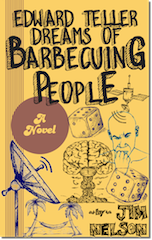
A new cover for Edward Teller Dreams of Barbecuing People

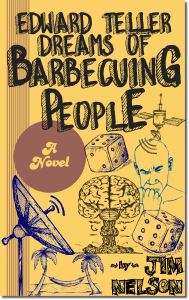
Edward Teller Dreams of Barbecuing People by Jim Nelson

Click for larger image

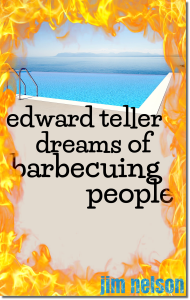
After a lot of scratching around in the dirt and a couple of heart-to-hearts with myself, I made the decision to ditch the old cover for Edward Teller Dreams of Barbecuing People. That cover attempted to capture the aesthetic of a classic Pee-Chee All-Season Portfolio that’s been doodled up with pencil and ink over the span of a school year. As much as I liked the concept, my artistic skills were simply not up to snuff for the challenge. I was never really satisfied with the final product.

The good news is, I’ve returned to the drawing board and come up with a cover I’m much happier with. The image to the above left is the result of that labor. I’m updating the ebooks on my various distribution channels as we speak. This is one of the great things about ebooks: if you don’t like the cover, you just change it. (For comparison, you can see the old cover in my original release announcement.)

Speaking of Pee-Chee, check out this great Flickr collection of folders marked-up and mutilated decades ago by school kids who were not altogether dissimilar to Gene Harland, the narrator of Edward Teller Dreams. My favorite in the collection? This one referencing Berkeley’s own The Uptones and featuring a ska sprinter taking the lead on the outside. In the 80s, you lived and died by a white pressed shirt and a skinny tie.

Junior High Pee-Chee - Front

Twenty Writers: Yoshihiro Tatsumi in retrospect

See my Introduction for more information about the “Twenty Writers, Twenty Books” project. The current list of reviews and essays may be found at the “Twenty Writers” home page.


Yoshihiro Tatsumi, Tokyo, 2010. (Yasu. CC BY-SA 3.0 Wikimedia Commons)

Yoshihiro Tatsumi, Tokyo, 2010. (Yasu. CC BY-SA 3.0 Wikimedia Commons)

Last night I learned Japanese manga artist Yoshihiro Tatsumi had passed away at the age of 79. Revered as the grandfather of gekiga (a darker form of manga, akin to graphic novels or alternative comics here in the United States), Tatsumi was known in Japan for his urban, noirish comics featuring a gamut of characters, from gangsters and back alley hoods to college students and office workers. Only in the last ten years did he became well-known in the North America (and perhaps elsewhere) due to new translations of his work published yearly by Drawn & Quarterly and edited under the guiding hand of Adrian Tomine (Optic Nerve, Shortcomings).

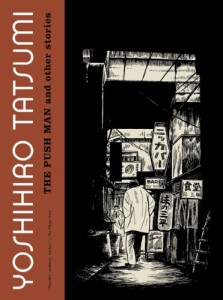
I don’t think I can express how much I enjoyed Tatsumi’s work or how his comics encouraged and shaped my own writing. I did not come to his work via manga (a form I honestly don’t know much about) but rather by accident while browsing the shelves at a local bookstore. The cover—a lone man in a raincoat receding down a seedy nighttime alleyway, his back to the viewer—led me to pick up The Push Man and Other Stories and read the first story, then the next, then the next. I promptly purchased the copy, returned home, and read the entire collection in one sitting. My only disappointment was that none of his other work was readily available in the U.S. at the time. (My novella Everywhere Man gets its name from Tatsumi’s Push Man, and takes a few other cues as well.)

It was remarkable, this voice from Japan whose stories respected their source culture while also digging up explosive emotional power directed at that same culture. Tatsumi’s minimalist style and quiet stories of “average” people are often compared to Raymond Carver, but they’re also deeply infused with American noir and crime fiction. Themes of sexual frustration and violence and emasculation are rampant in Push Man and elsewhere. His characters often seem like Japanese counterparts to Jim Thompson’s West Texas oilcatters and door-to-door salesmen: disposable men on the edge of breakdown or abandonment, with few choices other than to jump on the accelerator and push through their troubles rather than backpedal out of them. They rarely succeed. Tatsumi’s characters live in cramped rooms, cramped even by Japanese standards, usually only large enough for a futon and a hot plate. They sludge through dead-end jobs while watching from afar Japan’s miraculous economic boom of the 1960s and 70s. They aren’t preoccupied with death, they fear being erased. I have the idea these stories were intended for the same kind of audience Jim Thompson wrote for, young lonely men who felt shut-out from the American—or Japanese—Dream.

The Push Man and other stories (2005)

The Push Man and other stories (2005)

When recommending Tatsumi to friends, my trouble has always been what not to recommend. Of Drawn & Quarterly’s offerings, perhaps only the autobiographical A Drifting Life and Black Blizzard (penned when Tatsumi was 21 and the source of some embarrassment for him when reprinted) are reserved for Tatsumi completists. Otherwise the English editions we have available represent an impressive body of work which, as I understand it, remains an incomplete record of his full output.

In Push Man‘s stories, each limited to eight pages, Tatsumi deftly compresses grim situations down to their bare minimum and yet manages to leave himself the occasional panel for bleak panoramas of late-1960s Tokyo, its late-night bars and red light districts and walk-up ramen stands. The artwork is sometimes cartoony—even clunky—but the emotional force of his characters’ desolation carries through page after page. In later collections (Abandon the Old in Tokyo, Good-Bye, and Midnight Fishermen) the young men’s magazines Tatsumi was writing for opened up more pages for his work. His pen improves in these collections, trending toward photorealism and employing heavier use of shadow and contrast. These tightly-wound tales sometimes suffer from the breathing room four or eight additional pages allowed, but each collection stores more than a few gems.

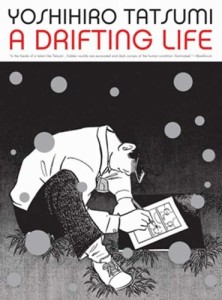
A Drifting Life (2009)

A Drifting Life (2009)

Tatsumi’s autobiographical A Drifting Life is his most ambitious work translated to English, and perhaps his most ambitious work of all. Intense but careful to withhold the most personal details of his life from the reader, Tatsumi lays out his formative years and how he entered the manga field while in elementary school. Each stage of his life is a new round of jousting with manga as an art form, tackling a narrative outlet he found liberating and yet restrictive and overly commercial all the same. I wish more time was spent on the side story of the manga rental industry in postwar Japan and its power to create and demolish artistic reputations. Some of the editors and publishers Tatsumi fought with sound straight out of Hollywood’s star system, right down to the shoddy treatment writers on both sides of the Pacific endured to produce consumable work week after week.

Still jousting with the strictures of manga at the age of 74, Tatsumi published Fallen Words, eight “moral comedies” inspired by rakugo, a venerable form of Japanese performance where a seated speaker narrates a story with a fan and a cloth as props. Rakugo performers will often tell stories that have been repeated for over a hundred years; the art is in the retelling and voices and mannerisms and novel uses of the props themselves. Tatsumi took this verbal art form and produced visual versions that depicted them in their original Meiji- and Edo-era settings: “I attempted to take rakugo, where laughter is supreme, and to tell the stories in the visual language of gekiga,” an art form not known for its comedy. Some stories rely on twist endings that don’t quite work, some on puns that only makes sense to Japanese speakers, but the book as a whole demonstrates the kind of experimentation Tatsumi was willing to engage in right to the end of his career.

Fallen Words (2009)

Fallen Words (2009)

When I was a graduate student teaching undergraduates creative writing, I included one story from Push Man as required reading. “Make-Up” remains my personal favorite of his work. It involves a young office worker living with an older woman, a bar hostess. When she’s gone at night, the young man dons a kimono, applies her cosmetic, and takes to downtown Tokyo passing as a woman. Not only is it remarkable the ease with which Tatsumi tells this nuanced story (another woman falls in love with him as a woman), it’s also surprising the sensitivity and compassion he offers his main character without falling into bathos. Some of the students tripped up on the simple lines of Tatsumi’s pen, some had trouble with the quietness (entire pages lacking a line of dialogue), but many gripped that something interesting and surprising was going on, right up to the ambiguous ending that opens up rather than shuts down the story.

Tatsumi’s work is often criticized as heavy-handed, cliched, and moralizing, which is arguable for his earlier output (such as Push Man) but is not so easily asserted with Drifting Life or Fallen Words. My response is to look at the boldness of the subject matter, the narrative distillation of complicated situations converted to deceptively simple panels on the page, and his early mastery of story structure. Each page of “Make-Up” is a self-contained scene, as perfect as a zen koan. It’s harder than it looks. That’s what I think Yoshihiro Tatsumi’s detractors are missing. This was not a natural talent who slipped into the form with ease, but one who struggled with it and attacked its firmaments, sometimes with mediocrity, sometimes brilliantly, but always thinking of his next push forward.

More on Yoshihiro Tatsumi’s passing: Adrian Tomine, Paul Gravett, Bleeding Cool.

Ring in the New Year: FREE ebooks on Kobo and Apple iBooks

A Concordance of One's Life by Jim NelsonFor the next month (or so), my short story collection A Concordance of One’s Life and novella Everywhere Man will be available to download for FREE on Kobo and Apple’s iBooks. That’s right, free, as in no money. Get ’em now:

A Concordance of One’s Life: Kobo / iBooks
Everywhere Man: Kobo / iBooks

Edward Teller Dreams of Barbecuing People by Jim Nelson
While you’re at it, be sure to download my latest novel Edward Teller Dreams of Barbecuing People. It’s not quite free but available for the cut-rate bargain of 99 cents on Kobo, iBooks, and Amazon.

(Why aren’t those first two books free on Amazon? Amazon won’t allow me to price my ebooks for anything less than $0.99 without entering into an exclusive arrangement with them, which I won’t do.)

Happy New Year!

UPDATE: I’ve extended the free book giveaway through February. They’re also now available for free on Smashwords (Concordance, Everywhere Man). Grab ’em up, folks.

Quote

Up at The Tusk, “This Shit Ain’t Ever Going to Work”

Edward Teller Dreams of Barbecuing People-10_1410The Tusk has posted a new piece of mine about the tortured history of my new novel Edward Teller Dreams of Barbecuing People. A sample:

And how could I forget my friend’s father returning home one afternoon from work, tie loose and hair splayed, bedraggled from wrestling some top-secret problem? Most likely not a problem scientific in nature, but bureaucratic. Thirteen years of age or so, a computer geek-in-training (largely because I wanted to grow up and write video games, unaware that a prerequisite for writing video games is to have never grown up), I was fascinated with the engineering problems these nuclear scientists must have faced every day. Sitting cross-legged on the lime-green living room shag playing Axis & Allies (and losing badly), I asked how his latest project was proceeding.

He leaned down to my ear and whispered: “Jim, this shit ain’t ever going to work.” Then he went to the kitchen and cracked open a beer from the refrigerator. By “this shit” he meant the LLNL’s latest budget-busting project, the Strategic Defense Initiative, a la Star Wars, a system of laser-equipped satellites promised to protect our country from ICBM attack and end the Cold War. You know, that Cold War, the mad weapons race the laboratory at Livermore had enabled and fostered and contributed to over the prior thirty years.

Read the whole thing at The Tusk. And while you’re at it, read Nate Waggoner’s brilliant dissection of how authors’ are learning to burnish their own laurels in today’s world of social media and independent publishing, “On Self-Promotion”.

Announcing Edward Teller Dreams of Barbecuing People

Edward Teller Dreams of Barbecuing People by Jim NelsonIt’s with a great deal of relief I announce the publication of my new novel, Edward Teller Dreams of Barbecuing People.

Yes, relief. I’ve worked on this book for over ten years taking it through six major revisions, including one of Melvillean proportions (the manuscript was too large for Microsoft Word, forcing me to split it into two files). What started as a throwaway line from an unrelated short story—”His father studied thermonuclear reactions. He could explain Nagasaki at the subatomic level”—grew into an undertaking that has consumed a double-digit percentage of my adult life and a fair chunk of personal sanity. I pushed the manuscript aside twice out of resignation, only to return to it years later convinced I could get it across the finish line. Most achingly of all, it received substantial interest from an agent who was patient enough to read three revisions…only to walk away from it, not convinced it was something she could get behind.

No matter. It’s done now. Saying “It feels like a weight has been taken off my shoulders” is too wordy. Strike “It feels like” from that sentence. It’s not a simile. Finally I can see straight, for the first time in over a decade.

Read more & learn how to download
Edward Teller Dreams of Barbecuing People