“Never open a book with weather”

"In the Rain", Sascha Kohlmann (CC BY-SA 2.0)

“In the Rain”, Sascha Kohlmann (CC BY-SA 2.0)

Lore is superstition for a modern world that thinks it has shaken off superstition.

Of all the different kinds of lore out there—office equipment lore, marijuana lore, etc.—writing lore is some of the worst. Inevitably writing lore is expressed as an indisputable maxim all writing must follow. Usually writing lore is attached to the name of a well-known, perhaps legendary, author. The august name only burnishes the lore’s authority.

These chestnuts of wisdom that all writers must adhere to thrive and breed unchallenged. Why? Why are we as writers beholden to this set of arbitrary do’s and do not’s?

Hence my peevishness when the Guardian printed a collection of writers’ “Ten Rules for Writing Fiction,” starting with Elmore Leonard’s famed list. (The Guardian cribbed his list from The New York Times, incidentally.) Not everything on these lists is lore—plenty of it is hard-learned personal wisdom—but I have a bone to pick with Leonard’s first rule:

“Never open a book with weather.”

Elmore Leonard isn’t so stupid as to pronounce this absolutism and move on. He offers a justification (“If it’s only to create atmosphere, and not a character’s reaction to the weather, you don’t want to go on too long”) and an exception (“If you happen to be Barry Lopez, who has more ways than an Eskimo to describe ice and snow in his book Arctic Dreams, you can do all the weather reporting you want”). When you contemplate both provisos, suddenly that “never” in “never open a book with weather” melts away like the warming Kilimanjaro snow.

Speaking of, this is what Hemingway wrote to John Dos Passos:

Remember to get the weather in your god damned book—weather is very important.

Hemingway managed to open “A Very Short Story” with a mention of the weather:

One hot evening in Padua they carried him up onto the roof and he could look out over the top of the town.

Here’s his rule-breaking opening to “In Another Country”:

In the fall the war was always there, but we did not go to it any more. It was cold in the fall in Milan and the dark came very early. Then the electric lights came on, and it was pleasant along the streets looking in the windows. There was much game hanging outside the shops, and the snow powdered in the fur of the foxes and the wind blew their tails. The deer hung stiff and heavy and empty, and small birds blew in the wind and the wind turned their feathers. It was a cold fall and the wind came down from the mountains.

Papa again, in “Cross-Country Snow”:

The funicular car bucked once more and then stopped. It could not go farther, the snow drifted solidly across the track. The gale scouring the exposed surface of the mountain had swept the snow surface into a wind-board crust.

I could go on.

In fact, if you think of a story’s title as its true opening, Hemingway is even more guilty: “The Snows of Kilamanjaro”, “Cat in the Rain”, “After the Storm”, even perhaps The Sun Also Rises.

You might object that these openings are reflected in Leonard’s provisos and exceptions. Strange how the circulated lore of “never open a book with weather” usually fails to mention those exceptions, though.

What’s more likely is a writer bringing to a workshop a story that opens with rain drizzling across a window pane, followed by another writing pouncing on the faux pas.

Worse, the lore of “never open a story with weather” is often misattributed to Hemingway, which is crazy. The man made an unstoppable reputation writing about the outdoors. For Hemingway to respect “never open a story with the weather” is like a mystery writer admonishing “never open a story with a murder.”

The prohibition against opening with weather is one more bit of lore designed to mystify and codify the craft. It bedazzles young writers who believe it a key to publication. It offers easy ammunition to every hack who’s entered a workshop ready to shred the story up for review. It’s time to set this tired chestnut aside.
Quote

North American Review: “Origins of The Obituarist”

A Concordance of One's Life by Jim Nelson

The North American Review blog has posted a piece I wrote for them, “Origins of The Obituarist”. In it I detail the inspiration and creative process I worked through to write my short story “The Obituarist”, which NAR accepted and published in their Summer/Fall 2009 issue. A sample from the original short story:

My editors and my fellow obituarists have a little list, The Nearly Departed we call it, celebrities and politicians and artists and authors whom we agree are not long for this world. The unlucky are crossed off the list the same day their obit hits the back pages of the Times. The unluckier are those added when that slot opens. There is no announcement, no press release of their addition. My subjects are not informed privately. We guard The Nearly Departed, not even speaking of it around lower staffers. Is it out of etiquette or some nobler purpose we do not make public our little deal pool? Or is the reason as crass and self-serving as the embarrassment of admitting we’re little more than vultures circling for the first moment we can unlock the work we’ve invested dearly in? Ah, there is one aspect to this game I am unsure of.

I interview their colleagues and relatives under a variety of pretenses. Ethically I’m bound to supply my name and the name of my publisher, but beyond that, ethics take on a certain…plasticity. When I say I need a quote for the Sunday supplement, which Sunday? Which supplement? And my name means little to anyone outside of the Times. Of the thousands of obituaries I’ve choreographed into print, not once have I enjoyed credit. It takes a peculiar modesty to pen the death notices of the famous and infamous. It takes even slimmer pride to gallop down to the newsstand and slap through the pages to locate the twelve column inches of your painfully sculpted prose. When someone particularly famous dies, there’s whole milk in my morning cappuccino.

There are others like me at the Times, but none with as much experience. I’ve written five thousand obits but my colleagues are developing thousands more as well. The Times is prepared for at least ten thousand celebrated lives to expire. Of the glitterati and politicos that fell within my sphere, only thirty-five hundred or so have expired. Those remaining fifteen hundred obituaries are on ice in The Freezer waiting for that special phone call from my editor. The liver transplant didn’t take. Or, Dropped dead on the back nine. Or, The pack-a-day finally caught up with him. Fifteen hundred unpublished obituaries is a sweet chunk of intellectual property, as the Times‘ retained lawyers say. My legacy.

Here’s what I wrote about this character and his odd profession for North American Review:

I wanted to know if this grim duty was a primary occupation or one-off work for idle journalists. I wondered if anyone would actually aspire to join the ranks of obituarists, or if junior journalists were lassoed into the role because more senior writers could take a pass on such bleak work. I did a bit of research, online and at the city library, and discovered that this particular field of journalism is remarkably underdocumented. Obituaries are a perverse and morbid obligation, one newspapers are obviously reluctant to discuss. In fiction voids can be filled in with imagination, like spackle covering up a crack in a wall, but with so little to work with I fretted I would muff the basic facts of my story’s subject matter.

A. O. Scott said “a great obituary is like a novel in miniature.” What would a writer learn after penning these miniature novels for thirty years? Compressing lives into column inches, never receiving a byline, not even being a full-fledged member of the newsroom, merely earning a check when someone famous died?

Read the whole thing here.

(Update: A follow-up on a NY Times story on obituarists published the same day as my NAR essay can be found here, “The Gray Lady dances with The Obituarist: ‘Obituaries for the Pre-dead'”.)

“The Obituarist” is available in my new collection of short stories, A Concordance of One’s Life, available as a Kindle e-book at Amazon (and coming soon to Kobo and Apple’s iBook store).

The craft of funny

Ask me my favorite movie moment and I’ll tell you a scene from It’s a Mad, Mad, Mad, Mad World. Before this morning I would have told it like this:

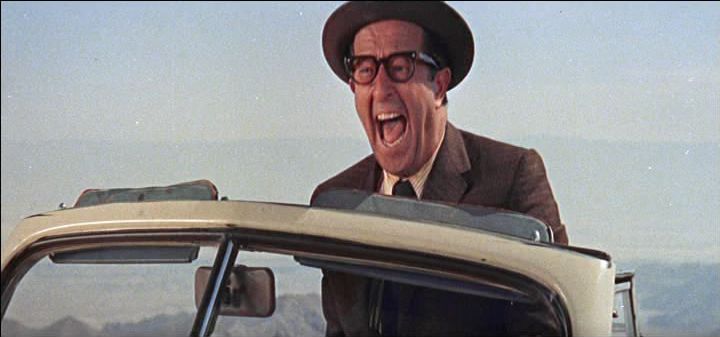
Phil Silvers and Jonathan Winters are in a private prop plane and the pilot has conked out. Silvers convinces Winters to take the wheel and fly the thing: “How hard could it be? Just put your hands there and there and your feet there. Now keep it steady while I go in the back and fix up an Old Fashioned like granddad used to make.”

Winters fumbles with the wheel and says, “What if something goes wrong?”

Silvers grins and shrugs, mugging a little for the camera. “What could go wrong with an Old Fashioned?”

Phil Silvers

It’s pure early-60s Tinseltown comedy: the oddball situation, the over-the-top response, the now-passe drinking humor, Phil “King of Chutzpah” Silvers playing a shtick nowhere to be seen in today’s Hollywood, and on top of that, breaking the fourth wall in a manner as old-fashioned as the cocktail he goes to prepare. All that’s missing is a Don Knotts double-take and someone getting trapped in a Murphy bed—both to be found elsewhere in the flick, of course.

One problem: the scene I just described is completely wrong. I’ve had it wrong for years.

I rewatched Mad, Mad World last night (finishing the second half this morning—it’s a long movie). Here’s how the scene really goes down:

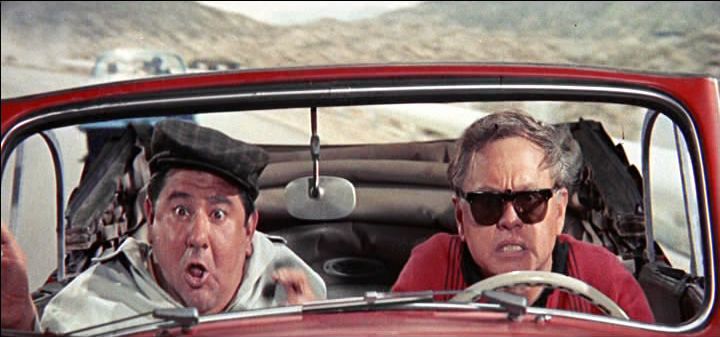
Buddy Hackett and Mickey Rooney are in a private prop plane that Jim Backus is piloting. Backus finishes his Old Fashioned and tells Rooney to make him another, this time not so sweet. Rooney suggests that maybe two drinks are enough. Backus dismisses this and orders Hackett to fly the plane while he goes to the galley to make an Old Fashioned “the way dear old Dad used to.”

Hackett fumbles with the wheel and says, “What if something happens?”

Backus replies in his upper-crust voice, chin jutting out, “What could happen to an Old Fashioned?”

As the cockpit scene started, I said to myself, “Wait, this isn’t it. When do Phil Silvers and Jonathan Winters charter a plane?” When Jim Backus is drinking Old Fashioneds, I thought, “This must foreshadow a scene to follow”—as though Mad, Mad World is some French New Wave masterpiece and not a Vaudeville crazy quilt of gags, farce, and one-liners.

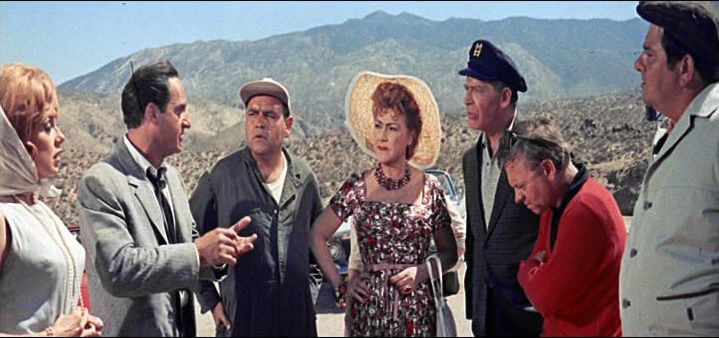
It’s a pretty serious lapse on my part. I confused all the actors and the details of the situation. (Backus conks out after the exchange, when Hackett starts whipsawing the plane to and fro.) I’ve only caught bits and pieces of the movie on cable over the years. I doubt I’ve seen it in its entirety since the early 90s. I think I invented elements because those elements made so much sense. Phil Silvers is the best-cast actor of the whole film (yes, even over Spencer Tracy) because his shtick is so attuned to the movie’s cold worldview. It’s his con-man personality, his P. T. Barnum patter that verbally corners his victims into submission. (See some of it on display here.) He’s a natural fit for Mad, Mad World‘s winner-take-all tale of All-American greed. Silvers and Winters are at each others throats throughout the movie, so I paired them in the cockpit. Not that Backus wasn’t suited for the scene, or that Hackett and his Play-Doh face was a poor substitution for Winter’s thick-as-a-brick truck driver, but the pair I imagined in my head seemed so much better.

Buddy Hackett and Mickey Rooney

My most serious lapse was to goof the set-up and the punchline. “What if something happens?” turned into “What if something goes wrong?” “What could happen to an Old Fashioned?” became “What could go wrong with an Old Fashioned?” If you’re telling a joke and you botch the set-up and the punchline, you’ve failed. The joke can’t be salvaged. It’s not dead-on-arrival, it’s a miscarriage.

And yet whenever I told my version, people laughed. After watching Mad, Mad World my girlfriend said that my version was actually better. She’s not an unbiased judge, but you know what? I think she’s right. My version is better.

Mark Evanier’s retrospective of Mad, Mad World mentions a quote attributed to Ed Wynn: “A comedian is not someone who says funny things…a comedian is someone who says things funny.” That distinction is vital. So vital, in fact, I think that distinction should be taught in every creative writing class out there. The twist is, it is being taught, even if instructors don’t know it. Some might even deny it.

I think Wynn’s observation is that a comedian takes great care in selecting his words because the right language can make a joke great, just as they can a story or a poem. Poor decisions not only rob the joke of its humor, they can even make the joke not a joke. “Take my wife—please!” may not carry as much water as it once did, but “Will someone please get my wife the hell out of here” is simply Neanderthal crudity.

The beautiful sentence movement has grown so mainstream, it has its own movie. I say let’s start the beautiful joke movement—an appreciation of their structure, grammar, flow, and word choice.

A fiction writer with any interest in humor should study the craft of funny. (A fiction writer with no interest in humor should consider another pursuit.) Jokes are the original microfiction, the first short-shorts. At their best, they’re Western imitations of Zen koans, but when told right, both hands are clapping. Great jokes have a sturdiness to them, a similar sturdiness I find in great literature. Great jokes leak humor. It pours out from them in all directions. Often the blunt force of a joke’s initial contact—the impact that yields the first laugh, the rest of the laughs only arriving when the full implication of the punch line descends—often lay in a single phrase, or even a word. “Wrecked him? Damn near killed him!” is demolished when a novice repeats it as “Wrecked him? He almost died!”

Here’s my latest favorite joke:

How many Freudians does it take to change a light bulb?

Two: One to screw in the bulb and the other to hold my penis—my mother—the ladder!

Freud may be a genius, but his work forever linked his family name to screwing, dicks, and moms. Mrs. Freud must be so proud.

I know it’s odd to admit I’ve thought a lot about the words penis and mother in this joke. I hope you believe me when I say I’ve also considered what’s left out of this joke. With writing, addition can be subtractive:

How many Freudians does it take to change a light bulb?

Two: One to change the bulb and the other to hold my penis. I mean my mom! No, the ladder!

The funny is still there, but the unnecessary I mean and No stilt the delivery and ruin the impression of beating back the subconscious. The formal mother delivers a sense of matriarchal authority that mom lacks. Think how completely derailed this joke would be if dick was used in place of penis. And don’t overlook the loaded meaning of the missing screw.

Seventeen ways to split a joke

And that’s why I prefer my cocktail debate over Mad, Mad World‘s. “What could happen to an Old Fashioned?” fits Backus’ old-money alcoholic because it places his primary concern with the well-being of the cocktail—but it doesn’t align with Hackett’s question, “What if something happens?” Backus should think Hackett is referring to the preparation of the drink, not the drink itself. The gag gets laughs because drunk pilots are always played for laughs. Its humor lies outside language and the characters’ subjective reality.

My version isn’t colossally superior, but it succeeds because Phil Silvers’ answer does align with Winters’ “What if something goes wrong?”—an Old Fashioned solves problems, ergo nothing can go wrong. His answer invites the audience in and makes them complicit in the joke—that is, the imaginary audience that never saw the joke that only existed in my head.

Now that I’ve amputated the funny bone from these gags (if you agree they had one) I head toward my liquor shelf asking myself the $350,000 question: What could go wrong with an Old Fashioned?