Syd Field
If you’re a writer, consider if this sounds familiar:
An idea snaps into your head—a character, a situation, a setup, a name—and you dive in, pumping out a promising first chapter in no time at all. You clean it up and bring it in to a workshop or writing group. You get some input and take away some praise and criticism. Back at home you move on to the second chapter, and the third, and then…kaput. You’re out of gas. You make a couple of aborted attempts to keep at it, but it’s just not in you.
Months later you pick up the manuscript, tinker with it, and slide it back in the drawer. And that’s the end of your novel.
The frustration goes beyond hard work being “wasted.” (I don’t think any writing is a waste, it’s merely practice for the next round of writing.) No, the frustration is the hollow feeling that, with just a little more inspiration or skill, you could’ve pushed on and completed that novel. The frustration is the suspicion that, with just a little more planning, you would have a clear path forward.
I’ve not outlined or plotted every story I’ve written. I’ve completed a few stories without any serious planning at all that I would say I’m proud of. I might even say they’re “successful.” But I also know how many failed and false starts I’ve accumulated, a frustrating pile of corpses that simply didn’t pan out. I started thinking about how to outline a story and realized I didn’t have a definite idea of how to do it. I had a couple of notions, but nothing concrete.
Some time ago, when I was first coming to grips with how to write fiction—especially longer forms—I grew interested in the three-act structure screenwriters use. It’s a form Hollywood follows slavishly. Books on screenplay writing are almost entirely devoted to the structure, going deep into the mechanics and timing (that is, the page count) of each act. They detail what questions must be posed in each act and when those question should be answered, even breaking down each act into smaller subunits. It’s much more rigorous than anything I’ve seen in the world of fiction or poetry (which has an encyclopedia’s worth of its own forms).
My experience has been that fiction writers disdain the three-act screenplay structure. Actually, most disdain any manner of plotting or outlining, usually while murmuring something about “plot-driven fiction.” For them, the three-act structure isn’t a revelation, it’s the reason for all the pandering crap Hollywood churns out year after year. Others seem to have the attitude that outlining a novel is somehow “cheating.”
I’ve taken a fair number of playwriting classes and workshops. In them I was struck how theater, just like filmmaking, emphasizes structure over any other craft element. We found structure laced through plays as diverse as A Raisin in the Sun, Glengarry Glen Ross, Danny and the Deep Blue Sea, Noises Off, Cloud 9, and Fences—brilliant work, all of it, and nothing I would call “pandering crap.” But it’s right there on the page: structure, structure, and more structure.
The Headlight Method
Between all the fiction classes, workshops, writing groups, and how-to books I’ve read, it’s rare to find anything approaching screenwriting’s or theater’s level of emphasis on narrative structure. When I have, it’s usually a method for writing thrillers or “guaranteed” bestsellers, something to the effect of putting the character into deeper and deeper holes and forcing him or her to make harder and harder choices. Oh, and be sure to end each chapter with a cliffhanger. In the case of romance novels, structure is defined in terms of the types of motivations and the types of problems the characters will face. Others argue that most (or all) proper stories follow the Hero’s Journey, although I find that dubious, especially looking back on the literature of the last one hundred years. These are not the kinds of narrative structures I’m talking about.
 The only vanilla structure I’ve seen consistently taught in fiction is the classic rising and falling action cliff ledge (also known as Freytag’s Pyramid). There’s tons of criticism of the pyramid out there. For my purposes, I ask if rising/falling action is an organizing principle or an observation. There’s a difference between a cake recipe and a photo of a finished cake sliced in half. In my mind, the cliff ledge is that photo.
Inevitably when discussing fiction and structure or outlining, E. L. Doctorow’s maxim makes an entrance:
Writing is like driving a car at night. You can only see as far as the headlights, but you make the whole trip that way.
Like opening a story with weather, this quote has become another scrap of writing lore, that body of accepted thought on the shall’s and shall-not’s of writing fiction. But reread that quote. Doctorow isn’t advocating structureless fiction or railing against the idea of outlining a story. All he’s saying is, you’re not going to know every little detail about a book before you start writing it. Even if you can only see as far as the headlight beams, there’s nothing wrong with having a map handy before you set out on your trip.
Last year I got serious about understanding how screenwriters craft a three-act movie script. In the process of researching the topic I molded the three-act screenplay structure into a form geared for fiction (novels and short stories) rather than movies. This process produces a rough guide for your story, disposable, and nothing more. I’ve applied it on a number of projects and found myself surprised at the results. And, yes, my writing has improved for it.
Syd Field
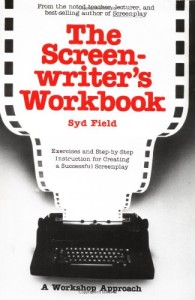 There’s countless guides, how-to’s, manuals, videos, and seminars on successful screenwriting. Syd Field’s Screenplay is, as I understand it, the Bible on the subject. First published in 1979, Field articulated his three-act structure (he calls it “the paradigm”) as a framework for telling a visual story via a series of scenes. Like literary theorists from Aristotle onward, Field recognized that most stories are built from roughly similar narrative architectures, no matter their subject or setting. In Screenplay he set out to diagram that architecture and explain how it applied to film.
Although Screenplay is the Genesis document, I recommend his Screenwriter’s Workbook (1984). It picks up where Screenplay left off, detailing discoveries and new thinking on his three-act structure. Syd Field made a lifetime career out of teaching people how to write movies; these two books are where he started.
Not everything Field discusses directly corresponds to fiction. Film is a different medium, after all. What I’ve tried to do is pare down and re-shape his three-act structure into something more appropriate for writing novels and, to a lesser degree, short stories. I’ve used this modified paradigm to write a four-page story (“The Last Man in San Francisco”), to revise a long novel that I thought was dead and lost (Edward Teller Dreams of Barbecuing People), and now a new novel (tentatively titled Bridge Daughter).
Let me be clear: this is not a robotic recipe for writing fiction. Syd Field did not lay out a formula for writing blockbuster movies, nor am I laying out a formula for fiction, bestselling or otherwise. This isn’t telling you how to write, it’s suggesting a creative process to engage with before you write. Basketball players take practice shots before a game; artists rough out ideas in their sketchpad before approaching the canvas; musicians practice their set before going into the recording studio. What I’m suggesting is for you to get some basic ideas about your story out of your head and on paper before you start writing.