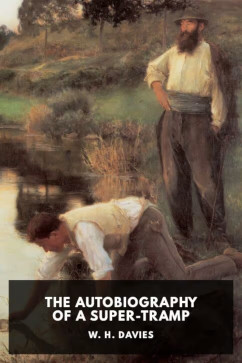
Last month, Standard Ebooks published a new edition of The Autobiography of a Super-Tramp by W. H. Davies. I’m announcing it here because I produced the edition, which entailed formatting, proofreading, assembling the metadata, and handing it off to the Standard Ebooks team for publication.
I’ve wanted to produce a book for Standard Ebooks since I first learned of their organization years ago. Getting an ebook over the finish line and accepted by them is a milestone for me.
If you’re unfamiliar with Standard Ebooks, they’re an open-source, volunteer-driven project producing high-quality ebooks of works unencumbered by copyrights. They’ve put out editions ranging from modern genre fiction to classical and ancient literature. They have a rigorous style guide, which makes these ebooks handsome, polished, and a pleasure to read. (I’ve found them to be of even higher quality than ebooks from some major publishers.) Best of all, their ebooks are free for anyone to download and keep.
I was thoroughly impressed by Standard Ebooks’ support. Not only do they have comprehensive documentation for building the ebook, but also the style guides I mentioned, and custom tooling for assembling and proofing the work. Whenever I ran into trouble, they were always quick to respond on their newsgroup.
I tend not to discuss my works-in-progress until they near completion, but I’ll make an exception here. My next novel (assuming I finish it!) regards a drifter wandering the Pacific coast between the world wars. My research led me to Davies’ Super-Tramp, which Standard Ebooks did not offer at the time, but had listed on their wanted list. I realized I could read the book as I worked on it. Two birds, one stone.
My work-in-progress is set in 1925, about seventeen years after Davies’ autobiography was first published. 1925 was also near the end of a period in American history where significant numbers of tramps and hoboes traveled the country. They sought work, relief, or simply a chance to experience all the natural beauty the United States had to offer. As H. L. Menken put it,
Tramps and hobos are commonly lumped together, but see themselves as sharply differentiated. A hobo or bo is simply a migratory laborer; he may take some longish holidays, but sooner or later he returns to work. A tramp never works if it can be avoided; he simply travels.
A hundred years ago, it seemed as if everyone wanted to be a hobo… Dreams of a tramp utopia, once termed “hobohemia,” produced classics of Americana. Recorded in the 1920s by [Harry] McClintock, the rollicking hobo anthem “Big Rock Candy Mountain” [sic] envisions an itinerants’ paradise where cigarette trees bloom and streams of alcohol trickle down the rocks. … The contradictory nature of the hobo, a character without home or possessions who embodied good-natured liberty and a gap-toothed joie de vivre, gave rise to a persistent sense of envy.
Davies appeared smack in the middle of this age of tramps and hoboes. These impoverished migrants were not uniformly uneducated or illiterate, as his autobiography shows.
Super-Tramp is a remarkable read, unadorned and understated in even the most shocking of situations, such as when Davies loses his foot in a train accident. This event, which curtailed his tramping days, is described so obliquely, and with such calm, I had to reread the passage to make sure he wrote what I thought he wrote.
Davies was not the only tramp documenting this way of life. Bart Kennedy also wrote several books on life spent on road and rail, with A Man Adrift being his most important by several accounts. Like Davies, Kennedy opens his book young and penniless in England, drawn to wander the United States out of a sense of awe for the young country’s purported freedoms and boundless natural beauty.
For my purposes—writing a novel about a loner drifting freely across the western United States—the most significant chapter in Kennedy’s book is the appropriately-titled “On Tramp”:
To be penniless and on tramp is a curious experience. You care for no one, and no one cares for you. Things about you seem vague and elusive. You are in a mental chaos. You are a link dissevered from the human chain. And you wander hardly knowing or caring where you wander. … Who you are or what you were matters not. You may be a man with a past, you may be a man with a future. You may be one who has belonged to the topmost class; you may be a labourer, or a man from out the filth of the slums, or a dispirited low-down thief.
Kennedy’s bleak outlook, which veers into a cynical romanticism, stands in almost direct contrast to Davies’ even-keeled account. Davies is less philosophical, and less analytical, but no less thoughtful than Kennedy:
Although I had at this time become lazy, losing almost all sense of respectability, I often reproached Brum for the aimlessness of this existence; telling him we must seek work and attend to other wants than those of the body. I would tell him of the arts, and how the cultivation of them was lost to us through a continual lack of funds. I told him of the pleasures of reading, visiting picture galleries, museums and theatres, and of the wonders of instrumental music, and of the human voice. …
We often go for days without reading matter, and we know not what the world is saying; nor what the world is doing. The beauty of nature is forever before my eyes, but I am certainly not enriching my mind, for who can contemplate nature with any profit in the presence of others. I have no leisure to make notes in hopes of future use, and am so overpacking my memory with all these scenes, that when their time comes for use, they will not then take definite shape. I must go to work for some months, so that I may live sparingly on my savings in some large city, where I can cultivate my mind.
These insights from Davies and Kennedy come nowhere near the common caricature of tramps, jolly homeless men in shabby clothes, bearing five o’clock shadow and an alcoholic’s rosacea nose, smoking discarded cigars and carrying handkerchief bindles.
Davies’ autobiography has the lens of a documentarian, a plain-speaking record of incidents and happenstance set against a pastoral backdrop of North America at the turn of the last century. (It is not a leap to compare it to Orwell’s Down and Out in Paris and London.) While Davies’ contemporaries were producing fin de siècles of decadence and decay, Davies described an earnest America on the rise, for the better or worse.
Breakfast in America
Although Davies and Kennedy hail from the British Isles, their books contribute important links in the history of American wanderlust literature.
Getting off the grid has an auspicious history in this country: From Transcendentalists like Walt Whitman and Thoreau, through the Age of Vagrancy documented by Davies and Kennedy, and into the 1950s and 60s, where no less than three styles of “life on the tramp” appeared in popular culture: the escapist beachcombers of Tiki and exotica music, the Kerouackian road-trip sagas popular with college students, and the middle-class tales of men ducking out of their button-up, chained-down lives, such as Updike’s Rabbit, Run.
If all-American wanderlust ever peaked, it would be among the counterculture of the 1960s, a mass youth movement essentially defined by the impulse to up and leave, recreating one’s identity in the process. Fraser points this out in her review when she recounts Bob Dylan’s youthful zeal to restyle himself a modern-day hobo-philosopher once he’d arrived in New York City.
Although a century has passed since Davies and Kennedy, the romanticized tramp’s life has not diminished in the modern popular imagination. The temptations of the wandering life are hardy and durable. You’ll find it among couch-surfers, backpackers wandering the Third World (with Alex Garland’s The Beach being its finest example), and the #vanlife movement.
The most extreme resurgence has to be with Christopher McCandless, the young man who abandoned an easy well-heeled life, drifted across the western United States, and died in the Alaskan interior after making a go at subsistence living there. McCandless admired Davies, going so far as to adopt the moniker “Alexander Supertramp.” (This is how I first learned of Davies’ autobiography, and have long wanted to write about such a character.) His example inspired countless young people, with many dying in a vain attempt to, in McCandless’ words, “Kill The False Being Within.”
As I’ve writtenbefore, the debate over the cause of McCandless’ death has become a decades-long fixture in America’s culture war. It centers on the very questions that Thoreau, Davies, Kennedy, and even the #vanlife movement have faced:
Should we admire or damn those who dare to escape their responsibilities to live a freer life? When they fail, should we honor their attempt? Or, should we hold them up as a warning for those curious to follow?
And if you look back at the list I’ve compiled here, just about all of them failed or collapsed in some way. Not only did Davies have to set aside his wanderlust due to injury, other tramps he meets find the demands of life on the road unsustainable. The hippy communes have all shuttered; the #vanlife movement has suffered; and Rabbit wound up not running very far. Even Walden has been used as a warning, not a blueprint, for subsequent generations toying with their own ideas of living off the grid.
Of Walden, E. B. White wrote it’s “the report of a man torn by two powerful and opposing drives—the desire to enjoy the world…and the urge to set the world straight.”
The same can be said of Davies’ autobiography. Contrary to George Bernard Shaw’s preface, Super-Tramp is not quite the unrepentant declaration of an anarchist’s credo he makes it out to be. It concludes with Davies settling down in an English country house, a return to the domesticated life he elected to abandon at the outset. There he writes,
People are not to be blamed for their doubts, but that they make no effort to arrive at the truth. However much people of a higher standing may doubt the veracity of certain matters, I have the one consolation to know that many a poor man, who is without talent or means to make his experiences public, knows what I have written to be the truth.
A desire to enjoy the world, and the urge to set the world straight: This is the tramp’s life.
Kat Rosenfield at Unherd claims she knows why men are no longer wild: “Our sense of adventure died with Chris McCandless.”
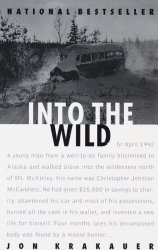
I last wrote about the mythology surrounding Chris McCandless and Jon Krakauer’s Into the Wild in 2015. Rosenfield’s article motivated me to survey the situation once again.
The meat of Rosenfield’s argument lies within this claim:
McCandless’s story became the object of fascination — and not long after that, backlash. His life was either an inspiring example of indomitable American spirit or a nauseating waste of privilege and opportunity; his death was either a tragic accident or an idiotic, avoidable bit of foolishness.
My motivation for this post started right there, in the above assertion. Compare it to what I wrote in 2015:
If this framing—reckless versus romantic—sounds wearily familiar, it’s because the debate over McCandless’s death has become nothing more than a flash-point in a broader argument we’ve had in America since he and I were born…
McCandless’ life has been converted into a proxy for this country’s culture wars, a string of battles where no one—no one—raises the white flag. … I’m unable to see how this situation honors or respects Christopher McCandless’ life.
Eight years later, Chris McCandless is still serving as a proxy for whatever culture war debate is on our collective brains at the moment. His life and death, cleansed and romanticized, provide a mythic framework to hang any number of ideological flags: anti-materialism, anti-woke, anti-technology, anti-Americanism, anti-capitalism, and more.
This is vital to recognize. Culture war ushers in an inevitable and putty-like transitive logic: Criticism of Krakauer is interpreted as an attack on McCandless; criticism of McCandless is read as an attack on his values; criticism of McCandless’ fans is an attack on progressivism; and so on.
So, yeah, I have and will criticize Krakauer, the actions of some of McCandless’ legions of fans, and the politicization of Into the Wild. I’ll even criticize some of McCandless’ choices. I’m trusting you to recognize that doesn’t make me a “Chris hater.”
“He’s emerged as a hero”
From there, Rosenfield takes what has become a standard approach in modern rhetoric: She claims her reasonable and clear-eyed position is the one under attack, even if she has trouble locating the hordes mounting said attack:
The lumping-together of McCandless with Thoreau was inevitable, and not just because the latter was a major inspiration for the former: here was an expression of the timeless desire to take these icons of male self-sufficiency down a peg. Today, the mention of either man tends to elicit a snarl — but the bulk of the anger is saved for McCandless, fuelled by a contemporary media ecosystem that keeps finding new ways to tell his story. [Emphasis mine.]
I cannot recall anyone “snarling” over Thoreau, who remains required reading in American high school and university curricula. He may have been dismissed in his time as a fraud or a crank, but I’m pretty sure Thoreau’s preeminence in American culture and letters is secure.
As for McCandless, Into the Wild has been translated into thirty languages, and has remained in print since it was first published in 1996. It was made into a major motion picture by Sean Penn. It’s on high school and college reading lists across the nation. It was selected by Slate as one of the best nonfiction books of the past twenty-five years. A web site dedicated to Chris McCandless (christophermccandless.info) is still going strong, hosting papers written by young people affected by McCandless’ life story. There’s a memorial foundation, and multiple documentaries. The PBS special “Return to the Wild” promises to “probe the mystery that still lies at the heart of a story that has become part of the American literary canon and compels so many to this day.”
Yet Rosenfield somehow concludes McCandless and his story are under a brutal and withering assault. If the debate could be placed on a scale like produce aisle apples, I’m certain we’d find any snarling criticism of Chris McCandless and Jon Krakauer is far outweighed by McCandless’ legions of fans and sympathetic media sources.
It doesn’t help that Rosenfield’s adoring portrayal of McCandless as the kind of masculinity we need more of in our on society is framed just as she outlined at the top of her article: “an inspiring example of indomitable American spirit.” There are no alternatives, apparently.
“But lately,” she writes, “the controversy surrounding McCandless as a mythological figure is no longer an accompaniment to the story; it is the story.”
I don’t know that “lately” part is true. The controversy around McCandless began almost immediately after Krakauer’s story was first published in Outside magazine. Its editors reported they’d never received as much mail about a single story. The controversy framed all subsequent debate over Chris McCandless for the same reason Twitter melted down over the color of a dress: People couldn’t believe any sane person would disagree with their interpretation—and if you did, there was something wrong with you.
Here’s a question: Why is McCandless a mythological figure? He was a human being, “full of vim and vigor, a complicated young man of effusive talents, predictable weaknesses, and eccentric foibles,” as I wrote in 2015. We can valorize a man, we can valorize his values. Why valorize his avoidable death?
Much of the time I agree with the “he had a death wish” camp because I don’t know how else to reconcile what we know of his ordeal. Now and then I venture into the “what a dumbshit” territory, tempered by brief alliances with the “he was just another romantic boy on an all-American quest” partisans. Mostly I’m puzzled by the way he’s emerged as a hero, a kind of privileged-yet-strangely-dissatisfied-with-his-existence hero.
I don’t agree with the “death wish” angle, nor do I think he was a “dumbshit” for entering the Alaskan interior. (I would say “grievously unprepared.”) “An all-American quest” ticks a few of my personal checkboxes, as does “I’m puzzled by the way he’s emerged as a hero.”
The diary
In an aside, Rosenfield complains that McCandless’ sister’s memoir The Wild Truth (2014) has been weaponized: “It was received less as additional context to his story than a debunking of it: McCandless wasn’t a latter-day adventurer, he was a spoiled trust-fund kid with daddy issues.” (It would have helped if Rosenfield could have linked to an actual “debunking.” The single link she provided goes to a perfunctory summary of the memoir by USA Today.)
Carine McCandless does offer eye-opening “additional context” to Chris’ story. She revealed that her family asked Krakauer to withhold key details from Into the Wild—a trust-fund kid from a wealthy family, the “daddy issues,” and some real behind-the-scenes familial dysfunction. By doing so, Krakauer created a hole in his narrative, and in our understanding of McCandless’ motivations.
But The Wild Truth was not weaponized for a mass “gotcha” campaign, or if it was, the campaign made not a dent on the beatification of Chris McCandless. Rather, as with the evolution of the poisonous seeds (explained below), its details were smoothed over by sympathetic media sources as completing and supporting Krakauer’s story, and further buttressing the McCandless hagiography.
“After a brief review of its contents and intention, we concluded that this fictionalized writing has absolutely nothing to do with our beloved son, Chris, or his character,” they wrote. “The whole unfortunate event in Chris’s life 22 years ago is about Chris and his dreams—not a spiteful, hyped up, attention-getting story about his family.”
There was another narrative hole, though, that is more substantial and of far more interest to people like me: The contents of the journal McCandless kept while in the Alaska wilderness. Initially only Krakauer had access to the diary, which he used while writing Into the Wild.
When the journal was finally released, it amounted to
approximately 430 words, 130 numbers, nine asterisks and a handful of symbols. Other than this, all Krakauer had to go on was several rolls of film found with the young man’s body and a rambling, cliche-filled, 103-word diatribe carved into plywood in which McCandless claimed to be “Alexander Supertramp” off on a “climatic battle to kill the false being within and victoriously conclude the spiritual pilgrimage.”
Craig Medred of Anchorage Daily News has much more to say about “the fiction that is Jon Krakauer’s Into the Wild“. That Krakauer reconstructed McCandless’ last weeks in minute detail from such sparse documentation should be a flare in the sky to anyone who still believes the label “nonfiction” means something.
“It is as if the late writer Ernest Hemingway found a 430-word journal written by Nick Adams containing the words ‘railroad,’ ‘fish,’ ‘forest fire,’ ‘camp’ and a few others,” Medred writes, “and from that wrote ‘Big Two-Hearted River’ as the true story of Adams’ biggest fishing adventure.”
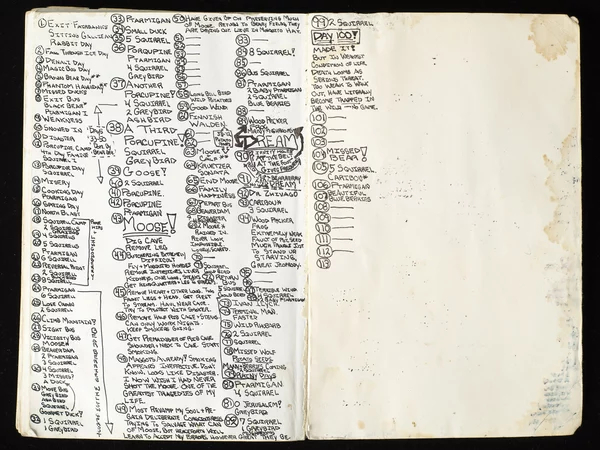
If that sounds like hyperbole, then reread the final three chapters of Into the Wild and reckon them against the source material Krakauer was drawing from. Here’s a portion of the journal, from the McCandless’ memorial site:
Day 2: Fall through the ice day. Day 4: Magic bus day. Day 9: Weakness. Day 10: Snowed in. Day 13: Porcupine day…. Day 14: Misery. Day 31: Move bus. Grey bird. Ash bird. Squirrel. Gourmet duck! Day 43: MOOSE! Day 48: Maggots already. Smoking appears ineffective. Don’t know, looks like disaster. I now wish I had never shot the moose. One of the greatest tragedies of my life. Day 68: Beaver Dam. Disaster. Day 69: Rained in, river looks impossible. Lonely, Scared. Day 74: Terminal man. Faster. Day 78: Missed wolf. Ate potato seeds and many berries coming. Day 94: Woodpecker. Fog. Extremely weak. Fault of potato seed. Much trouble just to stand up. Starving. Great jeopardy. Day 100: Death looms as serious threat, too weak to walk out, have literally become trapped in wild—no game. Day 101-103: [No written entries, just the days listed.] Day 104: Missed bear! Day 105: Five squirrel. Caribou. Day 107: Beautiful berries. Day 108-113: [Days were marked only with slashes.]
Chris McCandless’ entire diary, from day 1 to day 113.
McCandless notes on day 69, six weeks before his death: “Rained in, river looks impossible.” (I assume he means the river between him and civilization looks impossible to cross.) On day 100, he realizes “have literally become trapped in wild.” Earlier he writes, “Lonely, Scared.” Earlier still, he writes, “Weakness.”
“Male self-sufficiency”
McCandless entered the Alaskan wilderness packing ten pounds of rice, a .22-caliber rifle, ammunition, a camera, and a selection of books. Although his exact date of death is unknown, it appears he only survived for 113 days, or about sixteen weeks. All evidence is that he leaned heavily on a single food source, the seeds of a wild plant.
Rosenfield takes a crack at those who knock McCandless as unable to distinguish a moose from a caribou (“He could, actually”), although that’s beside the point. The real failure was him bagging a beast and lacking the skills to preserve it. After mere days he lost the carcass to maggots. Properly preserved, the meat and organs could have fed him for months, providing him with vital protein and fat. He wrote the waste was “one of the greatest tragedies of my life,” one of the few lucid and complete entries in his journal. Other than the wild seeds, he appears to have had no success in securing an additional food source.
The usual rejoinder to these failures is that the seeds he foraged were a good source of nutrition but, due to understandable circumstances, McCandless was poisoned by them, or some substance growing on them.
The seeds are, without a doubt, the most frustrating aspect of the entire affair. It’s oft-reported that over the years Krakauer required three tries to explain the puzzle of the poisonous seeds. As I wrote in 2015, the count was actually four, and is now closer to five:
and a modified fifth explanation in a peer-reviewed 2015 article, which he also discussed in a 2015 New Yorker article.
Diana Saverin of Outside magazine has a good summation of the history of the questions surrounding the seeds. (This article is also the first and only time I’ve seen a major media source acknowledge that the debate over McCandless’ legacy may be more than a Manichaean battle of “Chris supporters” vs. “Chris haters”: “[Some] readers don’t dismiss McCandless’ intention—spending time in the wilderness—as invalid or stupid. Rather, they reject his endeavor because of the consequence it led to: his death.” While not exactly my position, at least there’s an acknowledgment of a spectrum.)
With Krakauer’s later explanations for the seeds came sympathetic media outlets announcing he’d “solved” the mystery once and for all. NPR has declared the case closed on a couple of occasions. Salon originally titled their 2013 article “Chris McCandless’ death wasn’t his fault” before changing it to the blander “Into the Wild’s twist ending”. (The original title is still there in the page’s URL.)
The Salon switcheroo neatly encapsulates the stakes in play: By declaring McCandless was not culpable for his own death, the lessons and morality people wish to attach to McCandless’ life are preserved. Krakauer’s first explanation paints McCandless as fallible, and perhaps even liable for his own death (that Chris mistook poisonous seeds for edible ones). The later explanations (a mold or bacteria growing on edible seeds) reassures the faithful that McCandless’ death was understandable and unavoidable.
The various poisonous seed theories led to disputes between Krakauer and biologists. Even after the dust settled, the best the scientific minds could declare was “it is possible” the seeds were poisonous and “contributed” to McCandless’ death. That is not the indisputable evidence that some sources reported.
I’ll say it here, just as I said in 2015: I do not think McCandless was an idiot. I do not think he was reckless. He was far more prepared to enter the Alaska interior than a high majority of his admirers who’ve made similar attempts—but he was not prepared enough. I suspect he only realized his mistake when he could no longer trek out of the area (day 69, “river looks impossible”). Unlike living off-the-grid in places like the American Southwest, where he did well, McCandless’ resourcefulness was not enough in a truly remote and brutal location.
But even if rock-solid evidence arrived showing McCandless was poisoned by the potato seeds and nothing more, that does not prove his death was unavoidable. His survival in Alaska hinged on a single food source. He suffered from a single point of failure, and when that point failed, he was doomed. That is not “self-sufficiency.”
The cult
Rosenfield again:
On the 15th anniversary of McCandless’s death, Men’s Journal published a story titled ‘The Cult of Chris McCandless’, an examination of the young man’s legacy in and around the wilderness in which he perished. One gets the sense that there’s still little sympathy amongst Alaskans for McCandless’s death, and the quotes from locals range from pitying to contemptuous.
It’s true: A magazine wrote an article quoting some Alaskans’ contempt for Chris McCandless.
But it’s bewildering that Rosenfield could read the Men’s Journal story and come away with nothing more than the Alaskan angle. It’s titled “The Cult of Chris McCandless” for a reason. The bulk of the article regards the number of people—in particular, young men—inspired by McCandless to enter the wilderness and make a go of it themselves. They are almost always far less prepared for the ordeal than McCandless was when he entered Denali National Park.
I question the choice of the word “cult,” but confess I cannot offer a better alternative. The obsession with McCandless has made him a kind of secular saint, and the location of his death has become a pilgrimage site. TripAdvisor offers several pages on how to reach it; Google Maps still points to the site of Bus 142 before it was removed by the Alaska Army National Guard to discourage further sightseers. Authorities are routinely called in to rescue lost and stranded hikers. Deaths continue to occur. (Tellingly, Rosenfield mentions the reasons for the bus’ removal without pondering the implications of people losing their lives in the name of “authenticity.”)
If McCandless’ story truly inspires people to learn self-sufficiency—if it leads them to pause and hone the skills necessary to survive in the wilderness—I can only applaud that person for making the vision a reality. But when the inspired believe self-sufficiency is simply a matter of good intentions and a canteen of Evian, there’s a problem.
Compare the evolution of McCandless’ story—the beatification, the successive theories on the seeds, the guarded interpretation of his diary—to Charles Baxter’s observation of a proliferation of “dysfunctional narratives” in America:
Reading begins to be understood as a form of personal therapy or political action. In such an atmosphere, already moralized stories are more comforting than stories in which characters are making complex or unwitting mistakes.
That sounds an awful lot like what happened to Chris McCandless’ story over the last thirty years.
The politics
Krakauer:
A lot of people came away from reading Into the Wild without grasping why Chris did what he did. Lacking explicit facts, they concluded that he was merely self-absorbed, unforgivably cruel to his parents, mentally ill, suicidal, and/or witless.
Rosenfield picks up where Krakauer leaves off…and makes a serious detour:
The guy who hunts his own food, chops his own wood, and builds his own home, is a suspicious character: a little too trad, a little too in-your-face masculine, probably a Trump voter. And the guy a step beyond that, the one who doesn’t just paint outside the lines but wants to buck the system entirely? There’s something really wrong with him. He’s no pioneer; he’s a misanthrope, a deadbeat, an incel. … We’re afraid of men like this, and we’re afraid of the people who admire them.
This characterization is off-the-rails.
Rosenfield’s description sounds like a standard-issue take-down of libertarians and hard-right Republicans (“a little too trad…probably a Trump voter…a misanthrope, a deadbeat, an incel”). Those take-downs inevitably come from sources coded as left-wing—the same sources who trumpet McCandless as a modern icon (Salon, NPR, etc.) These sources will question the myth of rugged individualism in American history—and then, with no apparent introspection, hold up high Chris McCandless’ rugged individualism as an example to admire and follow.
If anything, the animus toward Chris McCandless is a mirror-image of the one Rosenfield describes. Critics portray him as a coastal elite, a spoiled hipster from a privileged enclave who foolishly launched a narcissistic quest for authenticity, and certainly not as a Trump voter. I’ve never heard anyone describe themselves as “fearful” of McCandless’ admirers. “Idiots” is the terse word one acquaintance used when I brought up the subject.
Recall Sherry Simpson: “Mostly I’m puzzled by the way he’s emerged as a hero, a kind of privileged-yet-strangely-dissatisfied-with-his-existence hero.”
“Gather, cook, and eat”
If you still think of me as a “Chris hater,” in return I ask for your opinion of other individualists who forsook modernity and escaped to the wild.
There’s Alastair Bland, the student I wrote about eight years ago. The similarities between Bland and McCandless are remarkable: Both were anthropology majors who believed hunter-gatherer societies were freer and enjoyed more leisure time than agricultural/industrial ones. Both expressed a sharp disdain for modern consumerism and materialism. Bland did not penetrate the Alaska interior, but he did live off the land in and around U.C. Santa Barbara in 2002. Bland found people around him cheering him on:
They marveled at how great [his experiment] was and exclaimed that they would some day try to do something similar. They thought it was a good thing to boycott the American market and a shame more people didn’t appreciate nature’s bounty the way I did.
Like McCandless, Bland wound up concentrating on a single food source—tree figs—which left him bleeding from the mouth and nauseous. His days were spent scrounging for his next meal. He dreamed of climbing trees and eating figs. His life became “gather, cook, and eat.”
Just as McCandless attempted to flee the Alaska interior sooner than planned, Bland too quit his experiment early:
Even now I don’t believe what I did was very constructive. It was a memorable time in my life, to be sure, and it was a good thing to have tried. But to carry on like that forever would have been, for me, social suicide.
There’s Timothy Treadwell who, like McCandless, found a spiritual refuge in the Alaska interior. He lived there for thirteen seasons among the coastal brown bears, both alone and with his girlfriend. Like McCandless, he came from a well-to-do family, and was athletic and gifted. After some failures as an aspiring actor and a bout with alcoholism, he turned his life around. He grew famous for spending time close to the bears in Alaska, daring to approach them to gain their trust. He was immortalized in Werner Herzog’s Grizzly Man.
In October 2003, Treadwell and his girlfriend were attacked and killed by a bear. Treadwell’s running camera captured the audio of the attack. It was the first and only incident of a bear killing a person in the history of Kitmai National Park.
What’s more, John Rogers of Kitmai Coastal Bears Tour writes of “The Myth of Timothy Treadwell”—a title redolent of “The Cult of Chris McCandless”—although his myth never took on more heroic proportions. While Rogers says, “Timothy Treadwell was not the foolhardy person the media portrays him to be,” he does not acquit him of culpability in his own death, either.
There’s Christopher Thomas Knight, the recluse who lived twenty-seven years in isolation in the north of Maine. In a bit of philosophizing that could have come from McCandless, he said by living alone “I lost my identity. There was no audience, no one to perform for … To put it romantically, I was completely free.”
But Knight survived while habitually breaking into nearby cabins. He was accused of performing over 1,000 burglaries over a quarter-century, pilfering goods and supplies for his own survival.
Note that McCandless has also been accused of breaking-and-entering by Craig Medred:
Three cabins — two privately owned and one a property of the National Park Service — were broken into while McCandless was at the bus. It had never happened before. It has not happened since.
There’s Robert Bogucki, raised in Malibu and a student at Georgetown University. As a young man, he began to question materialism and capitalism. He traveled to Australia to walk solo across its interior desert.
He entered the desert carrying a week’s worth of food and 26 liters of water. When his supplies ran out, he began digging for moisture, and cutting himself to drink his own blood. His absence sparked what was the largest and most expensive manhunt in Australia’s history. After forty-three days, he spelled out “HELP” with rocks and was rescued by a search helicopter. Bogucki “lost more than 30kg [66 pounds] from his 86kg [189 pounds] and it took him a full year to regain his previous strength and stamina.” (McCandless’ corpse weighed 66 pounds—half of Bogucki’s final weight—when he was discovered.)
Why did Bogucki do it? To see God. He desired to model Jesus’ forty days in the desert. He claimed God spoke to him and directed him to water sources. Where McCandless packed in a book on Alaskan horticulture, Bogucki carried a Bible.
Why are these “self-sufficient males” not idolized by the legions of McCandless followers? Why don’t we praise their “sense of adventure”?
Perhaps due to the faulty optics of each story: Bland’s admission of failure in a soft Southern California beach town; Bogucki’s distasteful Bible-thumping; Knight’s “self-reliance” revealed as a reliance on others; Treadwell’s violent attack recorded on tape, supplying us an unromantic record of nature’s grim realities.
Are optics really what makes McCandless different? Doesn’t such a cynical and relativist view smack face-first into McCandless’ values of authenticity—honesty with others, and honesty with one’s self?
It’s taken me nearly a year to write this post. I gave up twice. Researching and writing this has been exhausting. Why spend so much time and energy?
As I wrote in 2015:
Jon Krakauer introduced me to a vivid and lucid life, one that will stay with me for years.
That life has been flattened into an icon, propagated as a cult of personality, and used to buttress petty political divisions. In the least I must register my protest.
Original published November 10, 2014. Significant revisions made on July 15, 2015.
When I learned that Christopher McCandless’ sister Carine had published The Wild Truth, a memoir of growing up with Christopher as well as revelations of abuse within their family, I was surprised at my personal reaction. Many of my feelings I recognized from the time I first read about Christopher over a decade ago. Some of the feelings were new, however—defensive emotions for Christopher, unusual for me regarding a person I’ve never met.
Of course, I did meet Christopher “Alexander Supertramp” McCandless via Jon Krakauer’s bestseller Into the Wild. If Krakauer had published Into the Wild as fiction, he’d be lauded to this day for constructing a sturdy and memorable character, a modern ecotopian Prince Hal whose untimely tragedy stood as a sharp warning to America’s tabloid-driven, go-go 1990s. That Krakauer’s book was based on true events only cemented its standing.
Since its publication over twenty years ago, well-worn copies of Into the Wild have been passed from eager hands to eager hands with the assurance that this is the Baedeker to living an authentic, truthful life. It’s a brilliant read, brilliantly constructed and brilliantly executed. For all the complaints Krakauer has received over the years (he’s often accused of mythologizing McCandless’ exploits), the criticisms would hold no water if the book was a stiff recounting of facts, timetables, and inventories. Christopher bursts off Krakauer’s pages full of vim and vigor, a complicated young man of effusive talents, predictable weaknesses, and eccentric foibles.
I’ve not seen Sean Penn’s film adaptation, but it sounds like he chose to portray McCandless like Christ in the Gospel of John, enlightened and inspired and inspirational—not of this earth. Krakauer, a more evenhanded journalist, knew better. He humanizes McCandless even though he’s obviously intrigued, even infatuated, with the young man. For example, in Into the Wild Krakauer details his own foolish and head-strong solo attempt to climb Alaska’s Devils Thumb. He surely knew doing so he risked criticism of self-indulgence, but the tale perfectly explains by example his affinity for Christopher McCandless.
Into the Wild challenges the reader from beginning to end in all manner of ways. Time and again you must answer a personal question about McCandless: What exactly do I think of this guy? The proof of Into the Wild‘s sturdiness is that you might answer that question a dozen different ways throughout the book.
So, why my own mixed feelings on hearing of a Carine’s new book on her brother? Jon Krakauer introduced me to a vivid and lucid life, one that will stay with me for years. What could trouble me hearing Christopher’s story once again?
Born under a bad sign
Christopher McCandless was born in 1968, making him three years older than me. I have little in common with him otherwise. He was the golden son of a well-to-do family, a star athlete, popular and gifted, a graduate of Emory University with degrees conferred for history and anthropology. I flopped out of high school, technically graduating with a B+ average. Only by the grace of God did I stumble into a good university, then dropped out a year later while enveloped in a smog of marijuana smoke thickened by beer carbonation, much like Pig-Pen in Peanuts walks about in a cloud of grime.
Shortly after dropping out of college, I got in my car and drove. I drove down the California coast all the way to the Mexican border, made the hard decision not to jump across, and then aimed the hood ornament at Las Vegas and hit the gas. Halfway to Vegas, some time around midnight, I pulled off the highway onto a dirt road and cruised a hundred yards into the pitch black Nevada desert. I sat in the dark, the packed dirt of the road freezing my butt, my back against the front tire, and stared out into the darkness trying to figure out…something. Whatever pushed me into the Nevada desert was ineluctable but formless. When I woke up, shivering, I climbed into the backseat and slept a few more hours. The next morning I entered Las Vegas grimy as hell. I had a meal, drove around the city’s downtown, and asked myself what exactly I was doing there. Then I drove back to my rented room in San Luis Obispo.
A few months later, jumpy again and frantic about my life’s direction, I loaded into that same car a cheap tent, a grocery bag of food, some paperbacks, and a Hibachi I borrowed from a friend. I drove north on the winding Highway 1 this time, the endless Pacific yawning out to my left. I ended up at a beach outside of Monterey. I pitched the tent between two sand dunes. The Hibachi proved useless. I had in my haste forgotten to pack charcoal and matches, or for that matter, raw food to cook. I’d also forgotten a sleeping bag, a pillow, or blankets of any kind. A six-pack of beer and a bag of mixed nuts made for a hearty dinner that night.
I have a few more stories like this, but I’ll leave them be. There was a pattern of escape in that stage of my life, one that I recognized immediately while reading Into the Wild. I can’t compare these rather empty and brave-less jaunts to Christopher McCandless’ ruminative journey across the American West and into Alaska’s interior. I was never in any real danger. I was never gone for more than three days. I always had a bank card in my wallet for extra money. I could have called any number of people from a pay phone for help in a moment’s notice.
What I cannot fully explain, even to myself today, is why I undertook any of these manic unannounced departures. They continued until I was about 23, my last one when I was living with a woman and had to explain my way out of it to her when I returned.
What struck me about Krakauer’s book is that he can’t explain why McCandless flew from the good life either. Krakauer tries and tries, even bringing in his own tale about Devils Thumb as way of example, but a lucid explanation is nowhere to be found. It’s not his fault. Without a subject to interview, Krakauer must deduce an awful lot from interviews with McCandless’ acquaintances and the paucity of clues he left behind. But every reader’s first and central question—Why did Christopher flee from his past?—remains unanswered to the last page.
In the forward to Carine McCandless’ The Wild Truth, Krakauer explains he chose not to include details of the familial abuse Christopher suffered to honor the family’s wishes. I respect that. What I don’t respect is Krakauer’s either-or of how readers interpreted this exclusion from Into the Wild:
Many readers did understand this, as it turned out. But many did not. A lot of people came away from reading Into the Wild without grasping why Chris did what he did. Lacking explicit facts, they concluded that he was merely self-absorbed, unforgivably cruel to his parents, mentally ill, suicidal, and/or witless.
I suggest there are other critical interpretations that don’t require dismissing Christopher McCandless in this manner. From Krakauer’s follow-up writings—in Outside and elsewhere—he appears unwilling to entertain those interpretations.
But without this information, readers of Into the Wild form ideas of their own, positive and negative, and most of them clichéd. Impetuous youth—young man seeking Truth—the life of the tramp—even Hemingway-esque man versus nature—all reflect light on McCandless’ bravado but lack true explanatory power. Abuse or McCandless’ disillusionment upon learning of his father’s infidelities, while intriguing, hardly seem like enough jet fuel to carry him from a tony Washington D.C. address to the depths of Denali National Park.
This is why I don’t look upon Carine McCandless’ book with hope. No, I’ve not read it, so don’t view this as a condemnation or even a recommendation against picking it up. It’s just that I suspect her book will be one more attempt to decode Christopher’s psyche as A leading to B leading to C, neatly arranging his motives and back-story the way an English teacher enumerates the salient facts of Hamlet’s situation prior to Act One.
My defensiveness is in earnest. To date, all attempts to explain McCandless’ impulses only reduce him from a human being to a symbol or a metaphor, a grab bag of terminology and ideology.
No, worse: It’s reduced him to two grab bags of ideology.
On one hand, there’s the Authoritative framing. Terms like reckless,irresponsible, and schizophrenic have a comforting effect when applied to someone who steps beyond the norm and suffers for it. Framing Christopher through the authoritative lens leads to summing him up as a head case who stumbled naively into certain doom. That’s why he died in Alaska.
(Haruki Murakami notes a similar framing in Underground: The Tokyo Gas Attack and the Japanese Psyche when he admits to “looking away” from the Aum Shinrikyo cultists because they represented a “distorted image of [the Japanese].” Like Kraukauer, he too has trouble locating their motivations, and it hurts his book. He later admitted the Aum cult was the “black box” of Underground.)
On the other hand, thinking of Sean Penn and the “cult” of Christopher McCandless, there’s the Romantic framing. Web sites memorializing Christopher have sprung up on the Internet, including one (christophermccandless.info) which solicits and publishes essays on how Christopher has changed lives by example. The abandoned bus in Alaska has become a Mecca for young people—in particular, young white men—who brave the bush and snow to visit his death scene. For the followers of Christopher McCandless, terms like enlightenment, questing, and burning desire define and give meaning to his life. Chris was an inquisitive soul seeking truth, beauty, and purity. That’s why he died in Alaska.
If this framing—reckless versus romantic—sounds wearily familiar, it’s because the debate over McCandless’s death has become nothing more than a flash-point in a broader argument we’ve had in America since he and I were born: “The Fifties” versus “The Sixties.” In America those numbers have grown into symbols, binary oppositions of light versus darkness, forward versus backward, good versus evil. I find them frustrating and reductive, but it’s the language we’ve inherited, and so I invoke them.
Seeds, alkaloids, mold, amino acids
While the core question of Christopher’s fate may be Why would he flee? (or, for some, What was he running to?), the factual question that eludes a clean answer is the medical cause of his death. (Nearly half of the Wikipedia article on Into the Wild is devoted to this mystery.) Disappointingly, the contention over McCandless’ legacy—this inane, ceaseless debate of the constrictive Fifties versus the liberated Sixties—has boiled down to chemical analyses of some seeds.
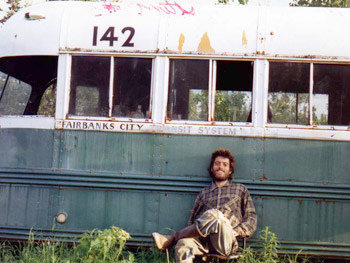
Christopher McCandless in Denali National Park & Preserve, Alaska. His corpse was discovered in the bus he’s resting against here. The bus remains a kind of mecca for Into the Wild devotees.
While living out of a bus in the Alaskan interior, miles from civilization, McCandless subsisted on a diet of squirrel and bird meat, rice he’d packed in, one moose he bagged (but whose meat he failed to preserve), and wild seeds he’d foraged. In his later diary entries he indicated that he believed the potato seeds were killing him, and Krakauer agrees. But how? These seeds had been gathered for thousands of years by indigenous peoples for food, why would they kill him now?
Over twenty years’ time, Krakauer has advanced four—count them, four—theories:
In his original article for Outside magazine, Krakauer suggested Christopher had misidentified the toxic seed of a wild sweet pea with potato seed. (This is presented as his cause of death in the movie.)
While writing Into the Wild and with more time to investigate, Krakauer came to believe the potato seed contained swainsonine, an alkaloid that stifles ingestion of nutrients. In other words, Christopher was receiving sufficient calories and nutrition to live, but his bodily processes to absorb those calories had shut down.
After that had been scientifically ruled out, in 2007, with the movie adaptation about to hit theaters, Krakauer suggested that the seeds McCandless had collected were wet and developed a poisonous mold.
In a 2013 New Yorker article, Krakauer announced the mystery had been solved: Rather than an alkaloid, the potato seeds contained an amino acid called ODAP which, like the alkaloid of his second theory, caused death by inhibiting ingestion of nutrients.
I don’t blame Krakauer for continuing to puzzle over this mystery. The medical cause of Christopher’s death is the only question of factual importance remaining unanswered. But with Krakauer’s Theory #3 came a whiff of desperation, of someone determined to sustain a favored pet theory no matter what the facts demonstrate. With Theory #4 that whiff became the odor of denial. Theory #4 has been disputed by chemists who’ve tested the seeds for the presence of the amino acid, leaving the question of McCandless’ death once again up for grabs.
There’s quite a bit at stake here. The irresponsible/reckless side of the debate often argue that McCandless’ own ignorance led to his death—not ignorance of toxins, but ignorance of the gauntlet he was undertaking when he struck out across the Alaskan interior. Krakauer’s continued announcements of new answers gives buoyancy to the conviction that McCandless could have continued living his authentic life in Alaska under a more favorable set of circumstances. Who would fault McCandless for failing to recognize an undocumented biotoxin in the wild seeds he was gathering? Ignoring, of course, that no laboratory can detect this poison.
Those on the romantic side of the debate have welcomed each of Krakauer’s new theories as further buttressing to prop up the Legend of Christopher McCandless. For example, Salon’s story on Krakauer’s fourth theory was first headlined “Chris McCandless’ death wasn’t his fault”. Later, Salon revised the headline to “’Into the Wild’s’ twist ending”. The original headline is preserved in the article’s URL. (Headlines are often included in the URL to improve search engine results. Changing the URL later can cause problems, so it remains fixed even if the headline is edited.)
It’s worth pointing out that Outside magazine’s web site no longer hosts Krakauer’s original 1993 article “Death of an Innocent”. Selecting that link redirects to “The Chris McCandless Obsession Problem” by Diana Saverin, dated December 18, 2013. Saverin’s article discusses the legions of McCandless fans who expose themselves to physical harm, and even death, in order to touch and walk within the bus McCandless perished in. It appears Krakauer’s story has been purged from Outside magazine’s web site. Links to it in Saverin’s article return 404 “not found” errors and searching the site locates no usable copy. Saverin’s article is not critical of Krakauer, and it’s difficult to know what to make of Outside‘s missing pages and URL redirection.
(Fortunately, Krakauer’s original 1993 article was reprinted elsewhere, including at The Independent. It was later removed from their site, leading me to now link to a copy stored at the Internet Archive’s Wayback Machine.)
Because of Chris’s childhood situation, he felt this need to push himself to extremes and prove something. Things came pretty easily to Chris—and by that I mean he was smart and he was good at everything he tried to do—so he had to up the ante a bit and make things harder. Chris believed firmly that if you knew exactly how the adventure was going to turn out, it wasn’t really an adventure. He understood the risks he was taking, and they were calculated, and there was a reason for it.
(Emphasis mine.) This is the crux of my issue with Krakauer’s continued defense of Christopher McCandless. He’s attempting to have it both ways—to claim Christopher was not suicidal, not reckless, and completely in control of the situation, and then claim his death was understandably unavoidable, all in the service of assuring McCandless’ fans that, under slightly different circumstances, Christopher would have fared well in Denali National Park.
But if Krakauer’s perpetually evolving hypothesis is correct, Christopher did not understand the risks he was taking. In engineer-speak, his survival had a single point of failure: He relied too heavily on a single food source, a poisoned source, according to Krakauer. Note that I’m not suggesting McCandless was reckless. Krakauer’s morphing defense of McCandless serves to perpetuate him as a paragon of living a full life. I’m saying the tragedy should be treated as a warning rather than a model.
There’s a fifth theory pursued by filmmaker Ron Lamothe in his documentary Call of the Wild: Chris McCandless starved in Alaska. Not ingested an agent which caused him to stop receiving nutrition, but simply starved due to a lack of available calories. Over the course of 119 days, “despite some success hunting and gathering,” Lamothe theorizes, “McCandless was not able to secure enough food on a daily basis.” It’s so simple it sounds too obvious, but Lamothe makes a strong case with numbers and research from the World Health Organization for support.
Why Krakauer’s and others’ determination to avoid this conclusion? Admission of caloric starvation is admission of defeat in the larger ideological battle. McCandless’ life has been converted into a proxy for this country’s culture wars, a string of battles where no one—no one—raises the white flag. Instead, the soldiers and field marshals and aide-de-camps simply pretend the last loss never occurred and move their attention to another stretch of the battle front. I’m unable to see how this situation honors or respects Christopher McCandless’ life.
“I often felt like a wild animal”
In Christopher’s diaries, he referred to his quests in warlike terms. (“The Climactic Battle To Kill The False Being Within And Victoriously Conclude the Spiritual Revolution!”) Sometimes his plans sound like he’s describing an experiment. Many years ago I learned about another young man who also decided to forgo modernity, to escape civilization, if even for only a few weeks. In the case of this other young man, it was, in fact, an experiment.
In 2002, Alastair Bland, a student at the University of California Santa Barbara, launched what he called “My Project”. For ten weeks he only ate food he gathered in and around Isla Vista, UCSB’s student community. Like McCandless, he opened this experiment full of high hopes. Also like McCandless, Bland was an anthropology student. At UCSB Bland learned hunter-gatherer societies
live freer lives, with more leisure time, than agriculturalists. Twelve to eighteen hours per person per week is all time needed by the famous !Kung people of the Kalahari Desert, for example, to collect all the food they need. This leaves more time for reflection and relaxation than most people in our affluent society ever have—the !Kung don’t need to work to pay rent.
Both Bland’s and McCandless’ rose-tinted exuberance was fueled by a disdain of our modern consumerist society. That disdain was shared by those around Bland:
They marveled at how great [the experiment] was and exclaimed that they would some day try to do something similar. They thought it was a good thing to boycott the American market and a shame more people didn’t appreciate nature’s bounty the way I did.
But Bland’s enthusiasm waned as his experiment progressed:
The people closest to me, more often than not, criticized what I was doing. They said I was becoming weird and that my obsession was taking over my life. They said that I was alienating myself and that all I ever did was gather, cook, and eat…
Even now I don’t believe what I did was very constructive. It was a memorable time in my life, to be sure, and it was a good thing to have tried. But to carry on like that forever would have been, for me, social suicide.
Krakauer stresses throughout Into the Wild and in later writings that McCandless was not in Alaska to commit suicide. I agree. Christopher comes across as too vibrant a personality for that. For him to be suicidal is to believe he was living in a pure manic state for years, hiding or suppressing his depression until his last days in Alaska. But Bland’s term “social suicide” hangs in the air as a remarkable description of what his experiment was truly proving.
I would try to tell myself as consolation that I was somehow perfecting my body and soul, but everywhere and everyday I encountered other people, people smarter and healthier and stronger than I.
The first half of the above sentence could have come straight from Christopher McCandless’ mouth. The second half is nowhere to be found in Into the Wild. And Bland discovers the above while foraging not in Alaska but Southern California, possibly the mildest climate in the Western hemisphere. He foraged along a coastline rife with an incredible variety of edibles, yet Bland’s staple was tree figs because they were the easiest to secure. When he gorged himself on them, they left him nauseous and bleeding from the mouth. Even though Bland didn’t suffer a caloric deficiency (he gained weight during his experiment), he was deteriorating from the inside out.
In Bland’s writings, both in 2003 and later, he comes across as an imperfect Xerox of Christopher McCandless, the toner ink a little less strong, the lines a bit fuzzier, a photostat who survived the journey rather than succumbed to its ordeals. In 2011, Bland’s blog rings of grandiose announcements:
“I was drenched in sweat and rather uncomfortable in the ripping gale that stormed about the mountaintop.”
“A hero’s journey through the Baja badlands in search of a hidden kilo.”
“A Daring Bicycle Ride Through Greece”
While these declarations hold superficial similarity to “Alexander Supertramp” McCandless’ bravado, they are only a surface veneer applied to more quotidian goals. Here Bland enjoys fine wine and craft beer, and he seems unconcerned about surviving off the land. He appears to view nature as a kind of experience to return to in-between necessary bouts of city life. Bland may be described as a bon vivant in the roundest sense of the phrase, one who relishes fresh air as much as he does the bottle of 2007 Pinot Noir he uncorked at the summit of California’s Mount Diablo.
Bland’s 2003 experiment is a vital data point when weighing Christopher McCandless’ fate. Krakauer’s never-ending pursuit to discover new Alaskan biotoxins is an atrophying defense of a way of life Alastair Bland discovered unworkable, an “alienating” “social suicide” that consumed his life. Krakauer and McCandless’ fans hang on to the belief he would have survived Alaska if not for an understandably unavoidable mix-up. They assert that, given a better roll of the dice, McCandless’ battle to “Kill the False Being Within” would have been a clear and decisive victory against modernity, consumerism, and whatever other 1950s ills you wish to conjure up. Bland’s experiment acts as a control to these notions.
Bland concluded his “My Project” experiment eating at a “horrible Mexican restaurant” with his father:
I really felt that I had become a shameless thief and a coward; that I had given up all my self-respect; and that I was going a little crazy, all for the sake of My Project.
Like those who encouraged Bland to keep fighting the good fight (even as he knew what a falsehood his life had become), Krakauer, Sean Penn and too many others are still rooting for Christopher McCandless to win the day—and leading many young people to make harmful, even fatal, decisions.
Maybe it’s time to step back and admit that McCandless’ survival was a matter of him conceding defeat and returning to civilization. That concession doesn’t mean McCandless was reckless or foolhardy. It would’ve indicated growth and maturity. And I suspect he was experiencing just that.
As Krakauer documented from McCandless’ own diary, he attempted to return to society but found himself blocked by a river swollen with snow-melt. I have to wonder if McCandless was not merely starving but also realizing his vision of a pure and authentic life was a one-way ticket.
“Even when full and satiated and liberated from the physical desire for food,” Bland wrote, “I couldn’t relax, I was held captive by thoughts of food. I sometimes dreamed of figs and climbing around in trees.” Is this the authentic life McCandless strove to achieve? His corpse weighed 66 pounds when discovered.
When I drove home from Las Vegas drained and feeling a bit defeated—when Bland took that first bite of his carne asada burrito—that’s the moment in the Hero’s Journey where the hero turns around and retraces the path he cut with his own feet. That’s the Hero’s Journey, dammit, heading home graced with a wisdom one did not originally possess, the journey Chris McCandless failed to take.

 Original published November 10, 2014. Significant revisions made on July 15, 2015.
