
I was raised in a house brimming with books. Children’s books especially, but plenty of books for teens as well. I inhaled these books, reading some three or four times, just so I could reenter their worlds and experience them one more time. My brother and I were never in want of books, although my parents were not especially well-to-do back then.
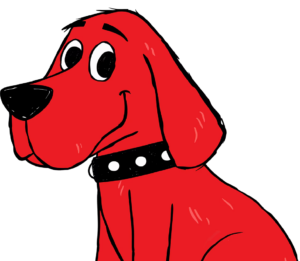
The reason for this surplus is that my mother worked for Scholastic Books—yes, the Scholastic Books that hosted book fairs at your school when you were young, the company that published evergreen classics like Clifford the Big Red Dog, Goosebumps, and Encyclopedia Brown, Boy Detective. She did not work at the company’s New York editorial offices—what a different childhood that would have been—but rather at a West Coast distribution warehouse located in sleepy Pleasanton, California.
My mother was a voracious reader, and she wanted to pass her love of books on to her children. She was in her early twenties when she landed her position at Scholastic, and it was a bit of a dream job for her.
Her determination to teach us to read paid dividends. I could read by age three, although I was not an active reader. I preferred running around our quiet suburban neighborhood, playing kickball and riding my Big Wheel from one neighbor’s home to the next. I was one of those fearless/clueless kids that would walk up to a front door, ring the bell, and ask the parent if their child could come out and play. (I often did this during dinner time, much to the annoyance of our neighbors.)
It was in this suburban idyll that my mother introduced me to books. Scholastic permitted employees to take home a small number of remaindered and returned titles from the warehouse. When my mother came home from work, she occasionally would be carrying a children’s book or two. I was completely uninterested at first, and so these books were stocked away in a hallway closet.
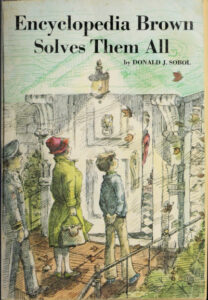
Finally, when I was five or six, my mother suggested I might enjoy Encyclopedia Brown Solves Them All by Donald J. Sobel. For whatever reason, I picked it up, lay on the couch, and consumed the book from start to finish in one read-through.
For those who don’t know, Encyclopedia Brown is a child sleuth who runs a detective agency out of the garage in his home. Propitiously enough, his father is also Chief of Police for the Smalltown, USA suburbia Encyclopedia’s family lives in. Each book in the series features ten (so so) short kid-centric mysteries, like stolen ice skates and missing hamsters. Right before Encyclopedia Brown solves the “crime,” the reader is asked to guess the solution before turning to the answer in the back of the book. (In this way, Encyclopedia Brown mirrors the Golden Age of Detective Fiction, where books also halted the narrative to challenge the reader to solve the mystery.)
Hooked, I read as many books in the series as she could bring home. From there, my reading habit grew outward. My mother happily brought home more challenging work for me to read.
The cultural, racial, and sexual shifts in America made the 1970s a rather shaggy and complicated time to be a child. This employee’s perk of bringing home remaindered books meant a great many of the titles I read were published in the 1950s and early 60s. The illustrations depicted working dads in ties and wingtips, and homemaker mothers in dresses and pearls carrying spatulas. Boys had haircuts like Marine recruits, or wore coonskin caps. Girls practiced ballet, rode horses, and, if they were a tomboy, tagged along with the boys on whatever wild adventure they cooked up. Some of these books had been published a mere ten years earlier, yet they read like they’d come to me via a bookmobile time machine.
Damn or praise these books on their political merits, the point is, I became an active reader at a young age. My reading diet quickly grew omnivorous.
I began to read the newspaper every morning. Not merely the comics page, but much of the front section, and especially the Opinion and Op-Ed pages. When I was bored, I would pick a volume of an encyclopedia off our family room shelf and simply browse it, page by page, until I found some topic I wanted to read more about. Later, I did the same with the colossal People’s Almanac #2, which I honestly believe I read in its entirety. (Not from front to back, but by dipping into articles as they suited me over the years.) All of this came about thanks to my exposure to Scholastic’s books.
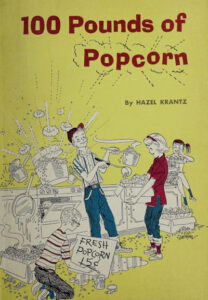
This Flickr collection of titles sold by Scholastic Books in the 1960s and 70s really takes me back. I’ve not read all these titles, but I recognize the covers of almost the entire collection. Books about fancy dolls and show horses were not really my “thing” as a young boy, but I treasured books by Beverley Cleary and Judy Blume, as well as the intense psychological portrait of Harriet the Spy. Encyclopedia Brown made me want to be a detective; Alvin Fernald made me want to be an inventor; 100 Pounds of Popcorn made me want to be an entrepreneur. Every young person who read the Mad Scientists’ Club’s books wanted to join.
There are other books that stayed with me, but whose titles I’ve forgotten. One was about a boy blinded by a firecracker who has to learn Braille and to navigate the world via a seeing-eye dog. Another regarded a pudgy boy who lives in a New York skyscraper with his fitness-obsessed parents. They want to send him to a “fat camp” boarding school which, he learns in confidence from an admission counselor, doesn’t actually care what the kids eat, or even if they exercise. The boy spends his summer break devouring ice cream sundaes and perfecting his admissions essay. It’s a subversive little book, and definitely the product of 1970s, and not 1950s, America. My young mind, raised on the coy cynicism of Looney Tunes and MAD magazine, was magnetically attracted to anything eager to thumb its nose at authority.
Over time, my mother got to know many of the Scholastic editorial staff in New York City, even if their friendship was purely via long-distance telephone conversations. She knew R. L. Stine, for example, creator of Goosebumps. (He was more familiar to me as Jovial Bob Stine, editor of Scholastic’s Bananas magazine, their family-friendly substitute for MAD.) Somewhere in my parents’ house is a copy of Clifford the Big Red Dog signed by Norman Bridwell.
My mother loved working for Scholastic, because she cherished children and wanted every child to have books. She did that by providing free books to our school’s Scholastic Books Fairs, to ensure no one went home empty-handed. And she made sure our teachers’ classrooms had things like children’s dictionaries on their shelves, if they needed them, or any other reference material they may be lacking.
She grew up on a ramshackle farm in the Mississippi Delta, raised by her grandparents, where the muddy soil was tilled by mules and mosquitoes clouded the humid air. For her, books were a cheap way to escape penury and live vicariously in another world, if even only for a few hours at a time. Books were “portable dreamweavers,” and she wanted to share that dream.